FULL
STEAM AHEAD
Whether at
work in the UC or at play on his boat,
Nick Boyadjian is a man on the move
BY LORI
BONA HUNT

When you work at a place as large and diverse as U
of G, you meet a lot of people you never really get to know.
You stand in coffee lines together, share elevator rides,
exchange hellos as you pass in the halls. Familiar faces in
familiar places.
Sometimes, you're lucky enough to get a chance to know them
better, to learn something intriguing that gives you a glimpse
of who they really are. This is one of those opportunities.
You may already know Nick Boyadjian. But even if you've never
spoken to him, if you've worked or studied at U of G in the
last couple of decades, chances are you've run across him.
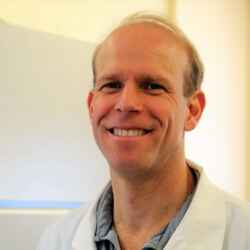
He's the tall guy with the dark hair and beard who rushed
past you in the University Centre. He was probably off to
check on this or that, to set up chairs for a special event,
to unlock the doors in the early morning hours or lock them
late at night.
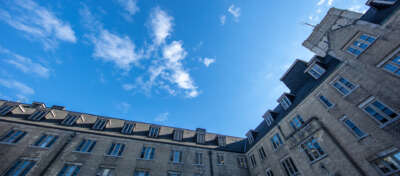
As special events co-ordinator for the UC's building administration,
Boyadjian is something of a permanent fixture in the campus
hub. But it's a status he never strived to achieve. He started
out working in the UC part time when he was in university,
mixing sound and setting up equipment for dances and concerts.
Before he knew it, a few grey hairs had crept into his beard
and somehow managed to turn it from brown to mostly silver
- a sure sign that 26 years had ticked by.
Longevity has its advantages, though. Boyadjian has had a
front-row seat for many milestone events at U of G. And there
are lots of tales to tell. For example, there was a time when
the place to be in Guelph was Peter Clark Hall. Elton John
once held a press conference there when he visited U of G
to attend a Maria Muldaur concert (Boyadjian got to meet him).
And the lineups at the pub used to be so long every night
that a second "holdingbar" had to be opened.
Boyadjian will share the stories with you, but first you
have to find him, and that's often a difficult task. He's
always on the move. Don't bother looking for him in his office
on the UC's second floor, unless, of course, you've made an
appointment to meet him there.
"I'm never here," he says with a sweeping gesture
across the room. "I live in the building."
That explains the clutter-free work space and nearly empty
shelves, not what you'd expect from someone who's been around
so long.
What you will find in the office, however, is a hint of one
of his passions. A large photo of a canopy-covered steamboat
hangs on the wall. It's one of only a handful in Ontario,
and Boyadjian is its proud owner.
It's more than just a rare boat to him, however. It's a coal-fuelled
connection to his childhood, his family's roots in Egypt and
Switzerland, and to a generation of people who remember a
time when steam powered the world. "I was always fascinated
by locomotives, anything that ran on steam," he says.
As a child, he'd visit his grandparents in England during
the summers, and they'd take him to see steam locomotives
as often as he liked. "I thought they were beautiful
things to look at - there is such romance in them. Steam locomotives
are just like big works of art to me."
Back at home in London, Ont., Boyadjian's parents indulged
his interest by buying him toy steam trains, and he'd spend
hours playing with them, making pint-sized puffs of smoke.
"I even used to go out in the fields and watch the steam-run
threshing machines. The smell of the coal burning, the sound
of the steam - I was hooked."
The other constant in Boyadjian's childhood was boating.
His father, Peter, was born in Jerusalem but grew up in Egypt,
where he was a member of the Cairo Yachting Club and would
regularly sail on the Nile. Later, in Great Britain, his father
belonged to the Royal Ocean Race Club. So it was only natural
that he'd pass on that great love to his son.
It would be depriving the reader not to include at least
a snippet of the story of how the elder Boyadjian went from
sailing in Cairo to working in London, Ont. The son of a prominent
business man, Peter Boyadjian went to England to attend the
University of London, where he met and fell in love with Susan
Wiesendanger, who was from Switzerland. But Peter Boyadjian
was being groomed to take over the family's photographic and
pharmaceutical supply company, and Wiesendanger wasn't ready
to get married, so he returned to Egypt alone.
But it wasn't the Egypt he remembered. It was 1956, and the
Suez crisis had just begun. Egyptian president Gamal Abdel
Nasser had declared martial law and seized control of the
Suez Canal Company after the United States and Great Britain
decided not to finance construction of the Aswan Dam.
"Nasser was getting rid of everything British in Egypt,"
Nick Boyadjian says. "My grandfather's company had ties
to the British, and my grandmother was British, so Dad, my
aunt and my grandmother were forced to leave, and my grandfather
had to stay."
The family moved to England, where Boyadjian's grandfather
was able to join them two years later. Peter Boyadjian reconnected
with Wiesendanger and they married.
"All of a sudden, the future that Dad thought he had
was gone," says Nick Boyadjian. "And post-war England
was not a happy place to be. Dad was casting about for work,
and they decided to immigrate to Canada, although Dad had
no idea what he'd do."
The family ended up in London, where the elder Boyadjian
went to work for Minnesota Mining and Manufacturing as a purchasing
agent. But he never lost his love for the water. He took his
son and daughter sailing often and would go on extended excursions
alone, including a four-month stint to Newfoundland.
So Nick Boyadjian grew up in London playing with steam toys,
sailing, taking fencing lessons (he was a two-time junior
champion) and playing the piano. He started taking piano lessons
when he was five, passed the Royal Conservatory exams to the
Grade 10 level and started teaching piano to children when
he was 15.
"I did that until I was 18, and I worked at night loading
trucks. Then one day out of the blue, Dad comes up to me and
says: 'Do you want to go to university?' I told him I didn't
have enough money saved, and he said: 'If you want to go,
I'll pay for it.'"
Boyadjian decided to take his father up on the offer immediately,
in case he changed his mind just as suddenly. Fall classes
were already well under way, and the only university with
a music program that accepted winter-semester students was
Guelph. It was 1978.
Once at U of G, Boyadjian switched from music to physical
geography and went six straight semesters. But he used his
music skills to land that first job in the UC. Soon after,
in 1980, he met his wife, Chris (now a graphic designer for
U of G) in the Bullring. She was also a student, working on
her second degree.
"After I graduated that year, I was offered a full-time
job in the UC," says Nick Boyadjian. "I liked it
here, I had this new girlfriend, so I figured I'd stay for
a while." He and Chris married in 1981. After a few years
of marriage and three children, Boyadjian started to think
about getting a boat of his own. It was more of a dream, in
truth, not something he could really afford. "So I told
myself I'd look for a steamboat, because I figured I'd never
find one."
Not long after, he went to a boat show in Toronto - just
for fun. "One of the sellers there asked if he could
help me and I said: 'I don't think so, I'm looking for a steamboat.'
He just happened to have one back home for sale."
Boyadjian went all the way to Gravenhurst to see it. "I
remember she was out in a shed, sitting up on this platform,
with a price tag on her I couldn't afford. My only thought
was: 'I have to have her.'"
He did not, however, know the first thing about running a
steamboat. "I'd played with all those steam toys as a
child, so I knew the basics, but that was about it,"
he says with a laugh.
That was 14 years ago. He's a master now, of course, and
the boat has a permanent spot in the family's driveway. At
six feet wide and 32 feet long, it is hard to miss (or hide).
He takes the boat out regularly during the summer, to family
cottages and even to Guelph Lake. It needs only 20 inches
of water to operate and travels at a whopping top speed of
six miles an hour. Even his father, used to much faster and
bigger boats, comes along for rides.
No matter where Boyadjian goes, the steamboat draws a crowd.
"I just pull the whistle, and people come looking."
The boat seems to especially touch a soft spot in older people.
"They smell the coal, hear the whistle, and it does something
to them. They get really emotional."
He smiles while recalling a time he had the boat out on Lake
Ahmic during a fireworks show. "Every time there was
a spectacular display, I'd blow the whistle. This old chap
who lived way across town woke up because he kept hearing
the whistle. The next day, he had his son drive him all over
the place looking for the boat. They eventually found us.
He comes right up and tells me: 'There hasn't been a steamboat
on this lake since the 1930s.'"
Boyadjian invited the man and his son to join them for a
ride. "He didn't want to come out. He just wanted to
find us so he could see the boat. He said it brought back
childhood memories. He wanted just to look at it and remember,
and to talk to someone about his experiences."
The steamboat photo that hangs in Boyadjian's office reminds
him of moments like that. The precious times when people find
a connection and catch a glimpse of each other's lives, of
who they really are.
|