Readership Survey
Environmental biologist to take part in campus conference on hearing impairments
BY ANDREW VOWLES
The neighbour. Some 30 years later, that's who Pamela Owen-Lafrance remembers — the neighbour who spoke to her one day after she'd seen Owen-Lafrance's son Nathan toddling outside their Ottawa home. This was shortly after he'd been diagnosed at 10 months with a profound hearing impairment in both ears and had been outfitted with hearing aids, including a clunky box-like contraption that he wore strapped to his chest. Recalling the incident, Owen-Lafrance says: “She asked why he wasn't in an institution. That was a pretty sad moment.”
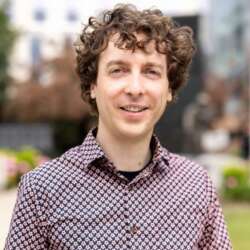
Scroll ahead three decades, and she's looking forward to a happier moment in June when she watches her eldest son, Nathan Owen-Going, cross the convocation stage at U of G to receive his PhD. That will complete an academic hat trick for Owen-Going, who also holds a B.Sc. in agronomy and a master's in plant pathology, both from Guelph. And it will end his on-campus work as an advocate and longtime peer helper for people with disabilities, including those with hearing impairments.
That advocacy role will be highlighted this month through his involvement with a conference on campus for parents of children with hearing impairments. Sponsored by the Centre for Students With Disabilities (CSD) and a non-profit organization called VOICE, the annual event planned for May 13 will involve speakers discussing hearing impairment research and technology, particularly for learning and literacy.
Referring to his own childhood and youth, Owen-Going says the message he wants to get across to parents of hearing-impaired kids is: “If I can do it with the limited amount of technology that was available to me until age 10 when I first got my behind-the-ears hearing aids, their children should have no problems.”
Take our recent two-hour-long interview, conducted over the phone to the Ottawa home of his mother, a longtime VOICE volunteer who serves as her son's ears throughout our conversation. She listens on one phone and types the questions into a computer, where he reads them and then replies over a second phone. It was a similar type-and-reply setup that allowed him to field questions during his thesis defence, delivered orally with a PowerPoint presentation.
The arrangement works fine, apart from the inevitable delay of several seconds between question and answer, punctuated by the rapid-fire drilling of his mother's fingers on the keyboard. Over the wire, Owen-Going's voice has a slightly mechanical quality, as if it's being filtered through a synthesizer — an artefact of having learned to speak without hearing his own voice. But his words are clear, and there are plenty of words about everything from his disability to his academic and research abilities.
For his PhD — co-supervised by Profs. John Sutton and Chris Hall, Environmental Biology — he studied ideas for preventing and treating infection of hydroponically grown crops. Ontario has the fastest-growing greenhouse and hydroponics industry in North America, says Owen-Going, but Canadian greenhouse growers lose 15 to 20 per cent of their annual income to root rot, a fungal disease that spreads quickly through densely packed plants grown in hydroponic solution.
Although the initial infection isn't apparent, changes in the plant soon stunt its production of fruit or vegetables; eventually the root turns brown and entire crops can fail. Owen-Going studied better detection of symptoms and how to help prevent and manage the disease. Looking at how the disease circulated through fungal spores in the nutrient solution, he found that diseased plants also spread byproducts that made other plants more vulnerable to the pathogen, a previously unknown consequence of infection.
“I don't think many growers realized the impact plant pathogens had on increasing the amount of byproducts introduced to the nutrient solution,” he says. “The industry will now have a greater understanding of the factors involved in Pythium root rot, and armed with this information, they can begin looking for measures to prevent and counteract the effects.”
Owen-Going has published a number of articles in peer-reviewed journals and discussed his work at scientific gatherings. In 2004, he received the Syngenta Scholarship in Sustainable Agriculture, one of a number of awards he collected at U of G.
Owen-Going began his post-secondary studies in Ottawa but switched to Guelph a year later in 1994. Besides following a close high school friend here, he had heard good things about the CSD.
“It was harder to adapt to the educational environment at Ottawa,” he says. “I went looking for a university with a well-developed program for hearing-impaired students.”
In class, he used volunteer note-takers provided by the CSD. He says professors here were accommodating, although he had to explain to some why it was so important to him that they use a microphone during lectures. (More than 20 U of G classrooms are equipped to allow students to receive enhanced audio through wireless receivers.)
Owen-Going himself became a CSD peer helper, often guiding blind students to classes. That volunteer role proved to have a bigger impact on his life than he might have imagined. It was while escorting a student to the library that he met one of her classmates and another CSD volunteer, Kathia Marie Hallal. She and Owen-Going were married in 2002, just as he began his PhD. Their first child, Luke, was born last summer; his hearing is normal.
Owen-Going notes that Luke is about as old as he was when he was diagnosed as profoundly deaf. Now 31, he is the oldest of four children and the only one in the family with a hearing impairment; his mother never learned why.
He was fitted with his first hearing aids just after his first birthday and began seeing a therapist at the Children's Hospital of Eastern Ontario. Having been diagnosed so early, he was accepted into a regular classroom under a new board program that saw a speech therapist visit his elementary school regularly.
Owen-Going remembers asking teachers to face the class when speaking or to write things on the blackboard.
“The main hurdle was trying to get people to understand that I had a hearing impairment. In many cases, the other children had not been exposed to somebody with the level of hearing impairment I had. Everybody was curious. Until I was 10, I had to wear this big hearing aid on my chest with a strap, a big bulky thing. It made me stand out a lot.”
Owen-Lafrance says there were “lots of little incidents where people reacted poorly.” Rude neighbours or not, she was determined to treat her oldest child as normally as possible, from entrusting him with money and instructions on errands to the store to signing him up for swimming and soccer. (She and her husband divorced when Owen-Going was seven.)
A turning point, academically and socially, came the year he fell off a roof while retrieving a tennis ball. While convalescing that summer, the nine-year-old discovered reading. Among other things, his early reading material included Archie comics, which helped him improve his colloquial English, a challenge for many hearing-impaired children learning to speak. Borrowing from that earlier experience, he's now reading French-language Archie comics to practise his colloquial French as he learns the language from his Montreal-born wife.
Another key move had occurred earlier when the family became founding members of the Ottawa chapter of VOICE. Using that support network allowed them to share experiences with other families and obtain access to resources, says Owen-Lafrance. “I would get a sense of optimism.”
The organization contacted Owen-Going to help organize this spring's conference. The event will include sessions on managing hearing loss in children, parental involvement, audio technology, hearing impairment in the classroom and the genetics of hearing loss. The keynote speaker is Lyn Robertson, chair and professor of education at Denison University, who will discuss literacy in children who are deaf or hard of hearing. Owen-Going will take part in a panel discussion and will staff a VOICE booth, where he expects to talk with conference delegates about his experiences.
“I've never had problems talking about my hearing impairment to people. I like to think of myself as an advocate, someone who's very open to teaching other people or letting them know what it's all about. People who have been in an environment without much exposure to people with disabilities don't have a clear idea of what it means. It's not ignorance; it's a lack of understanding.”
He notes that hearing loss can affect many people, perhaps not directly but as other family members age.
“These conferences have definitely helped to increase awareness of different technologies that allow people like me to communicate and learn to speak,” he says, referring to everything from cochlear implants to wireless devices such as the BlackBerrys he and his wife use instead of cellphones. “These events have been integral in demonstrating that people like me are able to progress academically and function well in what we call the hearing world.”
What struck Bruno Mancini, director of U of G's Student Life and Counselling Services, was the matter-of-fact way Owen-Going handled his own hearing impairment.
“We didn't talk about his disability. Some students have their disability define them, but not in his case.”
With his doctorate in hand, Owen-Going hopes to work in government or industry, perhaps in environmental or agricultural consulting. Meanwhile, he's helping his infant son learn to find his own voice.
Has he heard the baby cry? “Yes, I have. Of course, I need to be wearing my hearing aids and need to be in the room.”
In Luke's room, they've installed a baby monitor with a camera that alerts Owen-Going to his son's activity. “The monitor also has a sound indicator on it in the form of LED lights. Even my wife finds it useful.”
For more information about VOICE or the May 13 conference, call 416-487-7719, send e-mail to info@voicefordeafkids.com or visit www.voicefordeafkids.com.