Readership Survey
Research trip will help U of G English prof get in touch with roots of British working-class writing
BY REBECCA KENDALL
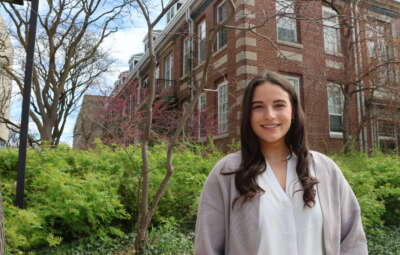
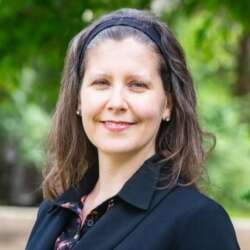
Prof. Julie Cairnie, English and Theatre Studies, understands new beginnings and the search for opportunity. At age 16, she left her hometown of St. Catharines and made her way to the northwest of England in search of a new start. “I decided I wanted a challenge and I went,” she says.
Cairnie settled in with her grandmother in the town of Poulton- le-Fylde, embraced her new community and worked to find her place within it and within a global context.
“It was a hard experience, but it was valuable,” she recalls. “It was the 1980s, Margaret Thatcher was the prime minister and I was living in the area that was the site of the Industrial Revolution. There was a lot of poverty, and people lived strong working-class values. It caused me to look at the world in a new way.”
She became active in Britain's anti-apartheid movement and increasingly interested in issues related to inequality, a topic that would inevitably set the stage for her future academic work. She now studies post-colonial literature, British working-class writing and issues related to race, gender and class.
Of particular interest to Cairnie are British working-class narratives that speak about southern Africa during colonial times. She has presented papers in South Africa, the United States and Canada and published articles in the Journal of Commonwealth Literature, World Literature Written in English and Southern Africa Report.
Cairnie, who joined U of G in 1999, is currently working on a manuscript called Imperialists in Broken Boots: Poor White and Philanthropy in Southern African Writing, a title that harkens back to the novel that first fuelled her academic fire. While attending high school in Britain, she was required to read The Ragged Trousered Philanthropist, a book by Robert Tressell originally published in 1914. “It's a very popular text in England,” she says.
The novel tells the story of a group of working-class men who meet a journeyman-prophet with a vision of a just society. The book examines the divide between members of the working class and those who employ them, political awakenings and class struggle with a mix of rage and humour. It continues to be hailed as one of the most authentic novels of English working-class life.
Following high school and her introduction to Tressell's novel, Cairnie returned to Canada to study philosophy and English at Brock University and found herself increasingly drawn to subjects related to human injustice and inequality. After completing her second year, she headed off to Zimbabwe with Canadian Crossroads International to teach high school.
“I was still very active in anti-apartheid work and wanted to go to a so-called ‘front-line state'— one of the countries bordering South Africa,” she says.
In Zimbabwe, Cairnie was sent to the small mining village of Mutorashanga to teach the equivalent of grades 9 and 11. Many of her students were the children of migrant workers from Zambia, Mozambique and Malawi.
She often thinks of the students she taught and their hardships because of politics and economics.
“I think of the crisis in Zimbabwe, the food shortage and the absence of gas. It's horrifying to read about. The people can't afford to bury their dead, and I think about the aspirations of my students who wanted to be engineers and doctors when they grew up. I know that this didn't happen for them, and it saddens me.”
After six months in Zimbabwe, Cairnie returned to Canada to continue her education and complete her BA. She went on to pursue an MA at York University and found her way back to The Ragged Trousered Philanthropist for an in-depth analysis and the beginning of a variety of research topics.
“I was really intrigued by its engagement with colonial issues, and my interest spiralled from there,” she says, adding that Tressell spent more than a decade in southern Africa before publishing his book. “On a personal level, my father was a carpenter, so certain passages reminded me of him, and it spoke to me in a way that other books hadn't.”
The Ragged Trousered Philanthropist inspired Cairnie's PhD thesis, also at York, on poor whites in southern Africa and how they spoke about poverty in Britain and southern Africa.
“They use some of the same language to describe each situation,” she says. “The poor in England were deemed degenerate because they weren't meeting expectations of what it meant to be white, and there was a similar sentiment in southern Africa on a larger and more obvious scale in terms of whiteness and upholding standards of proper conduct.”
Southern Africa represented a place of opportunity for the British, many of whom were struggling with unemployment and poverty, but this was problematic because they were improving their lifestyles on the backs of Africa's indigenous people, says Cairnie. She notes that several of her own Scottish relatives moved to Zambia, South Africa and Kenya in the 1940s and 1950s in an effort to improve their social status and economic conditions.
“It represented promise for them, but it created a strange situation of people moving from a system where they were potentially oppressed to being in the position of oppressor. It's that kind of ambivalence that really interests me. How can you be positioned at some point as the victim and change your position through the victimization of others?”
Cairnie is currently on a research trip in England with her seven-year-old daughter, Jane (she also has three-year-old twin boys). While there, she will visit with Reg Johnston, Tressell's only surviving relative. Johnston was married to Tressell's granddaughter and lived for many years with his mother-in-law, Kathleen, who was Tressell's only child. Johnston has all of Tressell's remaining documents and papers at his home in East Grinstead.
“He's an absolutely lovely man and so generous and insightful,” says Cairnie, noting that he often sends her items related to the book by mail.
Their connection was made after Johnston discovered her name on the Internet while searching for information related to Tressell's book. “It's a really interesting way to do archival research,” she says.
This trip marks the beginning of a new direction for Cairnie's study of Tressell's novel as she compares the writings of working-class women from the time period with the novel. Tressell spoke mainly of the male perspective of socialism and working-class life but did make some references to women that gesture towards feminism and the suffrage movement that was taking place at the same time, she says.