Features
Please, Please Don't Eat the Azaleas
New OVC ‘toxic garden' will help students, clinicians diagnose plant toxicities in animals
BY ANDREW VOWLES
It sounds like a who's who of botanical fiends. Lily-of-the-valley, foxglove and monkshood can all be deadly to pets, livestock and humans. Bleeding heart contains chemicals that can poison cattle. And the common yew tree can cause fatal heart arrhythmia in livestock, dogs and people. Why would anyone choose to plant these and similar nasty specimens in a teaching garden at the Ontario Veterinary College?
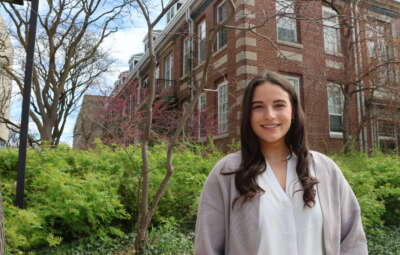
The new OVC “toxic garden” is intended to teach people about common plant species that may be poisonous to animals, says Melanie Philbin, a second-year DVM student and a member of the Guelph student chapter of the American College of Veterinary Pathologists (ACVP).
Guelph's new teaching resource garden covers about one-third of the fully enclosed and restricted-access courtyard garden, located between the Pathobiology Building and the Veterinary Teaching Hospital (VTH) in the middle of the OVC building complex.
The idea for the garden caught on after Prof. Margaret Stalker, Pathobiology, spoke to the student group last fall about the effects of toxic plants. Animals routinely sicken and even die after ingesting various plants in home gardens or farm pastures, says Stalker, who is the chapter's co-mentor for the project along with departmental colleague Prof. Dorothee Bienzle.
Working in OVC's post-mortem room this summer, for example, third-year DVM student and chapter member Colette Larocque saw necropsies on three horses poisoned by yew clippings left in a field. In another case this year, three cows out of a herd of 30 died after eating tansy ragwort in a pasture.
Veterinarians are expected to be able to recognize common plant toxicities in various animal species even as a packed DVM curriculum leaves less room for all the details. In response, a handful of veterinary schools across North America have developed teaching resource gardens, including a poisonous plants garden at Cornell University and the poisonous plants garden and database at the University of Illinois.
This spring, members of the University's Grounds Department and the ACVP student chapter designed and landscaped the space, including adding topsoil and mulch and screening for pathways. (Most of the previous plantings along the northwest corner of the site had been destroyed by rodent damage.) Students will maintain the garden.
The site includes Ontario native plants such as white snakeroot, mayapple and jack-in-the-pulpit, as well as exotics that have spread as weeds, such as tansy ragwort. It also includes nursery, garden and forage plants, including a variety of species that may surprise many gardeners who consider them indispensable for landscaping. These include azalea, bleeding heart, lily-of-the-valley, clematis, delphinium, foxglove, daylily and castor bean.
Still to come are another 20 species, including forage crops such as sweet clover. (Stalker points out that Francis Schofield, a longtime OVC pathologist, discovered in the 1920s that mouldy sweet clover could kill cattle.)
Besides opening eyes to the potential hazards in many backyards, the project is meant to teach students about the often-discriminating effects of certain plants. Chokecherry leaves may be toxic to ruminants, for instance, but not to dogs or people. That yew whose taxine alkaloids may be fatal for many animals is a deer's tasty meal.
“What's one animal's food is another animal's toxin,” says Larocque.
The group plans to launch a website with information about the plants from geographic distribution and habitat and identifying features to toxic principles, susceptible species and clinical signs of intoxication or poisoning. Members will also place interpretive information about individual species and warning signs in the garden itself.
Stalker says that information will help everyone from students to clinicians at the VTH. “They're more prepared to make a diagnosis.”
The group has also established connections with the University's Arboretum — which contains a number of larger and different specimens — and the U of G Herbarium in the College of Biological Science. Also involved in the project is Brent Hoff, a clinical pathologist and toxicologist with U of G's Animal Health Laboratory.
Acknowledging concerns about potential hazards to people and animals, Stalker says the garden is completely enclosed, with access only through two doors. Its isolated location will help prevent seeds from spreading to other parts of campus, and none of the species is likely to cause inhalant allergies.
“It's an ideal site,” she says, adding that U of G's Landscape Advisory Committee was also consulted on the project.
Although VTH staff occasionally walk recuperating dogs on the adjacent lawn of the courtyard, the animals are always leashed and little inclined to explore the garden, says Stalker. As an added precaution, the most problematic species for dogs have been planted towards the back of the garden and may even be fenced off if necessary.
Project funding to date has come from the Department of Pathobiology, the Grey-Bruce Veterinarians Association and Harriston veterinarian Terry Fisk.