News Articles
From the President
Accessibility Is Something We All Need to Think About
Editor’s note: President Alastair Summerlee welcomes comments on his column at president@uoguelph.ca.
Every now and then in life, you get a chance to do something that changes the way you look at the world. You may not realize it at the time. It may be days, weeks, months later before you understand just how profoundly you’ve been affected.
I had such an experience last June — the day I spent in a wheelchair to raise awareness about Wheels in Motion, an annual national event sponsored by the Rick Hansen Foundation. The Guelph event is held on our campus, and the money raised supports national research and the needs of local people with spinal cord injuries.
I was asked to spend a day in a wheelchair by Cyndy McLean, one of the local event organizers. In addition to being a national ambassador for the Rick Hansen Foundation, she is the director of the University’s Health and Performance Centre and a former marathon runner who was left paraplegic after a fall in 2003.
Cyndy said I could use one of her wheelchairs, Big Red (named for its bright colour) for the day and even offered to lend me her extra-padded seat cushion. Big Red soon arrived, I took a seat, and my view of the world around me was forever changed, literally and figuratively.
In the months that have followed, I have often thought about what I experienced and learned that day, and have contemplated the best way to share some of my feelings with the University community.
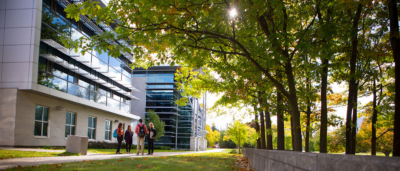
I’ve decided that now is the perfect time. Not only have I had time to fully reflect on my experience, but also the University’s annual Accessibility Awareness Week is coming up — March 5 to 9 — which provides me with the perfect context. This year’s theme is “Erasing the Stigma,” and the goal is to draw attention to the many issues facing people with disabilities on campus.
I experienced just a few of the many difficulties people with mobility issues encounter during my day in Big Red. Before I share some of them, I want to acknowledge that mobility issues are just one area the University needs to address when talking about accessibility. Students who have visual, hearing, learning, psychological or medical disabilities also face unique challenges and barriers, and each of them must be addressed to affirm our commitment to full accessibility on this campus.
Accessibility is something I am passionate about, which is why I stepped up efforts to ensure that U of G is truly a place that is accessible to all, regardless of physical or mental abilities, financial circumstances, background, gender or ethnicity.
To address the issues of physical challenges and barriers, I created the Campus Accessibility Committee. The group meets every six weeks to analyze all major construction/renovation projects on campus for accessibility features, to review other proposals and concerns, and to deal with any questions or complaints.
This committee has made many strides, and accessibility issues are receiving attention across all parts of the University community. Outreach activities such as the “Diverse Abilities, Infinite Possibilities” campaign and staff and faculty training workshops continue to increase awareness. U of G has also created a comprehensive accessibility website that provides access to a broad range of resources both on and off campus.
But there’s a great more to be done, which I can attest to after my brief but eye-opening experience. I encountered elevators where the floors didn’t line up, which made it extremely difficult to manoeuvre a wheelchair in and out. I rode over jutting bricks on Winegard Walk that nearly toppled me more than once. I wheeled along hallways that were so slanted, I had a tough time steering in the direction I wanted to go.
Although annoying and frustrating, these problems are at least visible no matter what your vantage point. Lots of other things, however, go unnoticed unless you’re sitting in a wheelchair. One small example: During my day in Big Red, I noticed that the signs indicating where accessible washrooms are located on campus were mounted at eye level for standing adults. When you’re in a chair, your line of vision is several feet lower.
I was bothered by the positioning of the signs, but more bothered by the fact that I’d never noticed it before. Getting the signs lowered required only one phone call; it took a lot longer for my sheepishness to fade.
I also recall the feeling of being a “little person in a crowd.” Everyone else seemed so tall, and it felt good to interact with people at my height — other people in chairs or children or people who just crouched to talk to me.
I believe all of us need to be more aware of both the hurdles and the subtle things that tell some of our students, colleagues and friends that they are “different.” This is the essence of Accessibility Awareness Week — that we must take steps to rectify both the physical and social barriers to accessibility.
I plan to spend another day in Big Red this year, in addition to serving as honorary chair of the Guelph Wheels in Motion event and heading a team in a “wheelchair challenge.” My day in that chair gave me new understanding of what “accessibility” really means.
When Cyndy asked me to spend a day in a wheelchair, she said the goal was to raise awareness. I now realize it wasn’t just public awareness she was talking about — it was also personal awareness. It was a lesson well learned.