People

The New Face of Farming

Geographer leads project to bring new breed of farmers to the land

BY ANDREW VOWLES

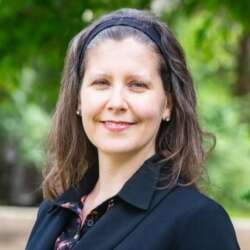
Graduate student Christie YoungA longtime business consultant stands in a field within view of a new shopping complex and a busy highway in north Guelph and surveys his freshly planted hops and barley. A Sikh immigrant in a Toronto grocery store cocks her eyebrow at produce trucked in from who-knows-where. In U of G's Hutt Building , a 28-year-old newish mom who's doing a master's degree in geography arrives at her desk. These are the new faces of farming in Canada ?

“There's a whole new breed of people coming to farm,” says graduate student Christie Young, a Toronto-born-and-bred social activist who has big plans to shake up how we grow and provide food. The self-described “do-er” is studying nascent food markets and ways to help new farmers — particularly immigrant and second-career farmers — meet consumer needs.

But Young, herself a sometime farmer in France , is hardly sitting around waiting for the data. Leading a brand-new incubator project in Guelph called FarmStart, she is now eyeing two more locations for similar plots near Toronto where immigrant Southeast Asian farmers might one day learn to produce food for a few of the city's masses. Call it “smart farming” — and perhaps a way for Young to channel any lingering anger and angst from her undergraduate days at McGill University, when she first began to look closely at how food is grown and distributed in this country and was appalled by what she saw.

These days, others see not anger but passion, determination and drive. Standing in a former orchard at the Jesuit-run Ignatius Centre in Guelph, FarmStart program manager Mike Shook describes her as “pretty amazing, a visionary. She's networked into the local food system. She's just full of ideas.”

For Young, whose activism was sown early, it's a matter of twinning ideas and action. “A lot of money is being spent to perpetuate a food system that doesn't make sense,” she says. “We need people with new ideas. I believe there's a life in agriculture.”

Nurturing that life is the purpose of FarmStart, which was launched by Young on a 200-acre plot of certified organic farmland at the Ignatius Centre. The program provides space, resources and training for would-be farmers, particularly young and immigrant farmers. She says she launched FarmStart to benefit both farmers and consumers.

Canada 's farm population is aging fast. In 2001, only 12 per cent of farmers were under age 35, compared with 25 per cent a decade earlier. By 2011, more than one-third of farmers will be over 65.

Canada needs new blood, says Young. The country also needs an alternative to its increasing reliance on food imports and a “crazy” distribution system that sees food routinely shipped thousands of miles to markets.

She says FarmStart is anticipating changes in farming as more consumers seek locally and organically produced food. The goal is not to grow a massive conventional operation in crops or livestock. Rather, the program is intended for people looking to serve smaller, more specific markets.

For their first three years, tenants will get discount-priced land, equipment and infrastructure. They'll also have access to support programs, notably training in technical skills, business planning and marketing. After that business development phase, farmers will get another two years at normal lease rates to find land and prepare to launch their own operation. Calling it the farm equivalent of a business incubator, Young says: “The hardest part for farmers is to get it all right in the beginning.”

This spring, three people have begun small-scale operations on land formerly farmed by the local Jesuits. One is growing beans. A second is raising pigs and turkeys. The third, Mike Driscoll, is growing barley and hops with plans to supply local microbreweries. (Two other members have taken plots less than one-quarter of an acre in size to plant medicinal herbs and vegetables.)

“This is the learning season,” says Driscoll, eyeing his newly planted hops one afternoon in mid-May. With help from the farm manager, he's erected two giant wood-framed trellises on a sunny slope. By July, he expects the plants will turn the trellises into living green tents. He plans to sell his harvest to a local brewer — along with the barley sown in a rectangular plot nearby — to produce organic beer. He rents four acres for $160 an acre, 20 per cent less than market rates. For that, he gets access to organically certified land, as well as equipment and expertise, to try out his ideas before committing to anything bigger. “That's the main thing FarmStart's all about,” he says.

Young expects the Guelph program to draw an average of eight to 12 farmers a year. Meanwhile, she aims to replicate the concept in Brampton and Pickering-Ajax. She's talking with prospective partner organizations in Southeast Asian immigrant communities, including a community economic development program for immigrant women in Durham Region. And she hopes to see more incubators established elsewhere.

That's what she regards as the next face of farming in Ontario and across Canada. With traditional families finding it more difficult to keep younger generations on the farm, Young says we need to look to new kinds of farmers. And those farmers need to be more closely connected to their customers, cutting out middle players and providing more ready access to locally grown, sustainable food, she says. That's a key point, not just for the FarmStart program but also personally for Young.

Ideally, she says, some of those growers and producers would supply clients of community shared agriculture programs such as Whole Circle Farm near Rockwood. That organic farm provides produce, meat and eggs during the growing season to fee-paying customers, including Young and her family — her husband, Andrew Angus, and their year-old son, Foster. They also belong to a program that delivers organically grown food in winter.

She says they pay more for food than most families, but they're committed to the “farm local, buy local” philosophy. At home in Guelph, they also tend a vegetable garden and buy beef from grass-fed cattle raised on a farm near Creemore. The farm is run by Young's father, David, who supplies a number of customers directly. “It's about choices,” says Christie Young.

In the case of that Creemore farm, it's also about staying connected to roots. Raised as a city mouse, Young spent weekends and holidays on the farm, which her parents bought when she was eight. She also worked on farms in Quebec and Vermont during her undergraduate summers. After completing a degree in environmental science and economic development at McGill University in 2001, she worked for a year on farms in France. Improving her French and getting her hands dirty were her goals. Another was to deal with her anger, she says.

By the time she arrived at McGill, she already considered herself an activist. In Toronto, she ran a women's group in her high school, organizing events to mark International Women's Day. Her leanings had been evident even earlier, says her mother, Lynn Eakin, a social worker who runs her own consulting firm in Toronto.

“Growing up, she was involved in a household where, if things were wrong, we took action,” says Eakin, who once enlisted community members in opposing a proposed dump site near the Creemore farm.

Says Young: “I understood early how we're connected to things. My ability to work and do things is affected by my mom, but the drive comes from inside.”

At McGill, that drive had turned to anger at examples of injustice and inequity she saw around her. She also felt guilt over her privileged status as a Canadian in the face of worldwide hunger and poverty. She organized discussion groups about food systems and security and about world trade. After graduation, she spent eight months working in a soup kitchen in Montreal before going abroad.

She says her odyssey in France suggested ways to focus that anger. She's still upset that food banks exist amid plenty or that potatoes grown in one province are shipped to another province whose own crop then goes abroad. “We have enough food in the world — it's how we use it.” But she's found more constructive avenues for her passion.

Back in Toronto, she worked with Food Share, an agency that promotes access to fresh, affordable and culturally appropriate food in communities across the city. She ran the organization's Field to Table festival, a one-day event that effectively turned Toronto's Nathan Phillips Square into a giant salad bar to promote food security and healthful eating.

Two years ago, she began her master's degree. Acknowledging that she's less a researcher than a “do-er,” Young says she wanted to learn more about the links between studies and activist programs such as FarmStart. Her supervisor, Prof. John Smithers, hadn't been looking to take on another graduate student. But he found himself captivated by her determination to shrink food-supply chains and link producers and consumers — not to mention the fact that she brought a ready-made passion and a specific idea.

“She pressed so many buttons,” says Smithers, who studies rural change and sustainability.

Young had already approached the Ignatius Centre to propose the program. She'd seen a similar project in Vermont called Intervale, which was established on a former dump site in 1994. The Guelph program has received funding from the Metcalf Foundation and the Laidlaw Foundation.

Running FarmStart keeps her busy. So does looking after a one-year-old — who inadvertently has renewed his mom's passion for environmental issues, including international moves to ban certain pollutants. Foster was born with a heart defect that will require surgery in a couple of years.

Young says there's no specific link between his condition and environmental contaminants, but she wonders. And she can't help getting angry all over again. Food, environment: they're both about choices and the effects of people's choices on others.

“That's the reason I work on food and agriculture. It's real in people's lives, how we produce food for ourselves and our families. People grow for us in terrible conditions and in an unsustainable way.”

TOP