News Articles
Bioproducts Centre Opens
New facility will position Guelph as a world leader in the field, says director
BY ANDREW VOWLES
![]() |
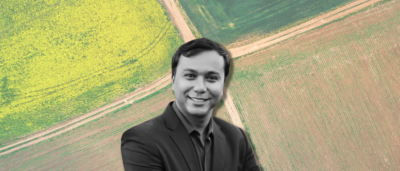
| Prof. Amar Mohanty, Plant Agriculture, directs the new Bioproducts Discovery and Development Centre. Photo by Martin Schwalbe |
Making car parts out of corn, soybean, wheat and other crops is just one way U of G research will help fuel the bioeconomy in the newly opened Bioproducts Discovery and Development Centre (BDDC). Last week, dignitaries, students, faculty, staff, alumni and supporters attended the opening of the new 2,700-square-foot facility, located at the south end of the Crop Science Building.
Organizers unveiled labs and greenhouses expected to allow scientists from Guelph and other universities and industry to grow crops and explore their uses, especially for new materials and sustainable fuels.
“This discovery centre is a nexus where physical and engineering scientists and plant biologists will work together on viable solutions to some of today's most pressing problems,” says president Alastair Summerlee. “Our reality now is global warming, growing environmental threats and depleting petroleum resources, and we must develop sustainable alternatives. Just as we have so many times in our 132-year history, Guelph has once again broken the trail and is leading the way.”
Products made from plants and plant wastes are expected to substitute for more conventional petroleum-based materials, says Prof. Amar Mohanty, Plant Agriculture, director of the new centre. He says the BDDC will help in investigating renewable materials, growing Canada's bioeconomy and reducing greenhouse gas emissions from oil-based fuels and products, especially those used in the automotive, packaging and building industries.
“Biobased materials, biobased chemicals and bioenergy are the major requirements to establish a bioeconomy,” says Mohanty, an international leader in biomaterials who joined Guelph early this year as the Premier's Research Chair in Biomaterials and Transportation. (He's cross-appointed to the School of Engineering.)
Take those bags of corn-derived plastic pellets along with packages of waste materials — wood, grass, straw, soybeans — sitting in the centre. Now imagine combining them in the BDDC's injection or compression moulding equipment to form an instrument panel in your car or building panels for your home or office.
Mohanty envisions the centre as a testing ground for researchers to try out processes on a pilot scale. After testing materials and processing conditions here, scientists will share what they learn with industry.
The single-storey facility includes a processing lab with new equipment for moulding and extruding materials. Organizers plan to build another processing lab of the same size and hope ultimately to connect the facility with existing greenhouses nearby.
Besides benefiting the bioeconomy by developing new products and processes for Canadian firms, the centre will help reduce greenhouse gas emissions by replacing petroleum-based products with renewable plant feedstocks, says Mohanty.
About 50 researchers will use the centre for their studies, including a core of 10 faculty members and 20 other researchers in the School of Engineering and the departments of Plant Agriculture, Cellular and Molecular Biology, Environmental Biology, Food Science, Physics and Chemistry. The centre will hire staff to run the equipment and the facility.
Besides U of G users, the facility will draw researchers from other universities and from industry. For instance, Guelph leads the $6-million BioCar project that involves researchers here and at three other campuses — the University of Toronto, the University of Waterloo and the University of Windsor — in studying ways to use crops for car parts.
Other projects involving U of G researchers include:
- Prof. Larry Erickson, Plant Agriculture, studies ways to add value to biomaterials from agriculture to manufacturing.
- Prof. Peter Pauls, Plant Agriculture, assesses plant proteins for functional and structural uses from sutures and clothing to packaging and coatings.
- Prof. Chris Hall, Environmental Biology, has studied bioactive filters to detect, capture and disarm pathogens — research that may help the greenhouse, health sciences and water treatment industries.
- CBS dean Mike Emes and Prof. Ian Tetlow, Molecular and Cellular Biology, investigate novel starches for various manufacturing processes.
- Prof. Manju Misra, cross-appointed to the School of Engineering and the Department of Plant Agriculture, studies green nanotechnology and biobased materials.
“It's a whole new way of looking at agriculture and a whole new relationship between the sector and Ontario's economy,” says Erickson. “Now agriculture is more than meat and potatoes — it's car parts, building materials, fuel and more.”
Countering arguments that growing crops for biomaterials may threaten food supplies or push up food prices, Mohanty says those problems stem not from bioprod- ucts alone but more from the costs of food production, packaging and distribution.
“We're not increasing food prices because of using crops for biofuel and biomaterials.”
He adds that wastes and undervalued byproducts from the emerging biofuel industries “have tremendous potential as the novel raw materials for industrial products in greening the manufacturing sector. This is one of the pathways toward a solution for global warming.”
Few research centres exist worldwide for exploring ways to add value to waste agricultural products, says Mohanty. Guelph's strength lies in interdisciplinary studies connecting plant breeding and genetics, materials and food processing, engineering, life sciences and environmental management, he says.
“This new centre positions Guelph as a world leader in the field of bioproducts.”