Features
Pathologist Finds All the Puzzle Pieces
"With some cases, I feel like Sherlock Holmes," says veterinary pathology prof, who helps farmers figure out what ails their livestock
![]() |
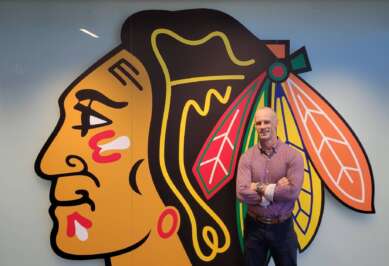
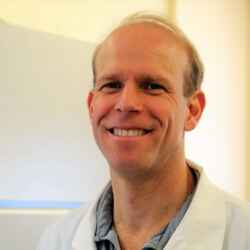
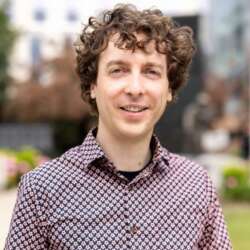
| “My father is a veterinary pathologist, and I always knew that’s what I wanted to do, too,” says Prof. Brandon Lillie. PHOTO BY MARTIN SCHWALBE |
BY TERESA PITMAN
"I'm a lifer at OVC," says Prof. Brandon Lillie, Pathobiology, who earned his DVM and PhD at the Ontario Veterinary College and did a post-doctoral stint there before joining the faculty this summer.
Actually, his connection to the college started even before he was born because his father earned a DVM there in 1966 and a master's degree in pathology in 1970. (His mother is also a Guelph grad, receiving a B.H.Sc. in 1967, a master's degree in family studies in 1970 and a PhD in 2008.
His sister earned a B.Comm. at U of G in 1996.)
"My father is a veterinary pathologist, and I always knew that's what I wanted to do, too," says Lillie.
Born in Winnipeg and raised in Vegreville, Alta., he had moved to Milton, Ont., with his familyby the time he was university age, and Guelph was a natural choice.
After a year of undergraduate studies in biomedical sciences, he was accepted into the DVM program and graduated in 2000.
"I took three months off, then worked part-time in a small-animal practice for a few more months," he says. "After that, I retired from practice and went back to school."
Lillie started in a master's program in veterinary pathology but later switched to the PhD program and did both the research component and training in veterinary anatomic pathology at the same time. As a result, he now has board certification in vet pathology. He then worked as a clinical instructor and did a year of post-doc research before obtaining his faculty position.
His research takes advantage of the study opportunities provided by the Animal Health Lab's necropsy service. Farmers who want to find out why one of their animals has died will send it to the lab for analysis. If the animal is a pig, Lillie requests tissue samples for his studies on proteins that help pigs resist infections.
"These proteins that fight off bacteria and viruses are also found in humans," he says.
"In my research, we're looking at genetic defects in some of these proteins, which could make pigs more susceptible to disease. If we can identify these defects, we could selectively breed for animals that are naturally more resistant and get sick less often."
One important benefit of this would be reduced antibiotic use in pigs, something farmers and consumers alike would find appealing, he says.
The particular proteins Lillie studies are called collagenous lectins, which bind to the sugar residues on the surface of bacteria and other pathogens, including some influenza viruses.
"These proteins can distinguish between the cells of the pig's body and foreign cells such as bacteria and viruses," he says. "Pigs have these proteins from birth, and most of them circulate in the bloodstream."
He was able to detect some mutations in the proteins in some pigs, and the data showed that certain mutations were seen more frequently in animals that had infectious diseases.
"We then broke the diseases down into different types and found that the type of defect in the protein seemed to be related to the kind of infection the animal developed."
Now Lillie is moving forward in his research and using microarrays to look at hundreds of gene profiles.
"We start with a very small piece of the liver. We want to look at the gene-expression level in healthy animals and sick animals to identify genes that are expressed differently in disease, then determine the genetic reasons for the differences so we can identify genetic mutations that affect resistance to disease."
As these protective genes are identified, the researchers will also be looking at other aspects of the action of the genes to see if there are potential negatives as well as positives.
"For example, we'll want to know if they affect the number of piglets born to that pig," says Lillie. "Our ultimate goal is to find a panel of these mutations that you might want to breed away from."
He says this aspect of disease resistance is a relatively new area of research with some exciting potential.
Teaching and diagnostic pathology are also a big part of Lillie's work.
"The final-year vet students all do a rotation in anatomic pathology, where they learn how to do a necropsy and what can be discovered in the process. They also learn surgical pathology, which involves looking at biopsies and tissues from live animals to make a diagnosis. This gets them comfortable with pathology and how it's used."
For Lillie, the appeal of pathology is the opportunity to solve a mystery.
"With some cases, I feel like Sherlock Holmes," he says. "I'm putting the evidence together,finding all the puzzle pieces and coming up with a diagnosis. It's like being a crime scene investigator for animals."