Alex Souchen
Associate Professor
College of Arts, Department of History
Education
Ph.D., University of Western Ontario, 2016
M.A., University of Ottawa, 2010
B.A., University of Ottawa, 2008
Positions
> Cross-appointed with Bachelor of Arts and Science Program
Assistant Professor, University of Guelph, 2022-2025
AMS Postdoctoral Fellow, Trent University, 2019-2020
SSHRC Postdoctoral Fellow, Wilfrid Laurier University, 2016-2018
Research
Research Fields & Graduate Supervision
- Canadian Military History
- History of Science and Technology
- War and Society
- Environmental History
- Consumption, Waste, and Pollution
- History of the Oceans
- First and Second World Wars
Current Research Projects
Underwater Munitions and Military Pollution: This project's goals are to explore the operational, scientific, logistical, and policy contexts that enabled the dumping of munitions into the oceans after the First and Second World Wars. By extension, I am also interested in the environmental history of war and disarmament, ocean pollution, unexploded ordnance, and the contamination of military activities.
Bombmakers: Canada's Industrial Front during the Second World War: This project examines the production of chemicals, explosives, and artillery shells during the Second World War and its wider impact on the communities, environments, and people connected to Canada's munitions industry. More specifically, it explores workplace safety, industrial hygiene, contamination, and exposure, as well as the expropriation of lands, factory construction, infrastructure and housing, production methods, commodity chains, demobilization, and environmental change.
Awards and Funding
2026, University Research Excellence Award, https://news.uoguelph.ca/2026/09/eight-researchers-honoured-with-u-of-g-research-excellence-awards/
2024-2026, AMS Project Grant, Toxic Work: Workplace Safety and Industrial Hygiene in Canada's Munitions Industry during the Second World War. https://www.ams-inc.on.ca/project/toxic-work-workplace-safety-and-indust...
Teaching
HIST*1250, Science and Technology in a Global Context
HIST*3490, Canada and the Second World War
HIST*4250, Warfare and the Environment
HIST*6500, A World on Fire: Historians and the Climate Crisis
ASCI*1110, Society and Inquiry I
ASCI*4040, The Past, Present, and Future of Waste
Publications
Books
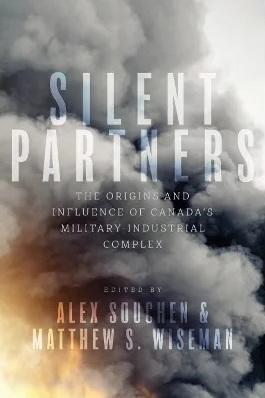
with Matthew S. Wiseman, eds., Silent Partners: The Origins and Influence of Canada's Military-Industrial Complex (University of British Columbia Press, 2023).
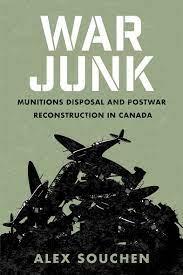
War Junk: Munitions Disposal and Postwar Reconstruction in Canada (University of British Columbia Press, 2020).
Articles & Book Chapters
"Out with the Old: Munitions Disposal, Marine Environments, and the Canadian Military." Scientia Canadensis: Canadian Journal of the History of Science, Technology, and Medicine 45, 1 (2023): 67-89.
with Matthew S. Wiseman, “Introduction: A Canadian Military-Industrial Complex?” in Silent Partners: The Origins and Influence of Canada’s Military-Industrial Complex (UBC Press, 2023).
“Victory at All Costs: Canada’s Munitions Industry and the Environment during the Second World War,” in Silent Partners: The Origins and Influence of Canada’s Military-Industrial Complex (UBC Press, 2023).
“Missing from the Record: Historians, Archival Research, and Underwater Munitions.” Rethinking History: The Journal of Theory and Practice 25, 3 (2021): 347-371.
“An Exceptional Mortality: Dumped Munitions, Inconclusive Science, and the Mass Death of Oysters in the Thames Estuary after the First World War.” Environmental History 26, 4 (October, 2021): 696-723.
“The Use of Historical Evidence in Studies on Underwater Munitions.” Marine Pollution Bulletin 167 (June 2021): 1-5.
“Killing Time, Not Germans: Reserve Positions in the 3rd Canadian Infantry Division during the Battle of Normandy.” Canadian Military History 30, 1 (2021): 1-33.
“Chemical Weapons Disposal and the Scuttling of LST 3521 in 1946.” Canadian Naval Review 16, 3 (2021): 14-19.
“Recycling War Machines: Canadian Munitions Disposal, Reverse Logistics, and Economic Recovery after World War II.” Business History 64, 5 (2020): 984-1000.
“Something Fishy? Underwater Munitions and Unexplained Die Offs in Marine Environments.” International Journal of Maritime History 30, 2 (2018): 355-361.
“‘Under Fathoms of Saltwater’: Canada’s Ammunition Dumping Program, 1944-1947.” Canadian Military History 26, 2 (2017): 1-34.
“The Culture of Morale: Battalion Newspapers in the 3rd Canadian Infantry Division, June-August 1944.” The Journal of Military History 77, 2 (2013): 543-67.