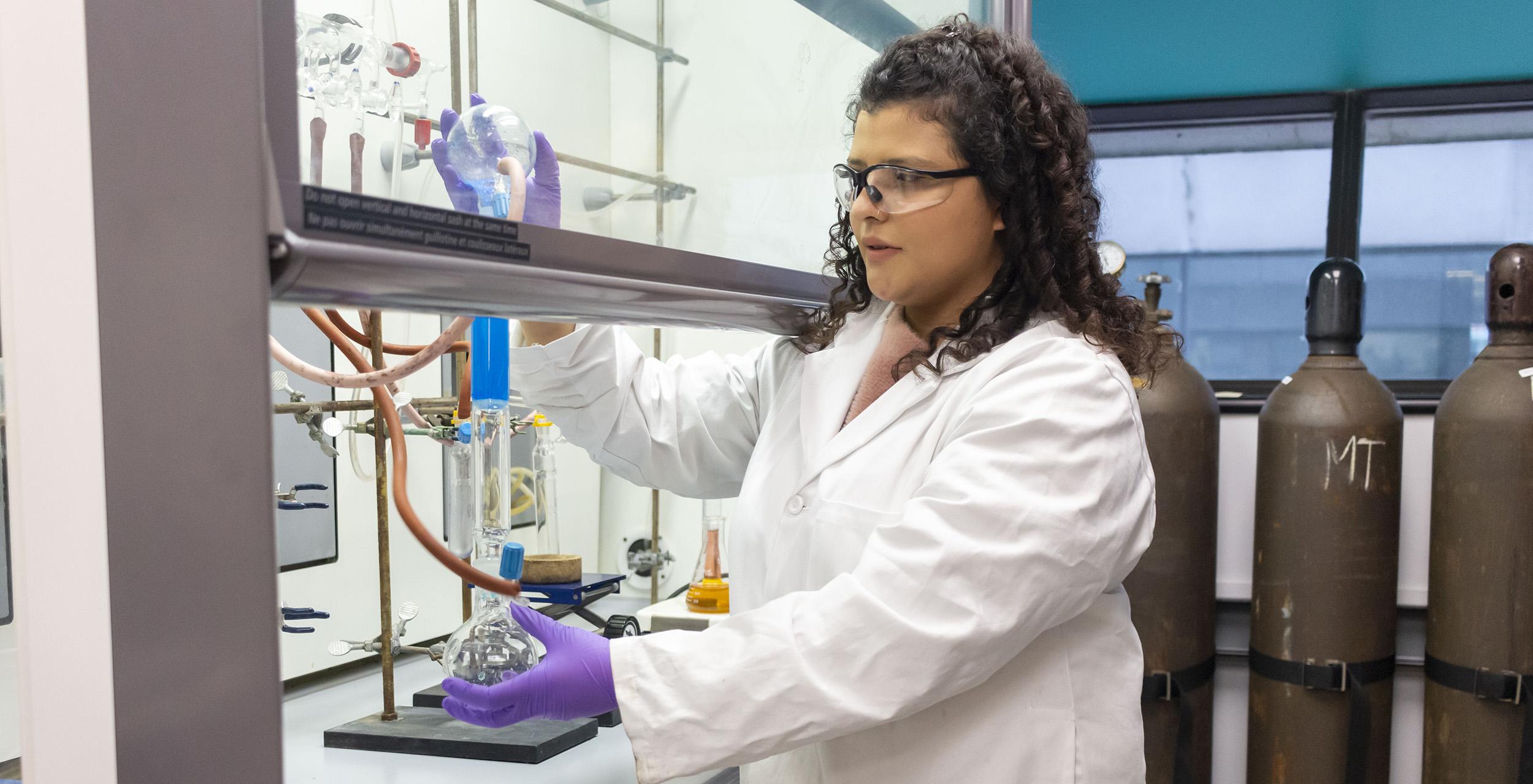
Genivieve Borg, a graduate chemistry student, working in Dr. Kathryn Preuss' lab at the University of Guelph

Master of Science in Chemistry

Why choose a Master of Science (M.Sc.) in Chemistry?

Start shaping the science of tomorrow. 

Are you interested in... developing new vaccines, making molecular magnets, turning CO₂ into fuel, improving nuclear power safety, protecting crops from fungi, or other advancements in chemistry? The University of Guelph’s Master of Science in Chemistry offers research-intensive experience across a wide range of modern scientific fields. Students collaborate with faculty conducting active research in areas such as analytical, organic, inorganic and physical chemistry. Students also engage in fields like nanoscience and polymer chemistry, with opportunities for interdisciplinary study.

You will carry out original research in an area that matches your interests while developing laboratory, analytical and communication skills in U of G’s state-of-the-art research facilities, preparing you for careers in industry, research or further graduate study.

Choose your research focus

Explore analytical, biological, inorganic, organic, physical, polymer or theoretical chemistry, nanoscience and more.

Access advanced research facilities

Work with specialized tools for NMR, mass spectrometry, X-ray diffraction, spectroscopy and nanoscience.

Expand your research network

Access research expertise at both the University of Guelph and the University of Waterloo.


What can you do with an M.Sc. in Chemistry?

The M.Sc. in Chemistry prepares you for diverse careers in science by developing advanced research, analytical, and problem-solving skills.

  • Chemist
  • Chemical/pharmaceutical industry
  • Analytical labs and forensics
  • Environmental protection and policy
  • Science writing and education

Faculty and Research Facilities

Work alongside accomplished chemistry researchers in a collaborative, research-intensive environment. From advanced spectroscopy and microscopy to mass spectrometry and NMR, you'll have access to the tools and expertise needed to pursue meaningful, hands-on research and develop the skills to take your next step in research, industry or further academic study.

Explore our Chemistry faculty and their labs here.

What can you learn – sample courses

Students in the thesis stream must successfully complete at least four 0.50 graduate courses. Some course options could include

Explore the molecular analysis of toxic substances using spectroscopic and chromatographic techniques, while developing skills to interpret real-world data and understand how molecular structure influences toxicity, metabolism and regulation.

Learn how X-ray diffraction is used to determine molecular structures, including crystal symmetry, structure solution, refinement and scientific reporting.

Explore important organic reactions and their mechanisms, stereochemical implications and applications in modern organic synthesis.

Develop a research proposal by reviewing, evaluating and bringing together scientific literature related to your thesis area.

Conduct original research and present your findings in a written thesis.

Program Information and Requirements

Minimum standing of 75 per cent in the last two years of an Honours Bachelor of Science degree, or the equivalent, from an accredited University.

Online Application Package Requirements

  • Payment of Fees
  • Transcripts
    • Academic transcripts from each post-secondary institution attended must be uploaded, including all marks and the awarding of degrees. The grading scale must be provided. A certified translation is required if the transcript is not in English. Official academic transcripts (received in a closed university envelope) are only required if you are offered admission.
  • References
    • 3 reference letters, two of which must be from academic sources (faculty, lecturer, etc.).
    • Your referees will be emailed with instructions on submitting forms electronically.

The reference form looks for an evaluation of the applicant’s preparation for graduate study, range of abilities and accomplishments, and creative and intellectual promise.

Supplementary Information

Completed areas of research interest, goals and objectives (Supplementary Information Form).

Additional Documentation (if applicable)

  • English Proficiency Certification. English tests are considered valid within two years of the start of a program, not when you apply.
  • GRE – The GRE and the GRE subject area test in chemistry and/or biochemistry are not required.
  • Funding Support Letter. If an applicant will be funded through scholarships provided by their country or institution, this letter must be provided, detailing the duration and level of funding.
  • Proof of Immigration Status (if applicable). Permanent Residents of Canada must provide a copy (front and back) of their Record of Landing form (IMM 1000) or Permanent Residence card.

Complete application submission instructions may also be found on the Office of Graduate Studies webpage or in the Graduate Calendar.

Entry points for the M.Sc. in Chemistry are Fall (September), Winter (January), and Summer (May). The application deadline is August 31 (domestic) and February 1 (international) for Fall; December 31 (domestic) and June 1 (international) for Winter; May 1 (domestic) and October 1 of the previous year (international) for Summer. International applicants are encouraged to apply at least nine months in advance of their start date, and all applicants are advised to apply as early as possible due to supervisor availability.

The M.Sc. in Chemistry is typically completed in two years of full-time study or four years of part-time study.

Full funding is typically provided for full-time, thesis-based students (who do not receive external funding) through a combination of scholarships, teaching assistantships, and/or research assistantships. For more information about funding your graduate studies at Guelph, please visit Funding Graduate Studies.

The Office of Graduate and Postdoctoral Studies provides estimated annual full-time tuition, fees, and living expenses for graduate students at the University of Guelph: Tuition, Fees and Cost of Living.

Our Chemistry graduate programs are part of a joint partnership with the University of Waterloo known as the Guelph-Waterloo Centre for Graduate Work in Chemistry & Biochemistry (GWC)2.

GWC² is housed in the Chemistry Departments at the University of Guelph and Waterloo, two of Canada’s leading Universities. A diverse team of world-class faculty from both Departments provide research opportunities in a myriad of chemical research areas.

M.Sc. students may enhance their studies by pursuing a collaborative specialization alongside their degree:

  • Toxicology: The collaborative specialization is the focal point for graduate teaching and research in toxicology.

Learn more about Toxicology and eligibility in the Graduate Calendar.

Students interested in Chemistry graduate studies may also be interested in exploring:

Chemistry Course-based Master's

The full-time, course-based M.Sc. option is designed for students who wish to complete the degree requirement over a one-year period. Students must secure a supervisor(s) for their Major Research Project. Financial support may be available (but is not guaranteed) to a student carrying out an experimental research project. Contact the Chemistry graduate program administrators for more information.

Master of Toxicology (MTOX)

Our Master of Toxicology (MTOX) is a one-year, course-based master's program that integrates analytical chemistry, environmental science and biomedical toxicology. Learn more about MTOX.

Person seated at a computer, pointing to a scientific diagram displayed on the monitor.
I hope that my research will help further our insight of electrode-electrolyte double-layer, leading to further innovation and development of fuel cells, batteries, and other energy transformation systems. 

Brendan Laframboise, Alumni
M.Sc. Graduate
Learn more about Brendan

Woman with long brown hair wearing a black turtleneck and pendant necklace, standing on a staircase and resting one hand on the railing.
We are working on new problems, including how to develop materials that can perform quantum computing functions, materials that are crystalline and yet mechanically flexible, and materials that can be incorporated into paints or coatings and possess magnetic memory. 

Dr. Kathryn Preuss, Faculty
Professor in the Department of Chemistry
Learn more about Professor Kathryn Preuss

Contact Us

Graduate Program Coordinator
Abdelaziz Houmam
519-824-4120 ext 56429
ahoumam@uoguelph.ca

Graduate Program Specialist
Tracy Burns
519-824-4120 ext 53044
chemgrad@uoguelph.ca

Chemistry Administrative Officer
Jackèe Colquhoun
519-824-4120 ext 53905
chemadmin@uoguelph.ca

The Guelph-Waterloo Centre for Graduate Work in Chemistry (GWC)2
519-824-4120 ext 53848
gwc@uoguelph.ca