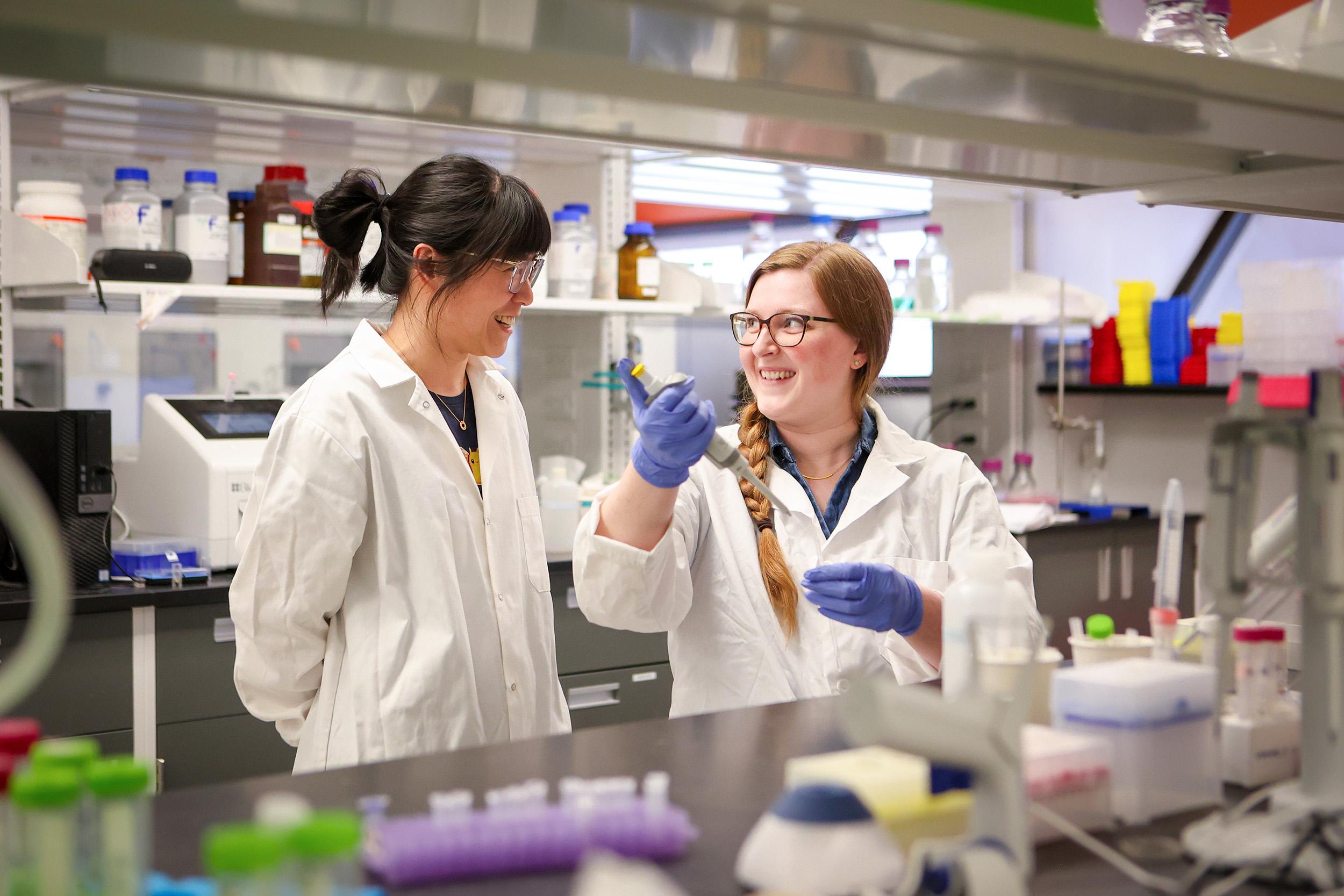
Dr. Rui Huang, left, and Megan Black, a Chemistry PhD student, are working together in a lab while wearing personal protective equipment

PhD in Chemistry

Why choose a PhD in Chemistry?

Lead meaningful research in the field of chemistry.

The University of Guelph’s PhD in Chemistry provides a research-intensive environment and advanced training, where students conduct original research alongside leading faculty across diverse areas of chemistry. Through advanced coursework, a comprehensive examination, a doctoral seminar and an original thesis, students develop the skills to conduct chemistry research at a terminal level- technical, analytical and communication skills needed to tackle complex scientific challenges. Graduates are prepared for careers in academia, industry, government, and research, and are equipped to make meaningful contributions to scientific discovery and innovation.

Advance your area of expertise

Conduct advanced, original research in analytical, biological, inorganic, organic, physical, polymer or theoretical chemistry or nanoscience.

Lead independent research

Develop and execute substantial research that contributes new knowledge to your field.

Prepare for research-focused careers

Build the expertise for academia, chemical and pharmaceutical industries, government laboratories, environmental science and research leadership.


What can you do with a PhD in Chemistry?

The PhD in Chemistry prepares you for diverse careers in research, industry, and academia by developing advanced expertise, research independence, and specialized scientific knowledge, including opportunities as:

  • Chemical/pharmaceutical industry
  • Analytical labs and forensics
  • Environmental protection and policy
  • Science writing and education
  • Academia
  • Advanced research in chemistry

Faculty and Research Facilities

Conduct original research alongside accomplished chemistry researchers in a collaborative, research-intensive environment, with expertise spanning electrochemistry and nanoscience, molecular materials, analytical chemistry and more. Build the depth of expertise, research independence and collaborative experience to advance your career in academia, industry or government.

Explore our Chemistry faculty and their labs here.

What can you learn – sample courses

Students in the PhD program must successfully complete three semester-long courses beyond those required for the master of science degree. One of these courses will be CHEM*7950 PhD Seminar. Students must also pass an oral qualifying examination in their major field, and submit and defend an acceptable thesis. Course options could include:

Learn how to identify, separate and measure chemical substances using modern analytical techniques.

Approximate solutions of the Schrödinger equation and calculations of atomic and molecular properties.

Physical organic chemistry, including a discussion of reactive intermediates, substituent effects, pericyclic reactions, radical chemistry and a basic theoretical description of the bonding in organic molecules.

Conduct original research that contributes new knowledge to chemistry and defend your findings in a doctoral thesis.

Program Information and Requirements

Admission Requirements

An applicant is eligible for admission to the PhD program at the discretion of the director. In general, an applicant must possess the qualifications listed for the MSc program, together with a Master of Science degree comparable to those awarded by North American universities and suitable references from the institution at which the MSc degree was awarded. However, direct admission to the PhD program is available to applicants with an overall A standing in an Honours B.Sc. degree.

A total of 3 references must be presented, which must be from academic sources (faculty, lecturer, etc.). Your referees will be emailed with instructions on submitting forms electronically. The reference form looks for an evaluation of the applicant’s preparation for graduate study, range of abilities and accomplishments, and creative and intellectual promise.

Supplementary Information

Completed areas of research interest, goals and objectives (Supplementary Information Form).

Additional Documentation (if applicable)

  • English Proficiency Certification. English tests are considered valid within two years of the start of a program, not when you apply.
  • GRE – The GRE and the GRE subject area test in chemistry and/or biochemistry are not required.
  • Funding Support Letter. If an applicant will be funded through scholarships provided by their country or institution, this letter must be provided, detailing the duration and level of funding.
  • Proof of Immigration Status (if applicable). Permanent Residents of Canada must provide a copy (front and back) of their Record of Landing form (IMM 1000) or Permanent Residence card.

Complete application submission instructions may also be found on the Office of Graduate Studies webpage or in the Graduate Calendar.

Direct Entry from a B.Sc.

Outstanding students with an overall ‘A’ standing at the undergraduate level may be eligible for direct admission to the PhD program. Students admitted directly to the PhD program from a BSc must successfully complete one semester-long course beyond those required for the master of science degree. In addition, students must also complete CHEM*7950 PhD Seminar, pass an oral qualifying examination in their major field, and submit and defend an acceptable thesis. The Direct Entry PhD program is typically completed in 15 terms.

Direct Transfer from an M.Sc.

Exceptional M.Sc. students may be eligible to transfer directly into the PhD program before completing all master’s requirements. Applicants should demonstrate strong academic performance, research potential, and effective communication skills. Students complete graduate coursework, seminars, an oral comprehensive examination, and a thesis defence as part of the PhD program.

Entry points for the PhD in Chemistry are Fall (September), Winter (January), and Summer (May). The application deadline is August 31 (domestic) and February 1 (international) for Fall; December 31 (domestic) and June 1 (international) for Winter; May 1 (domestic) and October 1 of the previous year (international) for Summer. International applicants are encouraged to apply at least nine months in advance of their start date, and all applicants are advised to apply as early as possible due to supervisor availability.

The PhD in Chemistry is typically completed in four years of full-time study or eight years of part-time study.

Full funding is typically provided for full-time, thesis-based students (who do not receive external funding) through a combination of scholarships, teaching assistantships, and/or research assistantships. For more information about funding your graduate studies at Guelph, please visit Funding Graduate Studies.

The Office of Graduate and Postdoctoral studies provides estimated annual full-time tuition, fees, and living expenses for graduate students at the University of Guelph: Tuition, Fees and Cost of Living.

The Guelph-Waterloo Centre for Graduate Work in Chemistry and Biochemistry, (GWC)², is housed in the Chemistry Departments at the University of Guelph and Waterloo, two of Canada’s leading Universities. A diverse team of world-class faculty from both Departments provide research opportunities in a myriad of chemical research areas.

PhD students may enhance their studies by pursuing a collaborative specialization alongside their degree:

  • Toxicology: The collaborative specialization is the focal point for graduate teaching and research in toxicology.

Learn more about Toxicology and eligibility in the Graduate Calendar.

Austin Pounder
My interest lies in the intersection of theory and experiment in the field of organic chemistry. In the laboratory, I focused on designing novel transition-metal catalyzed reactions that find applications in synthetic organic chemistry. 

Austin Pounder, Alumni
PhD Graduate
Learn more about Austin

Woman with long brown hair wearing a black turtleneck and pendant necklace, standing on a staircase and resting one hand on the railing.
We are working on new problems, including how to develop materials that can perform quantum computing functions, materials that are crystalline and yet mechanically flexible, and materials that can be incorporated into paints or coatings and possess magnetic memory. 

Dr. Kathryn Preuss, Faculty
Professor in the Department of Chemistry
Learn more about Professor Kathryn Preuss

Contact Us

Graduate Program Coordinator
Abdelaziz Houmam
519-824-4120 ext 56429
ahoumam@uoguelph.ca

Graduate Program Specialist
Tracy Burns
519-824-4120 ext 53044
chemgrad@uoguelph.ca

Chemistry Administrative Officer
Jackèe Colquhoun
519-824-4120 ext 53905
chemadmin@uoguelph.ca

The Guelph-Waterloo Centre for Graduate Work in Chemistry (GWC)2
519-824-4120 ext 53848
gwc@uoguelph.ca