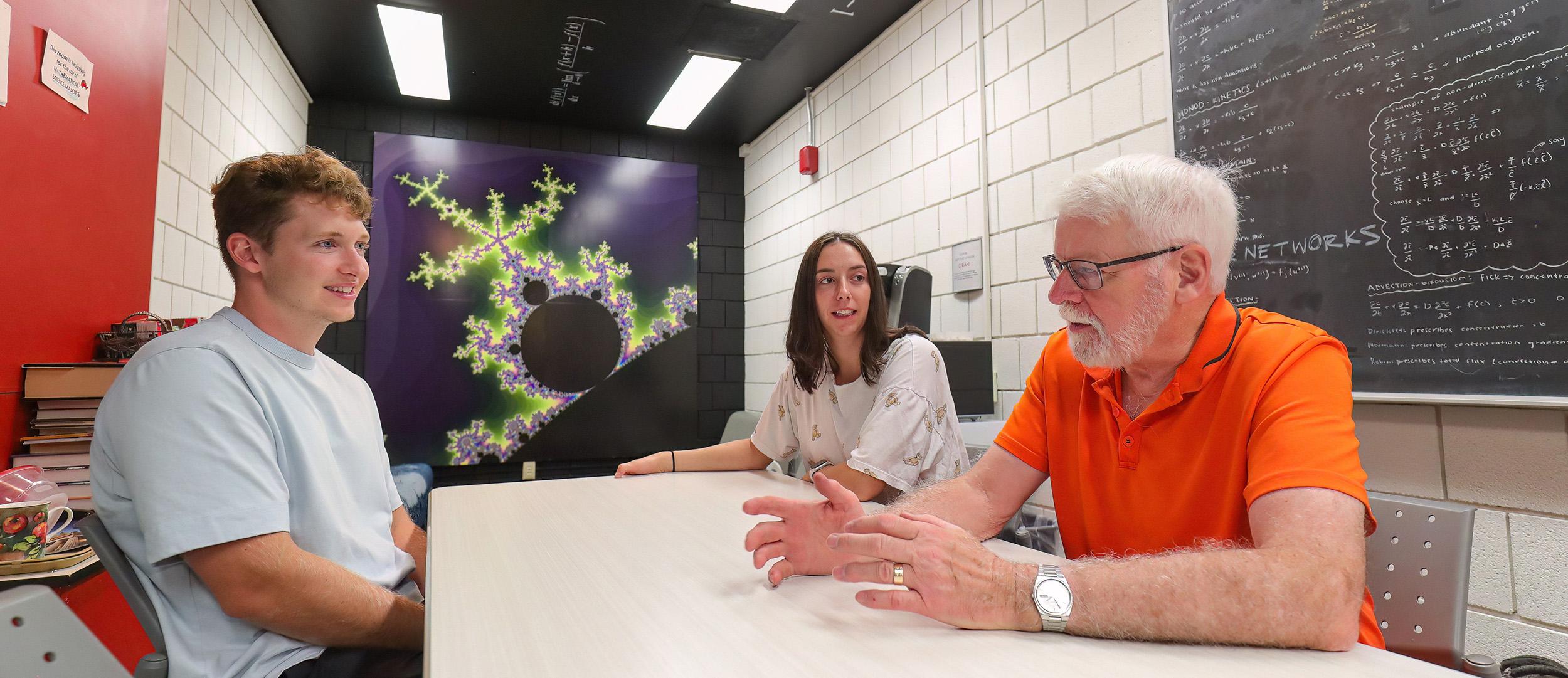
A group of people sitting around a table discussing.

PhD in Mathematics & Statistics

  1. U of G Homepage
  2. Programs

Degree

  • PhD (Doctor of Philosophy)

Program Type

  • Thesis

Delivery

  • On-campus

Entry Terms & Deadlines

  • Domestic:

    • Fall (September): July 30
  • International:

    • Fall (September): February 28

Duration

  • Full Time: 48 months
  • Part Time: 96 months

Admission Average

B (73% - 76%)
Program Structure

Why choose a PhD in Mathematics and Statistics?

Looking to turn your passion for mathematics and statistics into an impact at an advanced research level?

Our PhD program offers advanced study in two streams: Applied Mathematics or Applied Statistics, with distinct requirements for each stream, but a shared, collaborative community. In Applied Mathematics, major areas of specialization include dynamical systems, mathematical biology, numerical analysis, and operations research, while Applied Statistics focuses on developing and applying advanced statistical methods to complex real-world data.

The Department of Mathematics and Statistics is a highly active research environment, with faculty expertise spanning agent-based simulations, biostatistics, computational statistics, data science, machine learning, and infectious disease modelling.

Deep, focused research training

Work closely with expert supervisors in a vibrant department to complete an original PhD over 3-4 years.

Wide range of advanced research areas

Specialize in cutting-edge fields such as infectious disease modelling, scientific computing, quantum computing, machine learning, or statistical genetics.

Strong interdisciplinary and societal impact

Address real-world scientific and societal challenges through collaborations with industry, government, and interdisciplinary specializations

What can you do with a PhD in Mathematics or Statistics?

  • Mathematician
  • Academia
  • Postdoctoral Fellow
  • Data scientist
  • Machine learning researcher
  • Financial Analyst
  • Climate and Environmental Analyst
  • Public Health and Epidemiology
  • Quantitative Analyst
  • Software Developer
  • Statistician
  • Research Scientist
  • Mathematician

What you will learn – sample courses

The PhD degree is primarily a research degree. For that reason, coursework commonly comprises a smaller proportion of the student's effort than in the master's program. All courses are chosen in consultation with the student's advisory committee. That said, a sampling of coursework in the PhD program can include:

Study qualitative and quantitative behaviour of differential equations, including flows, bifurcations, and manifolds, with applications in biological, physical, and social systems.

Explore advanced, rotating topics in applied mathematics under faculty guidance through lectures, seminars, or project-based work.

Implement core computational methods in statistics such as Monte Carlo, MCMC, non-parametric techniques, and the EM algorithm.

Analyze time-to-event data using survival and hazard functions, censored data methods, and both parametric and semi-parametric models.

Program Information and Requirements

For the Doctoral program, a recognized master’s degree obtained with high academic standing is required, minimum B (73 per cent) admission average. The Departmental Graduate Program Committee will consider applications for direct entry to PhD with an undergraduate degree in exceptional cases, and for transfer from M.Sc. to PhD. In any event, a member of the department's graduate faculty must agree to act as an advisor to the student.

Complete application submission instructions may also be found on the Office of Graduate Studies webpage or in the Graduate Calendar.

Entry point for the PhD in Math and Stats is Fall (September). The application deadline is July 31 (domestic) and February 28 (international). International applicants are encouraged to apply at least nine months in advance of their start date, and all applicants are advised to apply as early as possible due to supervisor availability.

The PhD in Mathematics and Statistics is typically completed in four years of full-time study or eight years of part-time study.

The Office of Graduate and Postdoctoral studies provides estimated annual full-time tuition, fees, and living expenses for graduate students at the University of Guelph: Tuition, Fees and Cost of Living.

Full funding is typically provided for full-time, thesis-based students (who do not receive external funding) through a combination of scholarships, teaching assistantships, and/or research assistantships. For more information about funding your graduate studies at Guelph, please visit Funding Graduate Studies.

PhD students may enhance their studies by pursuing a collaborative specialization alongside their degree:

  • One Health: Available to students conducting thesis research with a One Health focus.

Learn more about collaborative specializations and eligibility in the Graduate Calendar.

The Department of Mathematics and Statistics is an active department with 23 faculty and over 50 graduate students. Specific research areas include:

  • Biomathematics, Differential Equations and Scientific Computing
  • Computational and Bayesian Statistics
  • Epidemiology, Biostatistics, and Bioinformatics
  • Machine Learning and Artificial Intelligence
  • Mathematical and Statistical Pedagogy
  • Network Modelling and Spatial-Temporal Statistics
  • Operations Research
  • Statistical Finance and Probability
  • Quantum Information and Matrix Analysis

Learn more about collaborative specializations and eligibility in the Graduate Calendar.

How to Apply
International Applicants
View Courses
Academic Calendar

Meet our Students and Faculty

A woman smiling in a black and white polka dotted shirt.

Our department offers an open and friendly atmosphere in which students can gain valuable experience and skills that are transferable to their future career paths, whether academia or industry.

Dr. Ayesha Ali, FacultyProfessor in the Department of Mathematics and Statistics Learn more about Professor Ayesha Ali

Contact Us

Chair
Rajesh Pereira (519 MacNaughton, Ext. 53552)
pereirar@uoguelph.ca
Graduate Program Coordinator
Zeny Feng (540 MacNaughton, Ext. 53294)
zfeng@uoguelph.ca
Graduate Program Assistant
Tricia Townsend (438 MacNaughton)
gradms@uoguelph.ca