Master of Science in Physics
Degree
- MSc (Master of Science)
Program Type
- Coursework
- Thesis
Delivery
- On-campus
Entry Terms & Application Deadlines
Domestic:
- Fall (September): August 31
- Summer (May): March 31
- Winter (January): January 1
International:
- Fall (September): May 1
- Summer (May): January 1
- Winter (January):
Why choose a Master of Science (M.Sc.) in Physics?
Are you interested in areas like remotely exploring the surface of Mars; better physics education practices; structure and dynamics of biological matter; understanding the nature of the atomic nucleus; or gravitational wave astronomy? Are you curious about the forces that shape matter, medicine, the universe and so much more?
The University of Guelph’s M.Sc. in Physics gives you the opportunity to take part in advanced study and research across fields such as Applied Physics; Astrophysics and Gravitation; Atomic, Molecular and Optical Physics; Biophysics; Chemical Physics; Condensed Matter and Material Physics; Nanoscience; Physics Education; Planetary Surface Exploration; and Subatomic Physics.
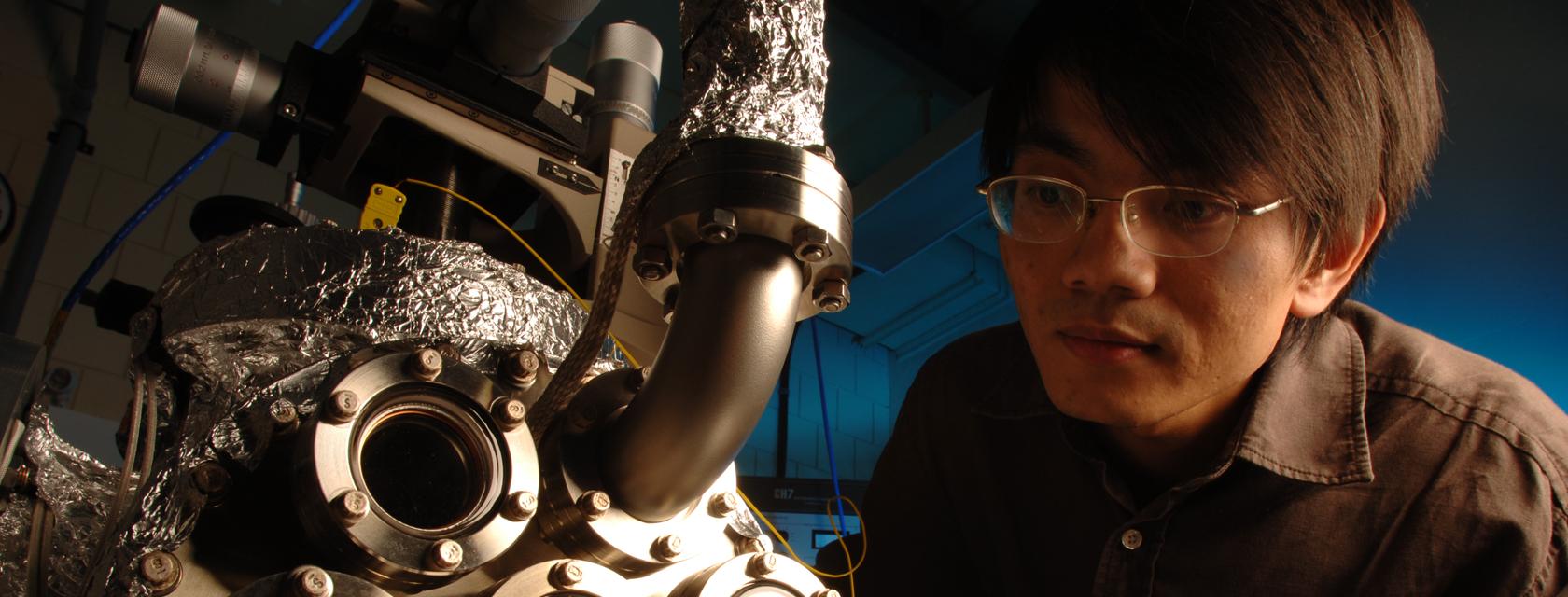
You will work closely with faculty to carry out original research while developing advanced experimental, theoretical, computational and scientific communication skills. Depending on your research area, you may use specialized laboratories, large-scale datasets, computational modelling or national research facilities to investigate complex physical systems and contribute to current scientific work. Our faculty are partnered with and have significant research programmes working alongside world-renowned research-intensive groups such as TRIUMF, the Canadian Space Agency, Perimeter Institute and the Canadian Light Source.
The M.Sc. can be completed through either a thesis or a coursework and major research project option, allowing you to choose the pathway that best supports your academic and career goals.
Choose your research direction
Explore fields such as astrophysics, quantum computing, subatomic physics, materials physics or biophysics.
Connect with a wider research community
Our faculty members collaborate with exceptional research institutions including TRIUMF, the Canadian Space Agency, Perimeter Institute and the Canadian Light Source.
Access advanced research facilities
Develop experimental, theoretical and computational expertise through graduate coursework and an original research project.
What can you do with an M.Sc. in Physics?
The M.Sc. in Physics prepares you for diverse careers in science by developing advanced research, analytical, and problem-solving skills.
- Energy production
- Financial modelling
- Government & policy
- Software development
- Physicist
- Researcher, research and development
Faculty and Research Facilities
At the University of Guelph, your master’s research in physics can take you from our specialized laboratories to some of Canada’s leading research facilities and collaborations around the world. Work closely with faculty spanning specialties in Physics, while contributing to research using advanced instrumentation and facilities at the University of Guelph and through partners such as TRIUMF, the Canadian Space Agency, NASA, the Canadian Light Source and the Perimeter Institute for Theoretical Physics.
What you can learn – sample courses
The M.Sc. can be completed through either a thesis or a coursework and major research project option, allowing you to choose the pathway that best supports your academic and career goals. For full course load requirements, please visit the M.Sc. Physics Academic Calendar.
Program Information and Requirements
Meet our Students

We are uncovering a story one piece at a time, working with clues the planet has left behind... The level of teamwork and engineering needed to even get [Mars research] instruments there is incredible.

The physics department was especially welcoming. The staff and professors were overwhelmingly friendly and approachable – if you had a question, you could simply go to their office. Those years as a grad student travelling to different laboratories are some of my most cherished memories – we had a lot of fun doing a lot of interesting science!
Contact Us
Chair
Stefan Kycia (324 MacNaughton, Ext. 53991)
phychair@uoguelph.ca
Graduate Program Coordinator
Eric Poisson (452 MacNaughton, Ext. 52540)
epoisson@uoguelph.ca
Associate Graduate Program Coordinator
Robert Wickham (448 MacNaughton, Ext. 53704)
rwickham@uoguelph.ca
Graduate Program Assistant
Janice Ilic (207 MacNaughton, Ext. 58176)
physgrad@uoguelph.ca