Exploring Planets and Protecting Earth: U of G Alumna Victoria Flood’s Scientific Journey
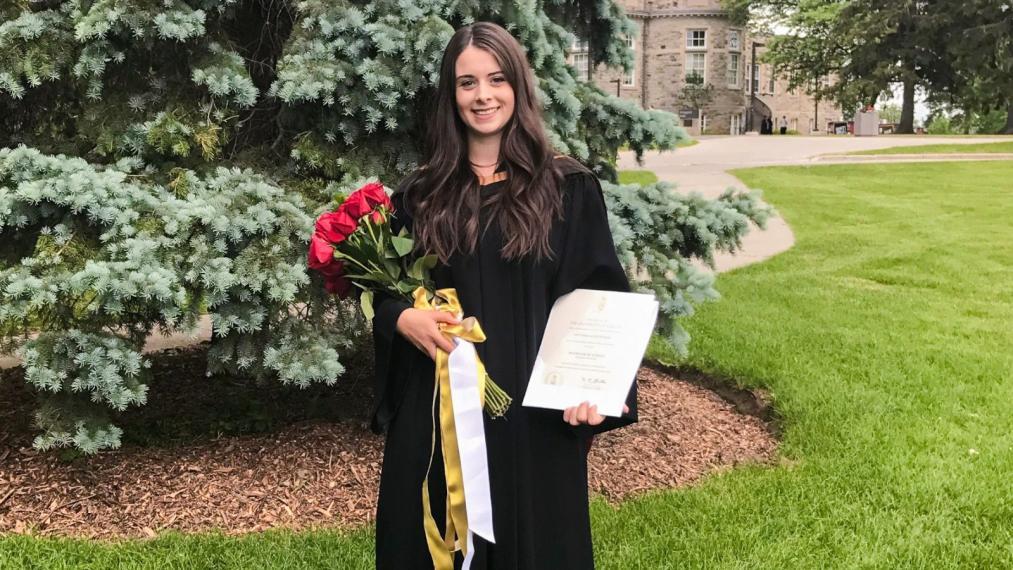
Victoria Flood’s path through physics has been shaped by curiosity, persistence and a desire to find answers. Now a postdoctoral fellow at the University of Toronto after being a two-time Guelph grad, she is contributing to atmospheric research that connects local measurements with large-scale models of Earth’s climate system.
Flood’s academic journey began at the University of Guelph, where she completed a Bachelor of Science in Physical Science in 2017 with minors in mathematics and physics, followed by a Master of Science in Physics in 2019 under the supervision of Dr. Ralf Gellert, associate professor in the Department of Physics.
Flood’s interest in physics started early, grounded in a desire to understand how the world works. “I liked that physics was more about understanding concepts than trying to memorize definitions or pathways,” she says. That mindset carried into a fourth-year research project that introduced her to planetary science and the Mars Science Laboratory (MSL) mission working with Gellert.
Researching Mars quickly became more than just an academic exercise.
She explains, “We are uncovering a story one piece at a time, working with clues the planet has left behind." Adding "the level of teamwork and engineering needed to even get those instruments there is incredible.”
During her master’s research at U of G, Flood worked with data from the ChemCam instrument, which uses laser-induced breakdown spectroscopy (LIBS) to determine the elemental composition of rocks and soil on Mars. Her work focused on detecting and quantifying sulfur, a challenging element to measure using this technique. By examining sulfur alongside calcium signals, she investigated the presence of calcium sulfate minerals, which provide evidence of past water activity on the Martian surface.
A key challenge was the weakness of the sulfur signal. “A lot of my work was addressing the limitations and obstacles of studying sulfur with LIBS,” she says, “and developing a method to better calibrate and quantify that signal.”
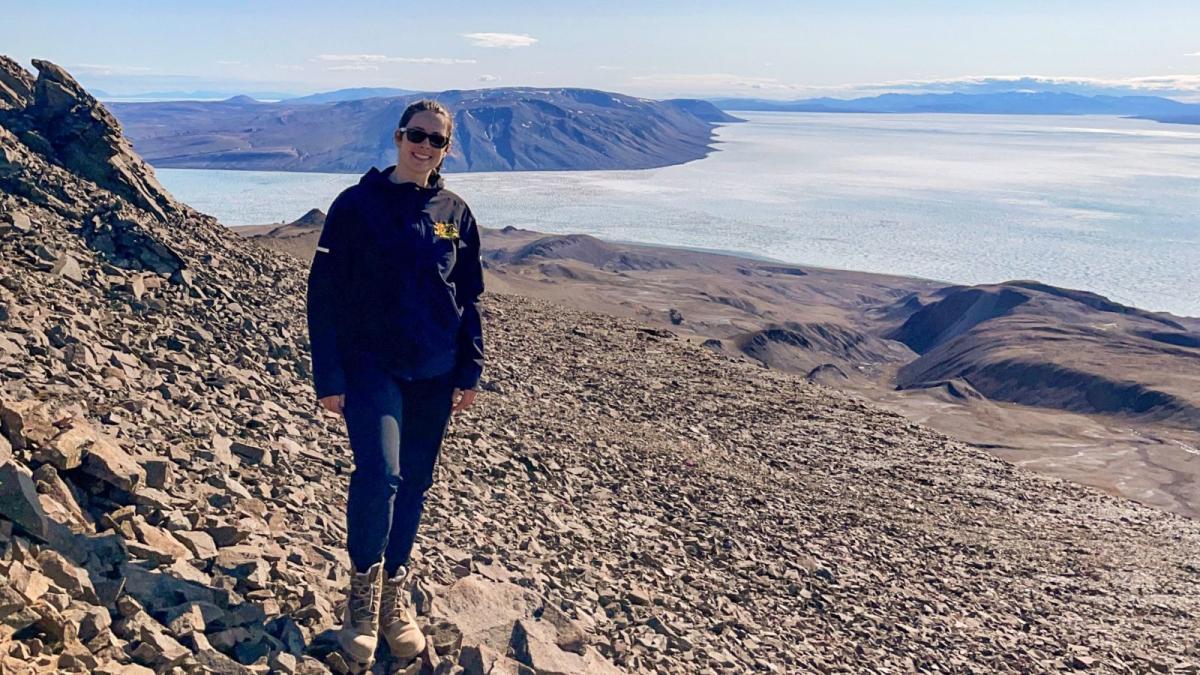
Victoria Flood in Eureka, Nunavut, as part of field work associated with the Polar Environment Atmospheric Research Laboratory (PEARL), July 2023.
Alongside her research, Flood contributed to operations supporting the Curiosity rover as a Payload Uplink and Downlink Lead at U of G through a collaboration involving NASA , the Canadian Space Agency and her research group. In this role, she worked alongside the MSL team to plan and deliver command sequences to the Alpha Particle X-ray Spectrometer (APXS) instrument onboard the Mars Curiosity rover, ensured its safe operation during data collection, reviewed incoming data, and reported on the instrument’s health and performance. The experience offered a rare glimpse into real-time space operations.
Beyond the laboratory, Flood embraced the broader U of G experience through athletics, student life and scientific networking opportunities. As a member of the varsity lacrosse team, she balanced academics, research and athletics while building lasting friendships. “Some of my most memorable moments were with the team,” she says, reflecting on early practices and weekends competing at the OUA finals.
She also travelled for conferences and research meetings, including the Lunar and Planetary Science Conference; these experiences broadened her scientific perspective and strengthened her connections within the planetary science community.
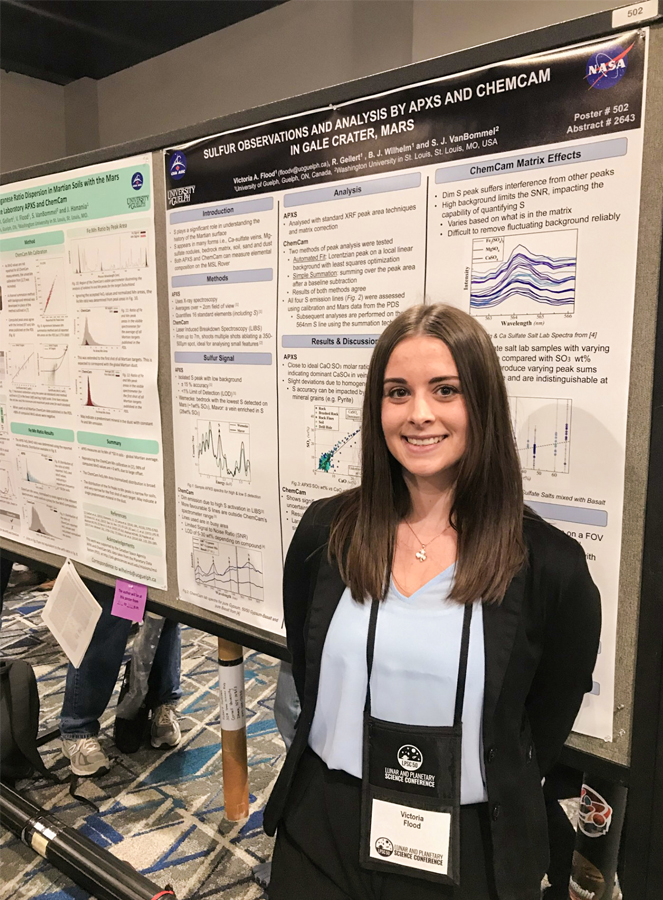
Victoria Flood with her poster presentation at the 2019 Lunar and Planetary Science Conference (LPSC).
After completing her M.Sc., Flood shifted her focus toward atmospheric physics, supported by her background in planetary science, particularly the study of climate history on Mars.
“I wanted to work on something that felt more tangible,” she says. “I’ve always had a passion for the environment, and I’m motivated to reduce anthropogenic impacts on climate change.”
Flood is currently working with Prof. Debra Wunch and Prof. Dylan Jones on the BBCAN project, examining the impact of Canada’s 2023 wildfire season. Her work combines measurements from the Total Carbon Column Observing Network (TCCON) Fourier Transform Spectrometer (FTS) at East Trout Lake with the GEOS-Chem chemical transport model to better understand the transportation and evolution of wildfire emissions, and the effects on air quality
Flood credits her time at U of G, including her work as both a research assistant and a teaching assistant, with helping her develop key skills that continue to shape her career. Research taught her independence and critical thinking, while teaching strengthened her leadership and communication.
“Leading a group in a lab doesn’t always go to plan,” she says. “You have to learn how to problem-solve on the fly and adapt quickly.”
For current physics students considering research or graduate studies, Flood encourages exploration and initiative. She points to the fourth-year research course as an accessible introduction to research and suggests reaching out to professors to learn more about their work.
“A lot of professors, even though they’re busy, will make time to talk or connect you with their students,” she says. “It’s a great way to see what research is actually like and figure out what interests you.”
Flood’s journey reflects the breadth of opportunities available through physical science and physics, shaping a career that spans planetary science, space missions and pressing questions about Earth’s climate.