Davor Ojkić, Jordyn Lopes, Christian Sandrock, Emily Rätsep, Emily Brouwer, Andrew Brooks, Tanya Rossi, Emily Martin
Animal Health Laboratory, University of Guelph, Guelph, ON
AHL Newsletter 2026;30(3):18.
An increase in inclusion body hepatitis (IBH) outbreaks associated with fowl adenovirus (FAdV) infection was reported in Canada between 2004 and 2006. Incidence subsequently declined following the introduction of bivalent autogenous vaccination for broiler breeders. However, since 2015, IBH cases have again increased across Canada.
To characterize the FAdV strains involved, genotyping based on hexon gene sequencing was performed on 1,362 submissions received between 2008 and 2024. Of these, 1,234 originated from nine Canadian provinces and 128 from the United States. Most samples were submitted from Ontario (681), followed by Alberta (243), Nova Scotia (116), British Columbia (77), Quebec (58), Saskatchewan (21), Manitoba (20), Newfoundland (16), and Prince Edward Island (2). The majority of samples (1,285) were associated with clinical IBH, while 77 were submitted for other reasons. Samples from non-IBH submissions lacked histologic lesions or clinical history consistent with IBH, or were derived from non-hepatic tissues (e.g., cloacal swabs, lung, or ventriculus).
Among IBH-associated cases, four FAdV genotypes were identified: FAdV2, FAdV8a, FAdV8b, and FAdV11. From 2008 to 2014, FAdV11 and FAdV8a predominated. Since 2015, however, there has been a clear shift in strain prevalence, with two closely related FAdV8b strains becoming the most frequent IBH-associated genotype and largely replacing FAdV8a and FAdV11 (Fig. 1). These two strains are 97.7% identical at the nucleotide level but are clearly distinguishable as separate viral populations. This same trend has been observed in U.S. submissions and aligns with reports from multiple countries worldwide.
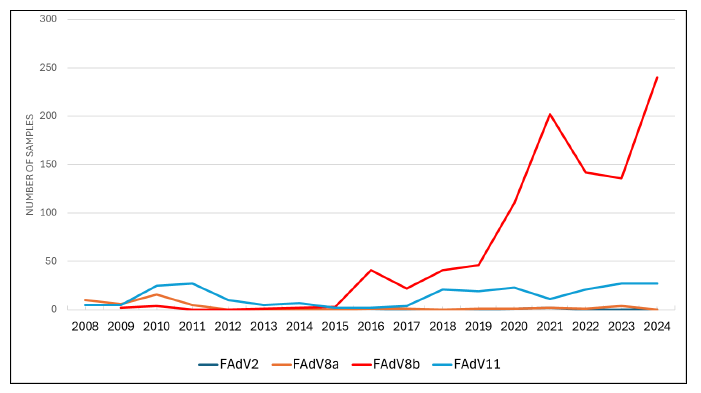
Figure 1. Detection of inclusion body hepatitis-related fowl adenovirus genotypes, 2008–2024
Within the smaller subset of 77 non-IBH submissions, 49 were from commercial flocks and 28 were from non-commercial flocks. A broad diversity of FAdV genotypes was detected in non-IBH submissions, including FAdV1, FAdV2, FAdV3, FAdV4, FAdV6, FAdV7, FAdV8a, FAdV8b, FAdV9, and FAdV11.
FAdV4 infection associated with hepatitis-hydropericardium syndrome (HHS) is widespread throughout Asia, Africa, South America, and Mexico. Although FAdV4 was detected in both commercial and non-commercial flocks in Canada, it was not associated with HHS, suggesting that circulating strains are non-hepatopathogenic and/or may require additional cofactors for disease expression.
Sporadic gizzard erosion outbreaks have been reported in broilers and layers in multiple countries, most frequently associated with FAdV1 and occasionally with FAdV4, FAdV8a, and FAdV8b infection. Of 49 non-IBH samples from commercial flocks, two were clearly associated with gizzard erosions: one with FAdV1 and one with FAdV8a.
References
1. Ojkić D, Lopes J, Sandrock C, Rätsep E, Brouwer E, Brooks A, Rossi T, Martin E. Fowl adenovirus infection and inclusion body hepatitis in Canada: genotyping trends from 2008 to 2024. J Vet Diagn Invest. 2026 Mar;38(2):168-173.