Mihai Nica
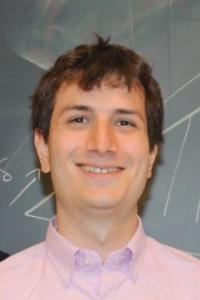
Associate Professor
College of Computational, Mathematical and Physical Sciences, Department of Mathematics & Statistics
Research Areas
- Stochastic processes
- Random matrices
- Probability theory
- Deep Neural Networks
Education and Employment Background
Dr. Mihai Nica received his PhD from New York University in 2017. From 2017 to 2019, Nica held a position as a postdoctoral fellow at the University of Toronto. He joined the Department of Mathematics and Statistics at the University of Guelph in 2020 where he is now an Assistant Professor and an affiliate of the CARE-AI Institute and the Vector Institute.
Research Themes
Nica’s research interests focus on the area of probability, stochastic processes, and their applications to machine learning. His work focuses on applying tools from probability to Deep Neural Networks (DNNs), which are a set of algorithms underlying machine learning technology. These algorithms were originally inspired by the human brain and can be used to recognize patterns. Some past areas of focus and the big questions in these areas include:
- Scaling limits of deep neural networks. Can we understand the behavior of very large neural networks?
- Numerical methods utilizing neural networks. How can neural networks be effectively used in places where traditional numerical methods struggle?
- Phase transitions in high-dimensional learning problems. How does the qualitative nature of learning problems depend on the problem’s signal-to-noise ratio?
- The KPZ universality class. How can we explain the randomness in complex systems that exhibit non-Gaussian behavior?
Highlights
- Vector Institute Postgraduate Affiliate Program, Vector Institute, 2020
- NSERC Postdoctoral Fellowship, 2017-2019
- F.V. Atkinson Teaching Award, University of Toronto, 2018
Media Coverage
Research
CARE-AI
Vector Institute