Interview with Dr. Latasha Ludwig
Tell us about yourself and why you chose to earn your PhD in Pathobiology at the University of Guelph?
I began my journey at the University of Guelph as an undergraduate student in the Animal Biology program. I intended to apply to veterinary school and during that time I took Dr. Rob Foster’s “Principles of Disease” course. This course made me very interested in the study of disease and curious about what it meant to be a pathologist. After three years of my undergraduate program, I was successfully accepted into the Doctor of Veterinary Medicine (DVM) program at the Ontario Veterinary College (OVC). Through the coursework required and working during the summers in Dr. Brandon Plattner’s and Dr. Geoffrey Wood’s labs, I knew that I was interested in research and anatomic pathology. The faculty in the Department of Pathobiology are leaders in the field of veterinary pathology and so it was a no brainer to remain at the OVC for this training. After graduation with my DVM degree I entered the Doctor of Veterinary Science (DVSc) program in Anatomic Pathology in the Department of Pathobiology where I would receive my practical training towards board-certification.
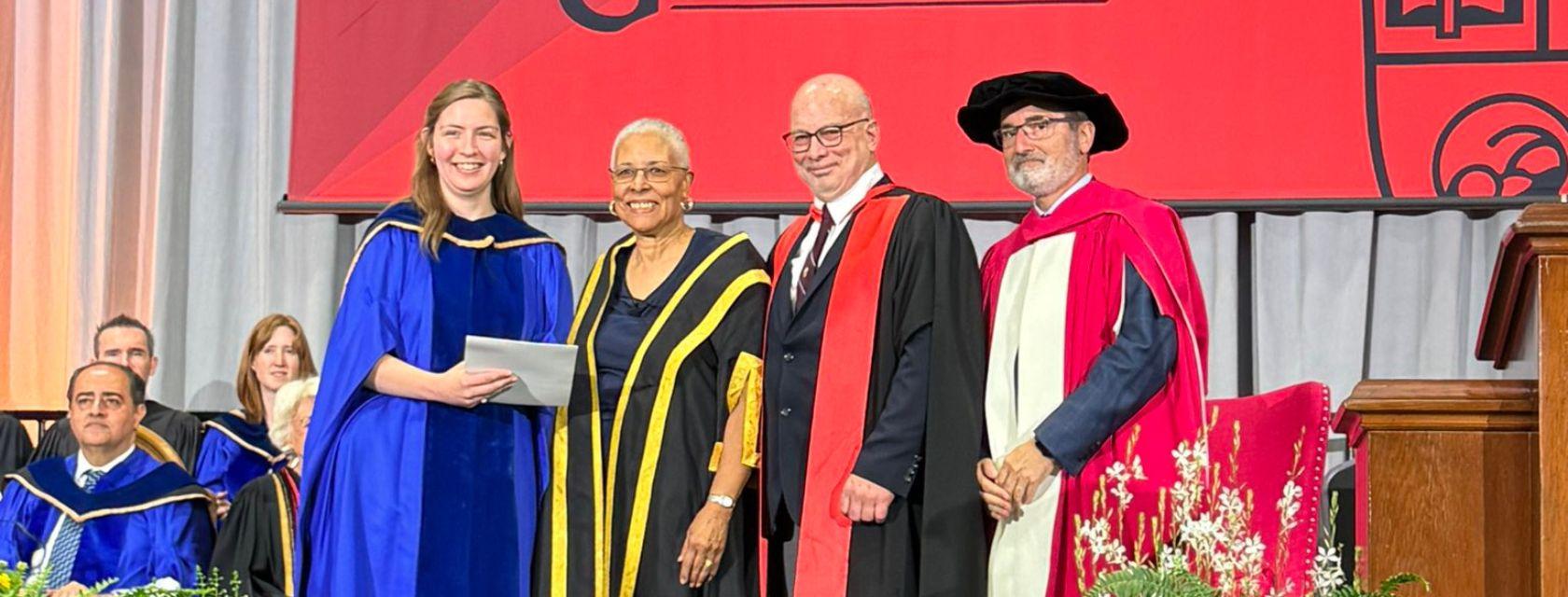
I continued working in Dr. Wood’s lab from my summer projects as a DVM student and knew that I wanted research to play a larger role in my training and that I was interested in a career in academia. So, a year after beginning the DVSc program I transferred to a PhD and was successful in obtaining a Vanier Canadian Graduate Scholarship (NSERC) and OVC Fellowship to fund this endeavour. This allowed me to continue to pursue my practical diagnostic training in anatomic pathology and advance my research and academic skills. In 2023, I successfully became a board-certified Anatomic Pathologist with the American College of Veterinary Anatomic Pathologists and defended my PhD thesis in the spring of 2024.
What did you like most about your program? Is there anything in particular about the courses or professors that stands out to you?
My program was unique in that it allowed me to obtain practical training towards board-certification in Anatomic Pathology while pursuing a PhD. I have an interest in canine and feline cancer and so I also really appreciated how integrated the oncology and pathology departments are at the OVC. My advisor, Dr. Geoffrey Wood, was very open to the ideas that I brought forward and wanted to pursue and he also did an excellent job in providing me opportunities, such as grant writing, that would allow me to succeed in an academic career. I was also heavily involved in teaching in the DVM curriculum as a teaching assistant and then a sessional lecturer for the Veterinary Anatomy course, as well as opportunities in pathology. From my perspective, the Department of Pathobiology and Biomedical Sciences has numerous opportunities for DVM graduate students to gain teaching experience, and this was crucial for my development in becoming a successful academic and made my CV stand out when applying for job opportunities.
Where are you currently working and what is your role?
I am currently an Assistant Clinical Professor in the Section of Anatomic Pathology at Cornell University. My role is mostly composed of diagnostic services in the Animal Health Diagnostic Center/New York State Veterinary Diagnostic Laboratory which involves my expertise as a diagnostic pathologist in performing necropsies and reading biopsies. This is a service not only to the state of New York, but internationally. I am still in an academic position, so the remainder of my time is dedicated to teaching in the DVM curriculum, collaborative research, and service, such as internal and external committees. I continue to collaborate with investigators at the University of Guelph in this role.
How did your PhD and time at the University of Guelph help get you to where you are today? How do the skills and education you gained help with your current work?
My PhD and diagnostic pathology training was vital for my day-to-day job as a pathologist and offered me great insight into this specialty by world-renowned experts. My time at the University of Guelph also created strong relationships with fellow students and faculty that allow me to continue to consult many of them on cases, continue collaborative research efforts, and maintain friendships. Several of my research projects also involved a specialized technique called immunohistochemistry. The background knowledge I obtained in performing that technique now allows me to better evaluate and interpret the results as a diagnostic pathologist. I am also able to provide guidance to our laboratory and troubleshoot when problems arise using this technique. As well, the teaching experience that I obtained throughout my PhD has greatly helped me develop lecture material, use effective teaching strategies, and provide construct feedback to veterinary students in the clinical and pre-clinical years. Writing is a big part of an academic career, whether for manuscripts or grants, and I was able to effectively practice these skills while as a PhD student and continue to apply those skills to my scientific writing.
What advice would you give someone considering a PhD in Pathobiology or applying to the University of Guelph?
The Department of Pathobiology provides a collaborative atmosphere with veterinary and non-veterinary experts in many fields across the spectrum of disease. The department has the potential to develop many experts from veterinary pathologists to molecular biologists and even those with an interest in statistics and bioinformatics. Email faculty, they are more than happy to talk about their expertise and projects. The University of Guelph overall provides an atmosphere of family and community on a campus that is not too overwhelming in a city full of life and experiences. Spending over a decade in the city and at the University emphasized these facts for me.
Bonus Questions