Evolve Guelph: Collaborating for Resilience in Uncertainty
Posted on June 25, 2025
Can interdisciplinary collaboration and education help us tackle today’s challenges and build a better future? Four expert panelists from the University of Guelph believe so.
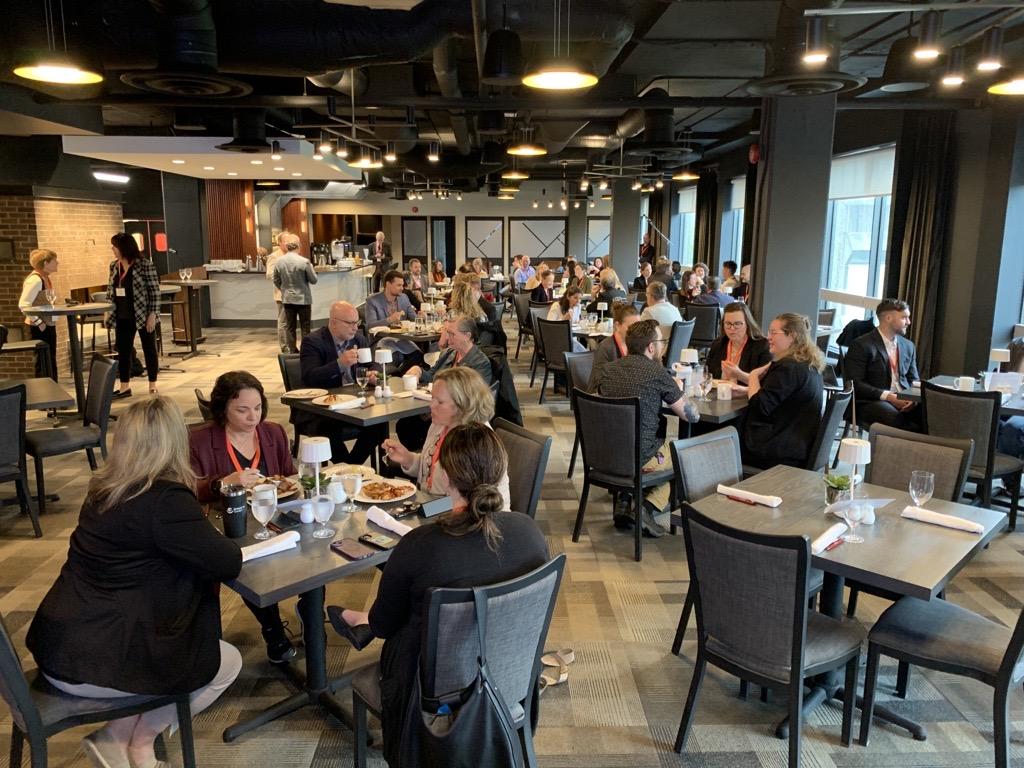
At the Evolve Guelph: Collaborating for Resilience in Uncertainty breakfast event hosted to mark the launch of the School of Continuing Studies, community members, faculty, and local leaders gathered to explore how global issues are affecting us locally, and how working together can drive meaningful change. Panelists shared insights from their diverse fields, highlighting a common message: complex problems demand collaborative solutions.
Panelists included Matthew Hayday, Professor and Chair, Department of History; Dr. Cate Dewey, Assistant Dean of Special Projects and Professor of Epidemiology and Swine Health Medicine, Department of Population Medicine, Ontario Veterinary College; Dr. Sandeep Mishra, Associate Professor, Marketing and Consumer Studies and Director, Adaptive Ventures Lab, Gordon S. Lang School of Business and Economics; and Dr. Michael von Massow, Professor, Department of Food Agriculture and Resource Economics.
What are the local impacts of the ongoing political, economic, technical, and social events in Guelph, through the lens of your area of expertise?
We’re seeing a range of local impacts as a direct result of global issues. From sudden changes in political relationships to the spread of misinformation, Professor Hayday shared that there is a widespread fear and uncertainty rippling through all sectors. As a professional working on complex challenges at the intersection of human, animal, and environmental health, Dr. Dewey shared that many of her concerns of local impacts are linked to one another. Housing insecurity, mental health, climate change, and food insecurity are all deeply intertwined, underscoring the importance of holistic solutions.
When attempting to solve interconnected challenges under the attack of fear, Dr. Mishra called for long-term thinking. “Short-term thinking has invaded everywhere because we’re under threat.” As a negotiation and sales expert, he stressed that it's important to offer alternatives and see hope and education as critical paths forward.
Dr. von Massow highlighted how the cost-of-living crisis disproportionately affects young people and low-wage workers, especially in the food system. He pointed to the need for stronger rural-urban connections and more diverse supply chains to build long-term resilience in the face of climate change.
Together, their insights offered a powerful reminder that addressing today’s challenges, whether social, economic, or environmental, requires both a systems-level view and a commitment to future-focused solutions.
What are the opportunities when thinking about these impacts?
With every challenge comes opportunity, and the panelists returned to this theme throughout the discussion. Grounded in hope, the panelists explored how Canada can navigate global shifts by rethinking its role and building more diverse economic, political, and cultural ties.
Dr. Hayday emphasized the value of historical insight in navigating change. “History broadly can teach you about pretty much every sector in the world and what we’ve done in the past,” he said. He pointed to the role of historians in promoting critical thinking and combatting misinformation.
Dr. Dewey stressed that today’s complex problems require cross-sector collaboration. “These aren’t problems one person or one discipline can solve alone,” she said. Through her work with the One Health Institute, she sees potential in students and professionals co-creating solutions with communities. The One Health micro-credential, in collaboration with the School of Continuing Studies, offers participants the chance to tackle real-world problems in interdisciplinary teams. One student shared they “learned to step away from isolated thinking” and embrace inclusive, systems-based strategies.
Dr. Mishra echoed the need for collaboration, claiming that the University of Guelph is a place that fosters shared well-being and community-driven innovation. “We need to build communities where people experience emergent value where they didn’t before”.
From a food systems perspective, Dr. von Massow shared his optimism, noting that more students are choosing to return to farming or working in food systems to drive change. As he explained, there is a lot of room for optimism and opportunity, “as long as we step back and look at solutions holistically”.
What is one actionable takeaway to help Guelph grow and thrive?
Reflecting on his distance education course Canada and the Second World War, Professor Hayday explained how a world crisis reshaped Canadian society, leading to major investments in education and social welfare “I think that’s a lesson that we can take from the past about what we should be doing today,” he said, emphasizing the value of collective action and sacrifice for the greater good.
Dr. Dewey echoed this, urging individuals to take leadership on tough local challenges and seek out collaborative opportunities to solve those challenges, while Dr. Mishra added that the future demands a “deliberate retooling” of skills. “We need capacity for innovation. We need people who think differently.”
Though these are all large actions that can be delivered over time, the panelists also shared some immediate takeaways. What can we do tomorrow to make a difference right away?
- Be kind to yourself.
- Don’t drive too fast.
- Donate to the food bank and invest in local food sources.
- Challenge misinformation. Think critically. Innovate for the future.