Lindsey Thompson
Social Practice and Transformational Change
College of Social and Applied Human Sciences, Social Practice and Transformational Change
About
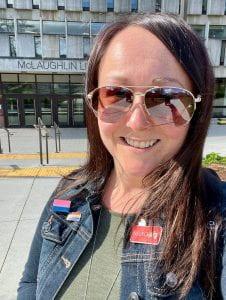
Hello, I am Lindsey Thomson (she/her) and I grew up in a working-class family in a small town in what is known today as Southern Ontario. I am a white settler and I currently live in Guelph, Ontario, treaty lands and territories of the Mississaugas of the Credit. I live with my partner CJ, our Scottish Terrier Kevin, and our 30-year-old turtle Toby. I am a femme-identified queer woman who is also late-discovered autistic. I enjoy trail walks with Kevin, checking out local coffee shops, and playing music as part of queer-led band @groundcoverband.
I have worked as the Manager of Community Engaged Teaching and Learning Program at the Community Engaged Scholarship Institute (CESI) at the University of Guelph. After over a decade of facilitating and supporting critical community engaged research partnerships, I decided to apply to the SOPR Program in hopes of returning to school to apply and expand upon my knowledge and passion for engaged research and the role it can play in social justice learning and action.
Overall, I aim to conduct collaborative research to engage diverse autistic femme communities in storytelling and photovoice methods to understand their unique, undervalued knowledges and lived experience. My research aims to expand understandings of autism, support diverse equity-seeking neurodivergent queer communities, and re-imagine and deeply align engaged research and community practice with disability justice principles. Additionally, I currently co-facilitate a Collective of neurodivergent/autistic researchers, artists, practitioners, and activists under the leadership of Dr. Patty Douglas, Queen’s University, and the Re-Storying Autism in Education Partnership. I also co-facilitate Rainbow Pride, a monthly virtual social and support group for queer autistic adults through the neurodivergent-led Dori Zener and Associates.
Ultimately, I view critical femininities and femme theory as having major potential to bridge critical autism studies, disability justice, and broader queer theory and movements while pushing back against colonial binaries, logics, and assumptions through centering historically marginalized femmes and related ways of knowing and being.