
Student Stories: Wen Jing (Savannah) Lesperance, Department of Animal Biosciences
Student Researcher Looks to Ease Cattle Gut Issues and Engage Industry in Innovative U of G Technology
Wen Jing (Savannah) Lesperance is one of more than 550 students each year who gain job-ready skills through Alliance research projects. As an ambassador at the Ontario Beef Research Centre, she develops communication and knowledge mobilization skills by sharing U of G research and technology with farmers.
Maintaining gut health can be a complicated balancing act – especially when dealing with four stomachs.
Department of Animal Biosciences master’s student Wen Jing (Savannah) Lesperance evaluates natural gut health supplements designed for finishing feedlot steers.
“We’re targeting the last phase of the production cycle before these animals go to market. It’s where you have a lot of muscle and fat deposition take place – or, really, the marbling on a steak,” says Lesperance, a researcher in U of G’s Ontario Agricultural College.
With that final production phase come a lot of gut issues due to a high-carbohydrate, grain-based diet for male cattle.
“Our hope with these supplements is that we can mitigate gut problems in a natural way,” says Lesperance. “Right now, the solution has been to use antibiotics. But with concerns over antibiotic resistance and consumer feedback, it’s something both the industry and producers are trying to step away from.”
Along with researching gut health, Lesperance and her co-investigators – including Dr. Katie Wood – are evaluating how the supplements impact the animals’ immune response and carcass characteristics.
Published: July 23, 2025
Lead photo: Lesperance at the Ontario Beef Research Centre., where research leads to improved growth and efficiency and productive, healthy herds.
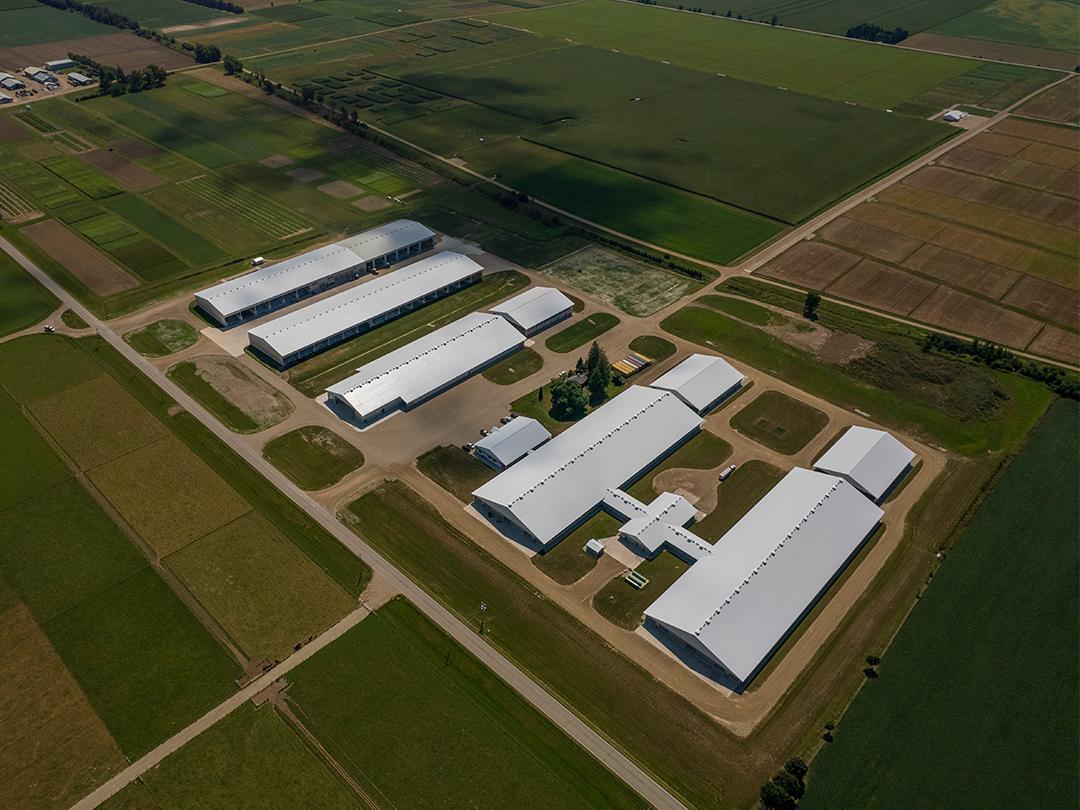
The Ontario Beef Research Centre is owned by the Government of Ontario through its agency Agricultural Research and Innovation Ontario (ARIO) and managed by the University of Guelph through the Ontario Agri-Food Innovation Alliance.

The next step, says Lesperance, is to move their research out of the Ontario Beef Research Centre in Elora, Ont., and into “real-world” scenarios on commercial beef farms.
Having promising results from research centre trials helps producers feel confident in testing new approaches on-farm.
“For me, the coolest part of animal nutrition is just how complex it all is,” says Lesperance. “If you feed a certain percentage of grain versus forage, you can completely change that steer’s gut ecosystem, how they’re growing and even how they deposit their energy.”
Finding her way to research
Studying animal nutrition was anything but a linear path for Lesperance. She started her career at the University of Guelph with twin passions for animals and veterinary medicine and became fascinated with a third-year animal nutrition course taught by Wood.
“I just knew I had to work with her,” says Lesperance. “I kept checking back in with Katie to see if she had any researcher positions available, and it eventually paid off.”
Bridging communication gaps: an ambassador’s role in mobilizing knowledge
After joining Wood’s research team, Lesperance became an ambassador and tour guide for the Ontario Beef Research Centre and the Ontario Dairy Research Centre.
“I’m a natural born yapper,” she says with a laugh. “So having the chance to explain agriculture, especially the research side of things, to people who may not know or understand what we do was exciting for me.”
Lesperance adds that she gets the greatest satisfaction out of showcasing to farmer groups how their investments in University of Guelph research are paying off.
“I think that’s the biggest reason why an ambassador program like this is so valuable,” she says. “Farmers aren’t always in the loop of where research and technology are headed – and that’s where I can come in and help bridge that gap.”
Now Lesperance has two career options: continuing her research in dairy and beef cattle nutrition or working with an animal feed and nutrition company.
Further reading
Wen Jing Lesperance on LinkedIn
This research is funded by the Ontario Agri-Food Innovation Alliance, a collaboration between the Government of Ontario and the University of Guelph. The Ontario Beef Research Centre is owned by the Government of Ontario, through its agency Agricultural Research and Innovation Ontario, and is managed by U of G through the Alliance.