Student stories: Dr. Anna Schwanke, Department of Animal Biosciences
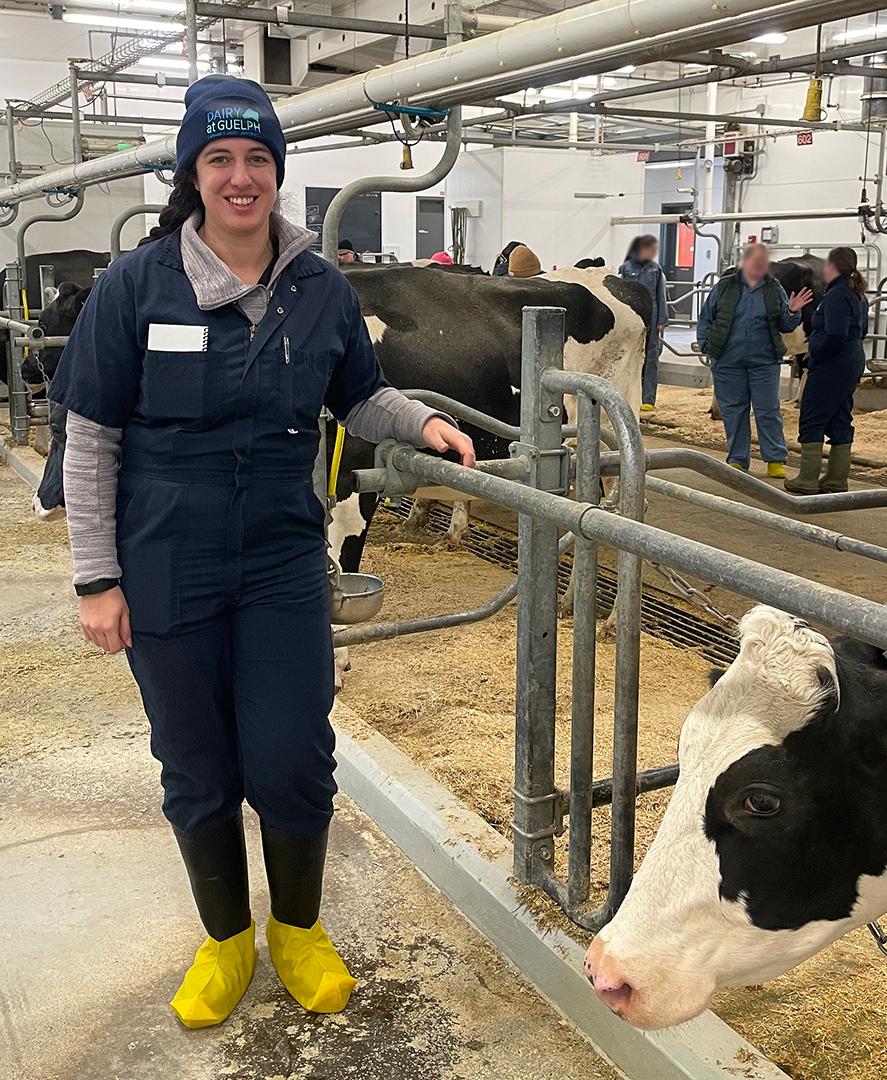
From PhD to dairy welfare program manager
U of G graduate brings research expertise and passion for communications to industry role
Schwanke will apply future-ready skills developed through Alliance-supported research and experience as a research centre ambassador to a Canadian dairy industry position.
Every cow has their own personality that informs how they react to management decisions, changes to their environment or unfamiliar humans.
Gaining a deeper understanding of those personalities could be a big step toward improving animal welfare, production and resource efficiency for Canadian dairy farmers.
Dr. Anna Schwanke, who earned a PhD in 2024 from the Department of Animal Biosciences at the University of Guelph, investigated how cow personality traits affect feeding and milking behaviour in automated (or robotic) milking systems.
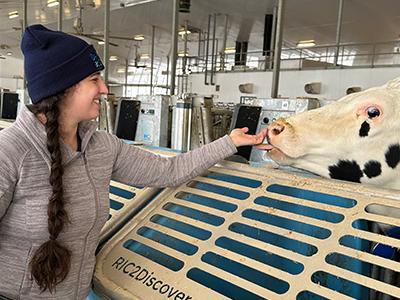
Working alongside Dr. Trevor DeVries, she scored cows for different personality traits such as “bold,” “explorative,” “active,” “fearful” and “social” based on how the animals responded to unfamiliar environments, objects and people.
“Cows will respond differently to management changes and decisions. What might work well for certain types of cows isn’t always great for other cows,” explains Schwanke.
She looked at how cows behaved when transitioning from a traditional milking parlour to an automated milking system. Animals with more “active” personality traits struggled with the change at first but ultimately adjusted far better than cows with less active personalities.
“Now we can guide a farmer. If they know they’re going to switch to a robotic system, they could pre-emptively cull cows from the herd or identify cows that might benefit from extra support or training on the robotic system,” says Schwanke.
Applying passion for science communications to ambassador role
After starting her graduate work in DeVries’s lab, Schwanke embraced the chance to become an ambassador at the Ontario Dairy Research Centre in Elora, Ont.
The Ontario Dairy Research Centre is owned by the Government of Ontario through its agency, Agricultural Research and Innovation Ontario (ARIO) and managed by the University of Guelph through the Ontario Agri-Food Innovation Alliance.
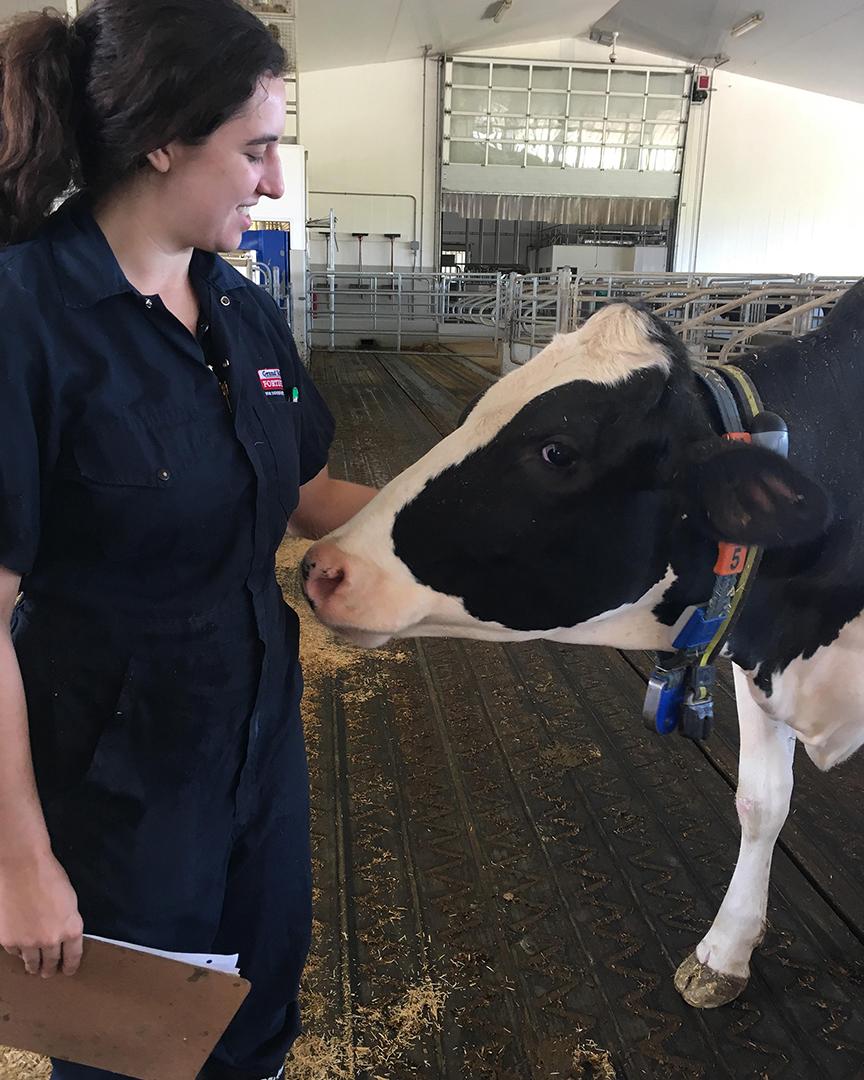
"I had always been really interested and passionate about science communications, so the ambassador program was a natural fit,” says Schwanke. “What also drew me in was the opportunity to spend a lot of time in the dairy barn, share about our research and showcase the great facilities.”
The ambassador role also gave Schwanke the opportunity to lead tours at the Ontario Beef Research Centre and to learn more about the beef sector in general. “I started by shadowing the beef ambassadors and asking lots of questions of them and fellow graduate students working on beef projects. Over time I became more comfortable leading tours of the beef facility and eventually training new student ambassadors there. Having that additional experience in another sector was definitely beneficial when I started searching for jobs. ”
Schwanke has discussed her work and the dairy research program as a whole with widely varied audiences.
“Most people who tour the barns have some tie to agriculture. Sometimes it’s government representatives or a 4-H group,” she says. “Getting people to see what we do and how it benefits the dairy industry as a whole is really rewarding for me.”
Moving from studies to the agri-food workforce
Schwanke recently became the manager of the Dairy Care Program within U of G’s Ontario Veterinary College. The program is funded by Saputo, one of Canada’s largest dairy processors.
“A big part of what I’ll be doing is communications. We’re going to have many stakeholders with different concepts of welfare, so my job will be to help put different management practices into context, like when calves are weaned or how cows are housed,” says Schwanke. “I’m excited to help show where the research is headed and how we’re constantly improving our understanding.”
This research was funded by the Natural Sciences and Engineering Research Council of Canada, Canada First Research Excellence Fund, and the Ontario Agri-Food Innovation Alliance, a collaboration between the Government of Ontario and the University of Guelph. The Ontario Dairy Research Centre is owned by the Government of Ontario through its agency, Agricultural Research and Innovation Ontario, and is managed by U of G through the Alliance.