Could Drone Seeding Solve a Key Ontario Crop Rotation Challenge?
Collaborative effort to develop new technology brings in academic and private sector input
University of Guelph researchers are collaborating with Corteva Agrisciences and the University of Waterloo to evaluate the feasibility of using drones to broadcast winter wheat into standing soybeans, addressing a key Eastern Ontario challenge where optimal wheat seeding dates often conflict with soybean harvest timing.
Dr. Joshua Nasielski, professor in the U of G Department of Plant Agriculture and Ian DeSchiffart, research technician, are answering questions about timing, seeding rates and establishment of drone-seeded winter wheat at the Ontario Crops Research Centre in Winchester. The research centre is owned by Agricultural Research and Innovation Ontario (ARIO) and managed by U of G through the Ontario Agri-Food Innovation Alliance—an ideal testing ground for new technology for Ontario’s field crop sector.
Drone seeding could address timing challenges
Nasielski says that while it’s important to keep winter wheat in rotation with corn and soybean, the optimum time for seeding winter wheat in some parts of Ontario is when soybean has not yet been harvested, creating a challenge for farmers.
At Winchester, about 50 kilometres south of Ottawa, the optimum planting date is September 20.
“Planting date is very, very important for high yields in corn and in wheat,” says Nasielski, noting that if farmers have to plant two or three weeks later, there’s nothing they can do to make up for the yield potential lost compared to an earlier planting date.
Published: April 7, 2026
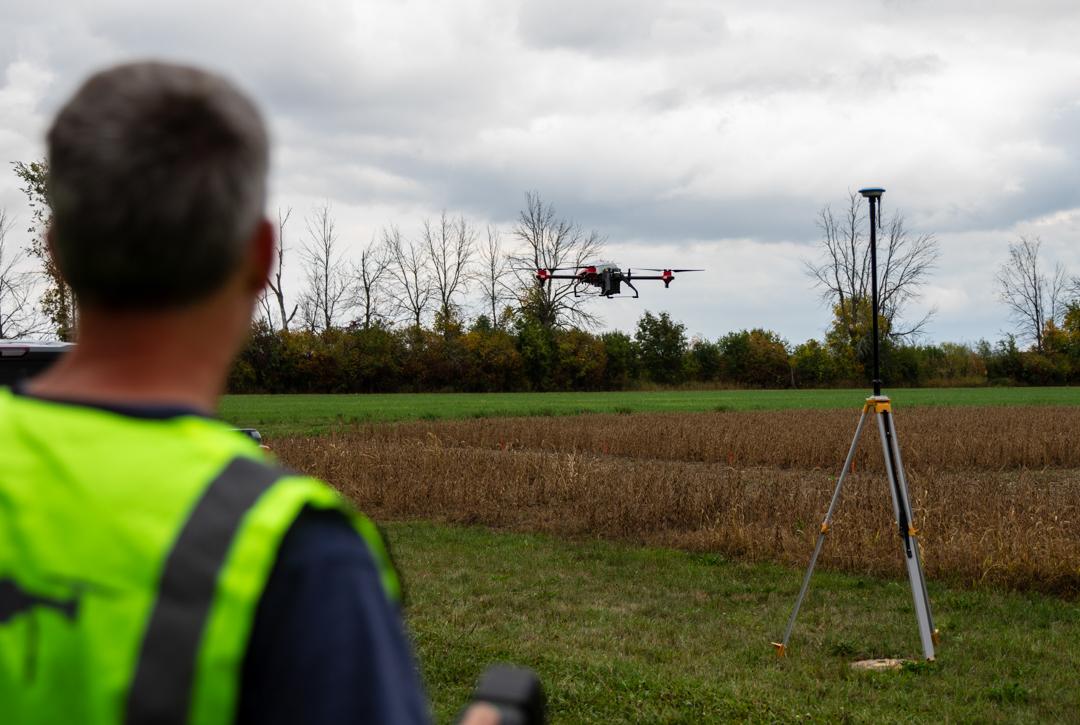
Lead photo: Research technician Ian DeSchiffart flies a drone at the Ontario Crops Research Centre in Winchester
“The reason we're interested in drones is because you could plant wheat whenever you want before soybean is harvested,” says Nasielski.
He explains that while broadcasting wheat into standing soybean isn’t new, the drone technology is what sets it apart from current available methods.
“The agronomy is very different,” he says. “What's the right seeding rate? When's the right planting date? You have to basically do an agronomy study.”

Field trials identify seed needs
DeSchiffart loading seed into the drone
Drone seeding is a broadcast method that can result in seeds being exposed to the elements
From worms moving seeds around to seeds drying out, the first two years of trials have identified some challenges.
DeSchiffart, who sought his advanced drone pilot’s license for this project, seeded untreated, uncoated winter wheat by drone in 2023, 2024 and 2025. The first two years, some seeds germinated but died because they lacked the water needed to germinate and establish.
Farmers normally seed winter wheat by drill and the strong seed-soil contact means seeds rarely fail to germinate. When broadcast from a drone, seeds land on the soil surface where they are exposed to sun and wind.
Drone seeding is a broadcast method that can result in seeds being exposed to the elements
Drone seeding can be patchy rather than consistent
To address that challenge, Nasielski brought University of Waterloo chemical engineering professor Dr. Tizazu Mekonnen on board. Mekonnen specializes in sustainable polymers, which can be developed into natural, biodegradable seed coatings that draw water into the seeds, buffering them against the elements and drawing in the water they need to germinate.
Together, they submitted a proposal to Corteva Agriscience’s Open Innovation program and were awarded funding for the project.
“The key challenge is seed coatings are always polymers: large molecules that can make films and coatings,” Mekonnen says. “They are synthetic by nature and they don't degrade in the soil or environment. If you use it as a coating, the seed will germinate and grow but the coating material stays in the soil and becomes microplastics.”
“Imagine if you are doing it every year, how much microplastic you are incorporating into the soil. It will eventually leach into our water system through rain and cause major ecological damage.”

For the trial, Mekonnen designed an innovative biopolymer seed coating to improve seed moisture retention—and therefore establishment—when wheat is surface applied by drone.
“The key challenge is seed coatings are always polymers: large molecules that can make films and coatings,” Mekonnen says. “They are synthetic by nature and they don't degrade in the soil or environment. If you use it as a coating, the seed will germinate and grow but the coating material stays in the soil and becomes microplastics.”
“Imagine if you are doing it every year, how much microplastic you are incorporating into the soil. It will eventually leach into our water system through rain and cause major ecological damage.”
Mekonnen’s solution starts with corn starch, a sustainable, biodegradable and bio-based product. “To make it into a coating and super absorbent material, we incorporated a functional group that likes to attract water and capture the seed within its system—like a sponge, says Mekonnen. “It is imitating what's happening with the synthetic system, but when the seed germinates, it is left behind, but very, very quickly degrades and assimilates with the soil with no negative impact on the environment.”

A bio-based seed coating developed in Mekonnen’s lab is designed to improve germination rates without negatively impacting the environment.
Bringing new areas of expertise to the lab – and the farm
To determine the optimal seed coating recipe, Mekonnen’s team-which includes a post-doctoral researcher and a PhD student-applied the biopolymer coating to bare (untreated, fungicide- and herbicide-free) seed at the U of W laboratory.
“We see the seed not as an agricultural item that can grow, but rather a chemical ingredient that you use in the lab,” says Mekonnen. “We were not familiar with the greenhouse seed growing environment until we came to see what Josh does.”
Nasielski and U of G post-doc Dr. Michael Gerbre grew out the biopolymer-coated seeds in a growth chamber and provided feedback to Mekonnen, around properties like coating thickness and water absorption, to implement in the next batch.
“We had to wait to see the results,” laughs Mekonnen. “Which we are not very familiar with in typical polymer research. We do our work and we have machines to evaluate what’s happening and get a very quick answer, usually.”

Seed sprouting test days 0 to 2

Seed sprouting test days 3 to 5
Early results are in
Each year DeSchiffart broadcasts the seed into plots that allow the team to compare different seeding times and rates.
A higher seeding rate is used with the drone compared to the drill.
“What surprised me is that establishment in the fall doesn’t compare to drill, it’s not uniform in a nice row. But every year in the spring, it fills out,” says DeSchiffart, noting that by spring some treatments achieve comparable yields to drilled wheat, or even higher yields with earlier seeding.
“When you broadcast, there might be fewer plants, but each plant is bigger,” says Nasielski, noting that soybean residue would need to be managed as well to ensure they don’t cause the wheat underneath it to die out.
The 2024 trial yielded slightly lower yields with broadcast seed versus drilling, but planting at the optimal time could lead to higher yields. Nasielski says this data is enough to warrant additional research.
Results from the 2025 trial using biopolymer-coated seed will be available in late summer 2026.
Should farmers switch to drone seeding?
While DeSchiffart says the drone broadcasting method is “pretty good”, he says that drilling still performs better, and notes that farmers with large fields (requiring more drone fill-ups) are unlikely to switch methods. However, both he and Nasielski think that might change if drone pesticide spraying becomes an option. “Once you have a drone that you’re using to spray, it’s not hard to change it so it can spread seed,” says Nasielski.
“There’s definitely something there, but it needs some fine-tuning,” he says. “Not in every farm or every management system, but I think there's certainly a place for this depending on the farmer.”

The Ontario Crops Research Centre sites, such as Winchester, are unique locations where the researchers can test different practices in real-world conditions, accelerating the adoption of innovation.
This project is funded, in part, by the Ontario Agri-Food Innovation Alliance, a collaboration between the Government of Ontario and the University of Guelph.