  • Undergraduate Studies
  • Graduate Studies
  • Fees, Funding & Scholarships
  • Student Resources
  • Academic Advising
  • Co-operative Education
  • Job Opportunities
  • Computer Science Clubs
Research
  • About Us
  • Contact Us
  • Our People
  • Alumni & Friends
  • News
  • Events
  • Computer Science Clubs
  • Teacher Resources
  • Go CODE Girl
Intranet
  1. U of G Homepage
  2. School of Computer Science
  3. Current Students

Academic Advising | SoCS

Academic Support – Academic Advising

The Undergraduate Academic Advisors for SOCS can provide information and advice regarding:

  • Course selection
  • Program guidance
  • Admission questions, such as transfer credits
  • Credit equivalencies for courses from other institutions
  • Clarification of rules, policies, and procedures
  • Continuation of study and probation questions
  • Course enrolment issues

Sarah Brennan and Greg Klotz are the SoCS Academic Advisors.

Contact them through cscouns@uoguelph.ca (Computer Science Counselling).

Jump to Section
  1. Course Selection
  2. Academic Support
  3. Academic Planning
  4. Areas of Emphasis
  5. How to declare an Area of Emphasis

New for 2026

CIS Course Changes:

Changes to CIS course offerings and/or prerequisites are coming. These changes take effect over the next few years. WebAdvisor will not immediately show these changes on your course plan until later. In some cases, you may need to remove and re-add them to your course plan after the changes take effect.

CIS prerequisites are mandatory for CIS courses. This is not a decision on our part as academic advisors. It applies to all students. This rule was decided on by SoCS Faculty with the goal of supporting students and to ensure they can be successful in their courses.

EffectiveCourseChange
Fall 2026CIS*2250Offered in the Fall semester only and requires both CIS*1250 and CIS*2500.
Fall 2026CIS*2750*

Offered in the Winter and Summer semester only.

Fall 2026CIS*3000

Introduced and offered in Fall semesters. Requires 4.0 CIS credits.

Fall 2026CIS*3050

Requires both CIS*3110 and CIS*2750.

Fall 2026CIS*3110*

Offered in the Winter and Summer semester only.

Fall 2026CIS*3150

Requires only CIS*3490.

Fall 2026CIS*3490*

Offered in the Winter and Summer semester only.

Fall 2026CIS*3700

Requires CIS*3490, STAT*2040 and MATH*1160.

Fall 2026CIS*3750

Requires 9.0 credits including CIS*2750.

Fall 2026CIS*3760

Requires CIS*2750, CIS*3110 and (CIS*3750 OR CIS*3250).

Fall 2026CIS*4020

Offered every Fall semester.

Fall 2026CIS*4030

Requires CIS*3110 and (CIS*3750 or CIS*3250).

Fall 2026CIS*4150

Requires 1 of CIS*3750, CIS*3250 or ENGG*4450.

Fall 2026CIS*4250

Requires CIS*3260.

Fall 2026CIS*4720

Offered every winter semester.

Fall 2026CIS*4780

Offered every winter semester and requires CIS*3700 or (MATH*1210, CIS*3490, and STAT*2050).

Fall 2026CIS*4800

Requires CIS*3110, MATH*1160, and (CIS*3750 or CIS*3250).

Fall 2026CIS*4820

Offered every winter semester and requires CIS*3110 and (CIS*3750 or CIS*3250).

Fall 2027CIS*3250

Requires CIS*2250 and CIS*2750.

Fall 2027CIS*4300

Requires CIS*2170 and (CIS*3760 or ENGG*4450).

Fall 2028CIS*3260

Requires CIS*3760 and CIS*3250.

*CIS*2750, CIS*3110 and CIS*3490 are planned to be offered in Summer 2026 at Guelph.

SENG Major:

Starting in Fall 2026, students admitted to Honours, Bachelor of Computing in the Software Engineering major will follow a revised Schedule of Studies. The changes include:

  • CIS*3750 is no longer a required course
  • CIS*4300 is no longer a required course
  • CIS*3000 is a required course
  • An additional CIS elective at the 4000 level is required

These changes do not impact SENG students on the 2025 calendar or earlier unless you apply to change your calendar year to 2026 and that request is approved. For students planning to switch from 2024 calendar or earlier, note that an Area of Emphasis is required for calendar changes to 2025 or later.

User Experience Area of Emphasis Update:

Effective May 2026, CIS*4030 (Mobile Computing) has been added to the User Experience Area of Emphasis as one of the optional 0.5 CIS credits from a list. Students with this AoE can now select either CIS*3530, CIS*3700, CIS*4020, CIS*4820 or CIS*4030 to fulfill that requirement.


2025 Changes

Area of Emphasis:

Starting in Fall 2025, students admitted to Honours, Bachelor of Computing (Computer Science or Software Engineering majors) are required to complete an Area of Emphasis in order to graduate.

Credit weight change affecting all students, including ones on previous calendar years:

Effective Summer 2025, CIS*2170, CIS*2750, CIS*3750 and CIS*3760 are worth 0.5 credits instead of .75. If you have planned these courses on WebAdvisor for future semesters, you may need to remove and re-add them to see the new credit weight.

Course Selection Information

The required courses in fall and winter are clear. Please start by registering in them first. Declare a planned Area of Emphasis [AoE]. It is possible to change this later, but changes beyond first year may delay graduation. You will likely be able to take one AoE course in the fall and one in the winter. Your other electives can be any course you can register in on WebAdvisor. These are general interest electives in subjects you are interested in. At most 6.0 credits at the 1000 level count, don't go beyond that. You are welcome to take more AoE courses in first year if possible. That would move your general electives to later.

CIS pre-requisites are mandatory for CIS courses. This is not a decision on our part as academic advisors. It applies to all students. This rule was decided on by SoCS Faculty with the goal of supporting students and to ensure they can be successful in their courses.

Add yourself to the waitlist. If the course is required try to select a shorter wait list section. For an elective the same approach but consider a different elective in the meantime. For required CIS courses do your best to register in an available section rather than waitlisting.

For restricted courses you may need to declare a minor or Area of Emphasis (beginning with 2025 calendar years) if not having the specialization formally declared is preventing you from registering. You can also try emailing the course contact with details explaining you need the course. First year restrictions are not bypassed, they are scheduled to be removed in the afternoon of July 23. Check for other sections. Many courses have multiple lecture and lab sections, one may have space. Do add a different course while you wait.

With the introduction of wait lists there is no option for us to register students beyond the capacity. Please add yourself to the wait list. Check for other sections first. Many courses have multiple lecture and lab sections, one may have space.

If the next semester will be your last semester and you need to take more than five courses please email us with the details.

Otherwise please email us about why you would like to take more than five courses a month before those courses start for your request to be considered. In this case students need at least a 70% average for the semester overload to be considered.

  • When can I start registering? Course selection windows.
  • The waiver process for non-CIS courses.
  • Contacts for non-CIS course waivers.

Academic Planning

The order in which you take your courses is critical, so you need to use both Student Planning AND your Schedule of Studies (described below) to plan your courses. While Student Planning gives you a list of the required courses, it does not always indicate the order to take them; for that you also need to use your Schedule of Studies.

The list and order of courses you must take for your major is called your Schedule of Studies. Your Schedule is based upon your Undergraduate Calendar Year, so it is important to confirm your Calendar Year first. Note: if you follow the incorrect Calendar Year, you could be taking the wrong courses and delaying your graduation.

Follow the steps below to find your Calendar Year.

  1. Login to WebAdvisor and select ’Student Planning Overview’.

  2. Select ‘Go to My Progress’. On the top left of ’At a Glance’ you will see ‘Calendar’. The year listed indicates your Calendar Year, e.g., 2026 means that you will follow the 2026-2027 Academic Calendar.

  3. Once you know your Calendar Year, select it from the following list (this link will take you to the Undergraduate Calendar):

    • 2026

    • 2025

    • 2024

    • 2023

    • 2022

  4. From the "Areas of Study" tab, select your Major from the list (if you are in Co-op, be sure to select the Co-op major). Here you will find all the courses required for your degree program in semester order.

The Undergraduate Calendar lists the courses offered by all units on campus and contains the recommended schedule of studies for the Bachelor of Computing program. The schedule of studies is important, and you should plan your schedule early and follow it.

Course prerequisites are described in the calendar. The prerequisites for a course must be completed before you can register in that course. Dropping or failing a course may limit the courses in which you can register in the following semesters because the dropped/failed course is a prerequisite for later courses. If you need to deviate from the schedule of studies due to failing or dropping a course, then you should contact the SOCS Counsellor for help in planning your new schedule of studies.

Information for each CIS course you are registered in, such as course outlines, lecture notes, assignment information, and grades appears on either the University Courselink system or on the SOCS Moodle server. The course instructor will tell you which server is appropriate for the course.

Beginning in Summer 2025, all computing courses are worth 0.5 credits.

When registering for a semester you should look at the recommended courses in the calendar. The schedules are listed in section X. Degree Programs under the Bachelor of Computing (B.Comp.). There are different schedules of study for the major in Computer Science and the major in Software Engineering. The majors with Co-op have their own schedule of study which is also listed on this page. It is important that you register for the courses that are listed in the schedule of studies as they are all required to complete your degree. There will normally be some credits in each semester that can be taken in your Area of Emphasis (2025 onward), Area of Application (2024 or earlier), or as electives. It is a good idea to start taking your Area of Emphasis or Area of Application courses as soon as possible.

All courses have a course code which usually looks something like this CIS*1300 and may sometimes look like this CIS*1300*0102. The first three or four letters indicate the discipline. All Computing courses begin with CIS. The next four numbers after the asterisk are the number of the course. Numbers that begin with a 1 are usually first year courses and those that begin with a 4 are normally fourth year courses. If there is a second asterisk and numbers at the end of the course code, then that is the lecture and lab section number of the course. In the CIS*1300*0102 example the 0102 indicates lecture section one of the course and lab section two. When a course has multiple lab times it will usually have a different section for each lab.

Starting in Fall 2025, students admitted to Honours, Bachelor of Computing (Computer Science or Software Engineering majors) are required to complete an Area of Emphasis in order to graduate.

Students must choose between one of four Areas of Emphasis:

  • Data Science
    • The Data Science Area of Emphasis focuses on the analysis and interpretation of large data sets to solve real-world problems. Students will learn data analysis, visualization, and machine learning techniques.
  • User Experience (UX)
    • The User Experience Area of Emphasis is a study of user-centered design. Students will learn how to conduct research to understand user needs related to technology design, and learn to design, build and test interactive prototypes to validate their ideas.
  • Cybersecurity
    • The Cybersecurity Area of Emphasis equips students with the skills to protect computer systems and networks from cyber threats. Students will learn to identify security risks, implement cryptographic techniques, and design secure systems.
  • Artificial Intelligence
    • The AI Area of Emphasis focuses on teaching students how to design and build systems that can learn, reason, and solve problems like humans. Students will learn key AI techniques such as machine learning and neural networks. They will also explore the ethical implications of AI in society.

The Area of Emphasis must be declared using the Schedule of Studies Change Request form. It is recommended to declare your Area of Emphasis prior to the start of first year course selection to ensure sufficient time to complete the required courses within the regular Schedule of Studies.

Students who were admitted and started their degree prior to Fall 2025 are not eligible to declare an Area of Emphasis. Students in earlier calendar years may switch to the new calendar year but it is strongly recommended to check in with your Academic Advisor to discuss the impacts of this change.

Students registered in Honours, Bachelor of Computing with a calendar year of 2024/25 or earlier must complete an Area of Application as part their degree requirements. The AoA is described in the calendar, but it primarily consists of 4.0 credits from a discipline other than Computer Science with 1.0 of those credits being at the 3000 level or above. You should pick the area in which you wish to study from those described in the Undergraduate Calendar. If you are unsure which courses to take then look at the minors offered to see what courses they recommend. Some disciplines that have traditionally been popular AoA’s for Computer Science students are Business, Psychology, Economics, Mathematics, Statistics, and Project Management.

It is important to choose an Area of Application in your first year and begin taking the courses necessary to complete it. If you do not do this then you may not be able to complete your AoA requirements on time which can delay your graduation. Taking too many courses from different areas in your first year may limit your ability to complete the AoA on time. It is a good idea to plan which courses you will take for the AoA for each semester of your degree.

Minors typically consist of 5.0 credits (usually 10 courses) you take over your 8 academic semesters. Minors give a good foundation and introduction to the subject. They also go on your transcript, and are an officially recognized credential.

Most Minors are available to students enrolled in Honours, Bachelor of Computing. The Mathematical Science (MSCI) and Computing and Information Science (CIS) minors are not available for the Bachelor of Computing degree.

Each Minor requires the completion of specific courses. You can find the lists of minors and the courses they require described in the Undergraduate Calendar under Areas of Study. A minor may include additional prerequisite courses not included in the minor, so it is best to plan your courses ahead of time.

If you wish to pursue a Minor, you need to declare it as part of your program using the Schedule of Studies Change Request form.

It isn’t unusual for students to decide they would like to change their major after they have been here for a few semesters.

To change majors within Computing, please see details in the Academic Calendar.

To change degrees, it is an Internal Transfer through Admission Services.

The Bachelor of Computing Program describes the requirements that are necessary to get a Bachelor of Computing Degree. There is an honours degree which normally requires four years to complete, honours with Co-op which normally requires five years to complete, and a general degree which usually requires three years to complete.

In the honours program there are two majors. One is in Computer Science and the other is in Software Engineering. Both of these majors have a Co-op option. The general program does not have majors, minors, or a Co-op option.

If you are having problems in a course, then you should talk to the instructor first. In many cases the instructor can help deal with the problem if it is addressed early. If you wait until a course is over or it is late in the semester before identifying a problem, then it can be too late for the instructor to anything to help manage it.

Types of problems that students commonly encounter are: difficulties with group interactions; missing several assignments, tests, or labs due to illness; difficulties with labs or teaching assistants; and problems with marking.

If you are having difficulties with the instructor of a course, then you can discuss these concerns with the Associate Director Undergraduate (ugraddir@socs.uoguelph.ca).

Failing or dropping a course is not the end of the world. Talk to the SoCS Academic Advisors to find out what options are available to you if you want to drop or you fail a course.

AoEs

For students in the 2025 academic calendar year onward, an Area of Emphasis is required. It is recommended to declare your Area of Emphasis prior to the start of first year course selection to ensure sufficient time to complete the required courses within the regular Schedule of Studies.

We recommend all students plan out their degree requirements on WebAdvisor. Please see here for how to create a plan on WebAdvisor: video or PDF

Some of the Areas of Emphasis have more options than others. You will need to customize your plan details based on your interests, your major, and whether you are in Co-op or not. Some important course planning considerations for each Area of Emphasis can be found below.
The Area of Emphasis must be declared using the Schedule of Studies Change Request form. It is recommended to declare your Area of Emphasis prior to the start of first year course selection to ensure sufficient time to complete the required courses within the regular Schedule of Studies.

Students who were admitted and started their degree prior to Fall 2025 are not eligible to declare an Area of Emphasis unless they switch to the new calendar year. It is recommended to check in with your Academic Advisor to discuss the impacts of this change.

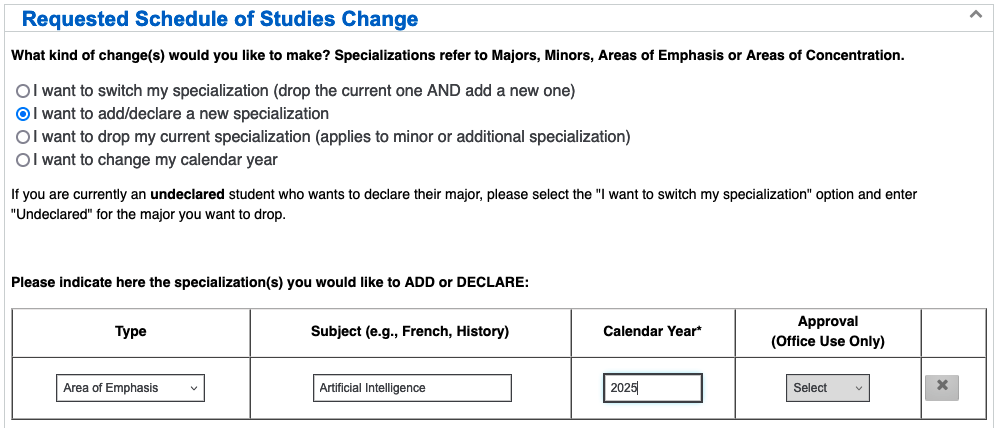
If you started in 2025 or later please declare your AoE as shown in this screenshot:

Schedule of Studies change form with Type: Area of Emphasis, Subject: the chosen area of emphasis, Calendar Year: 2025

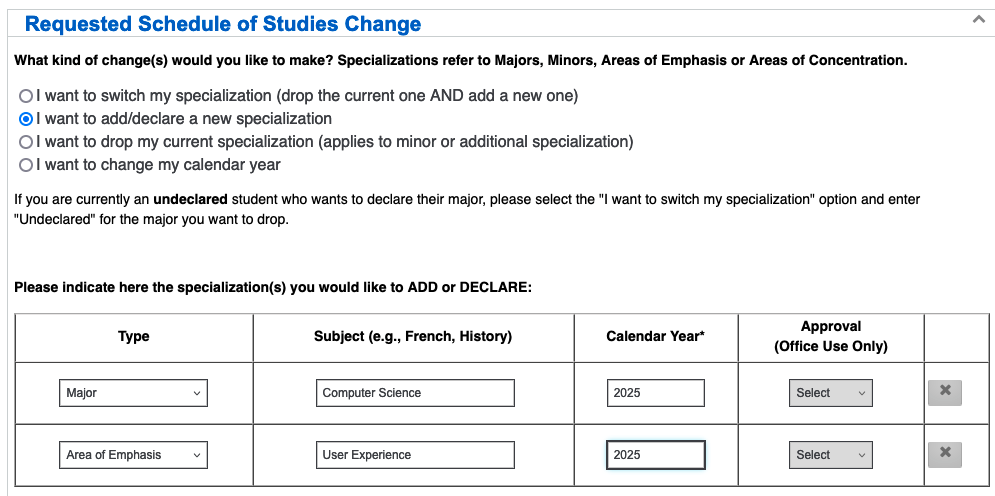
If you started in 2024 or earlier and you would like to declare an AoE, please declare your AoE as shown in this screenshot. You will be changing your calendar year to the new requirements including an extra 3rd year CIS elective and declaring the AoE. This does not change your Co-op sequence. You must enter 2025 as the calendar year on the form.

A Schedule of Studies Change Form with First line: Type:Major, Subject: CS or SENG, Calendar Year:2025. Second line: Type: Area of Emphasis, Subject: your chosen AoE, Calendary Year: 2025

  • CIS*4300 will require CIS*2170 starting in Fall 2027
  • Effective May 2026, CIS*4030 (Mobile Computing) has been added to the User Experience Area of Emphasis as one of the optional 0.5 CIS credits from a list
  • It is recommended to take STAT*2040 and STAT*2050 in first year if you are enrolled in the Co-op program and began your studies on an odd calendar year (e.g., Fall 2025, Fall 2027, etc.)
  • STAT*3210 is offered in the Fall of even years only and requires STAT*2050 as a pre-requisite
  • SENG majors need to take MATH*1200/MATH*1080 as an elective in order to have the pre-rerequistes for MATH*1210
  • CIS*3210 and CIS*4510 are both only offered in the Fall semester. CIS*3210 is a pre-requiste for CIS*4510
  • MATH*3130 is offered in Fall of even years only. It is recommended to take in the Fall of your second year if you are in Co-op and you began your studies in an odd year (e.g., Fall 2025, Fall 2027, etc.)
  • SENG majors need to take MATH*1200/MATH*1080 as an elective in order to have the pre-rerequistes for MATH*1210

College of Computational, Mathematical and Physical Sciences School of Computer Science logo.

About

The University of Guelph's School of Computer Science (SOCS), instituted in 1971, has a long history of interdisciplinary, cutting-edge research and providing hands-on learning experiences to our students.

Contact

School of Computer Science
Reynolds Building
University of Guelph
474 Gordon St.
Guelph ON, Canada N1G 1Y4

Social Media

Instagram

Twitter

Facebook