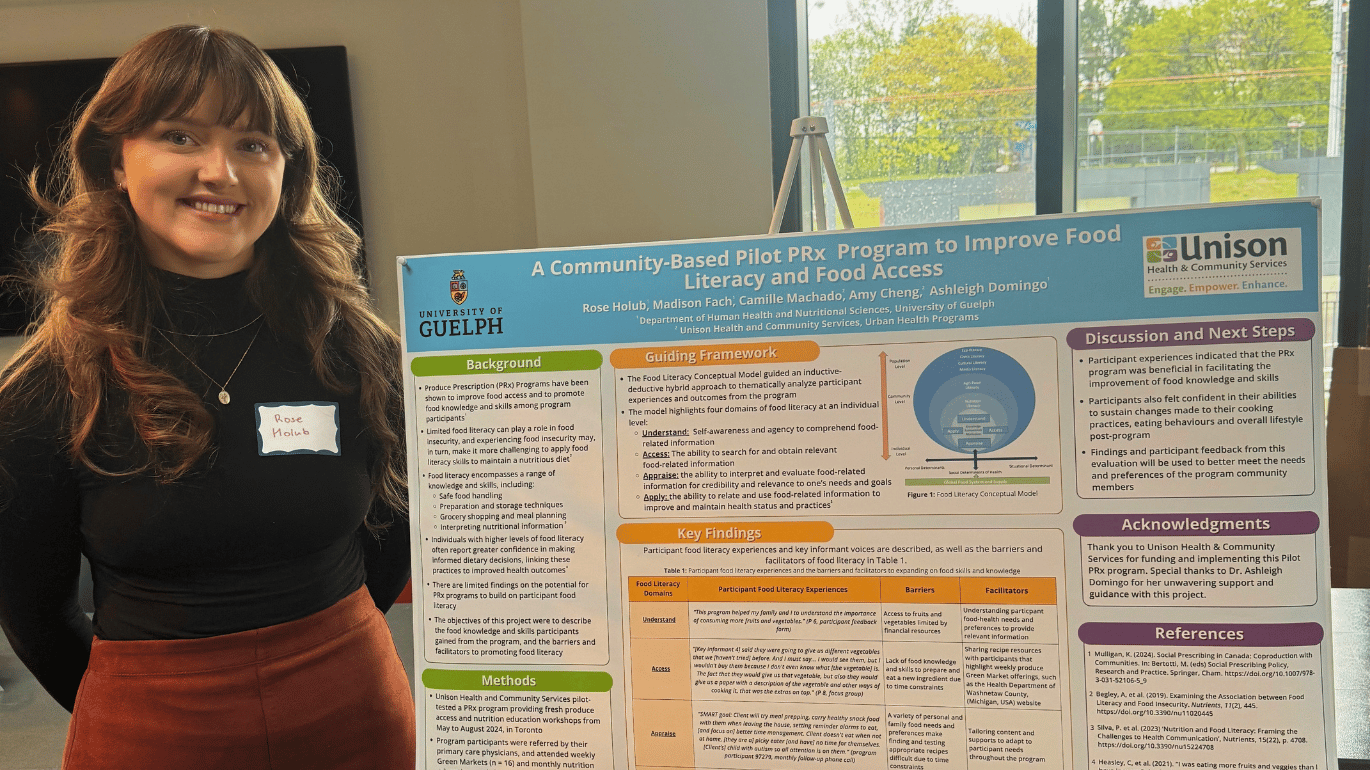

Choosing Applied Human Nutrition (AHN) at the University of Guelph felt like the natural choice for my academic and career ambitions. With my sights set on becoming a registered dietitian, I chose the Area of Emphasis in Dietetics. This allowed me to learn more about the varied field of nutrition and dietetics and provided me with multiple professional development opportunities.
The Deeper Meaning of Nutrition
Growing up, my family always made an effort to involve me in the kitchen. As food connects people, I found joy in building community around cooking, trying new cuisines, and sharing my passion with others.
Over time, my appreciation for cooking, health and wellbeing has translated into a fascination for nutrition. Nutrition looks different for everyone, but for me, it means fueling your body adequately with food readily available to you. I appreciate that during the AHN program, we were encouraged to think critically about how different lifestyles, diseases, and overall social determinants of health impact what, how, and why Canadians eat.
Bringing Course Learnings to Life

Opportunities to apply what I was learning in class through real-world settings helped me to further my learning and deepen my understanding of the need for dietitians in many different areas of practice. Through Guelph’s vibrant food security and nutritionally minded community, I was able to explore my various interests relating to food and nutrition. For example, working alongside the Student-driven Engagement in Educational Design (SEED) Grant, a program run out of the Guelph Community Health Centre focused on removing barriers to health and wellbeing, while volunteering with the U of G Food Market piqued my interest in community-based approaches to food security. I then learned more about food provision and community work through volunteering with Community Food Equity with Dignity (FEWD), a program that reduces food waste by turning surplus food into free and nutritious meals weekly.
My curiosity for food security grew when I took the Food Security course, where we explored the historical context of Canada’s food system, the progression of food insecurity, and current strategies in place to mitigate malnutrition. From this class, I had a clearer picture of how I could apply my education in a variety of different food security-focused settings, such as community health teams, non-profit organizations, or within government.
Before entering my fourth year, I was put in contact with Dr. Ashleigh Domingo, an Assistant Professor in the Department of Human Health Sciences. Under her outstanding mentorship, I completed two thesis courses, evaluating the process and outcomes of a pilot produce prescription program (PRx) based out of a Toronto community health centre.
Produce prescription programs are emerging as an approach to support food access and food literacy education by providing a combination of free fresh produce and nutrition education. My evaluation looked at the program’s preliminary impact on increasing confidence in preparing and trying new foods and achieving SMART health and nutrition goals. Hearing positive feedback from participants was very motivating. Unexpectedly, many mentioned how the program helped them to build community, walking away with new friendships and support.
As this was my first practical research experience, I had a lot to learn. Due to the independent and asynchronous nature of the courses, setting deadlines, navigating roadblocks, and balancing multiple priorities became very important. However, I was grateful to feel consistently supported by Dr. Domingo and was thrilled to take part in the data collection and analysis process.
This opportunity resulted in two poster presentations at a Community Engagement in Research Day hosted by Northwestern Toronto Ontario Health Team (2025) and the Canadian Public Health 2026 Conference in March, an experience that I still talk about to this day. Networking is so beneficial to a nutrition student’s professional development, and during this experience, I worked with students from a variety of different nutrition and public health-related backgrounds. Hearing their unique perspectives on this work assisted with our interpretation of the data and broadened my understanding of food security and food literacy.
A Foundation for My Future
Reflecting on my academic journey, I am proud of the skills that I have developed. Through the AHN program and other associated opportunities, I have grown more confident in my leadership skills. Public speaking was never something I looked forward to, but now I can approach a talk, presentation, or more casual one-on-one conversation with confidence and excitement.
My time at the University of Guelph will always hold a special place in my heart. From the campus community, to the unique and encouraging learning environment, and of course, the incredible food, I feel proud to call myself a Gryphon. I am excited to put my skills to the test as I move on to the next chapter in my academic career by pursuing a master's in dietetics and look forward to sharing my nutritional knowledge with others in hopes of making eating a balanced diet more accessible for my future clients.