
GFIC Partners with Index Biosystems on Sanitation Validation Technology
When Toronto-based bio-tech company Index Biosystems wanted to expand its BioTags® food safety technology to a new food product, they needed to validate the new use under real processing conditions—beyond the lab bench.
Their next move? Partnering with the Guelph Food Innovation Centre (GFIC) at the University of Guelph.
GFIC is an applied research centre that uses food science and technology to help agri-food businesses develop and advance new products. The centre acts a bridge between new innovations and fully validated solutions to real-world challenges.
The centre’s recent collaboration with Index Biosystems shows just how valuable that bridge can be—not only for advancing new food safety innovations, but also for supporting the food processing industry as a whole and training students with valuable, hands-on industry experience.
At the heart of this success story is Index Biosystems’ new BioTags technology.
BioTags are microscopic, DNA-based tracers made from inactive baker’s yeast. They’re designed to be introduced into industrial food production systems (and equipment), and act as harmless proxies for contaminants to help evaluate cleaning and sanitation processes.
While traditional food safety tools are effective at alerting when something has gone wrong, they don’t always provide the full picture. In other words, they can’t show how contamination travelled, or what parts of a food processing system might be carrying hidden risks.
BioTags are designed to close that gap, helping users simulate contamination pathways and see how material moves through complex production systems proactively—before a major incident takes place.
“Typically, when there’s a food safety issue, the response is reactive. That can mean trace-backs, far-ranging recalls, and multiple investigative cycles over months, in part because there aren’t tools that let food safety professionals stress test multiple hypotheses at the same time,” explains David Singer, Index Biosystems’ co-founder and VP of sales. “BioTags can expedite root cause when something does go wrong—and more importantly, proactively identify vulnerabilities and potential contamination pathways so teams can take action before they become crises.”
“There’s really no limit to how often and where BioTags can be used, so you can continuously build data that helps drive food safety improvements at your facility,” he adds.
Published: April 7, 2026
Lead photo: A spray dryer at the Guelph Food Innovation Centre (GFIC)
Putting BioTags to the test under industrial conditions
Index Biosystems was interested in expanding the use of BioTags to dried food production, with a focus on powdered milk. To reach this new market, they needed to validate their technology in a pilot-scale facility that mirrored real dairy processing conditions.
Singer says that validating sanitation in low-moisture production is particularly challenging, while the stakes couldn’t be higher in products like infant formula.
A major benefit of working with GFIC is that they have small-scale, food-grade production facilities, including a spray drying system.
Spray drying is used to convert liquid milk into powder, a process that involves exposing product to high pressure and temperature as milk is atomized through a fine nozzle into hot air within a drying chamber.
BioTags were added to liquid milk at extremely low concentrations before running the spray drying process. The GFIC team wanted to determine two things: first, whether the BioTags could survive the severe conditions of spray drying, and second if the tags could still be detected after standard cleaning-in-place (CIP) procedures were performed.
Detection was carried out using PCR (polymerase chain reaction), a highly sensitive DNA analysis method at the Canadian Research Institute for Food Safety (CRIFS) at the University of Guelph. This provided independent, high-sensitivity detection, allowing any remaining BioTags on equipment surfaces after cleaning to be quickly and precisely identified.
The results of GFIC’s testing demonstrated that the BioTags could withstand harsh industrial processing conditions and remain detectable, validating their potential as a powerful food safety tool.
“Being able to conduct this work in a pilot plant environment was critical. Companies can’t simply approach commercial manufacturers and request production downtime to test new validation technologies,” says GFIC manager Nataly Lopez Baron. “GFIC fills that gap between benchtop research and full industrial production with our facilities and by providing deep technical expertise to ensure all trials take place under realistic and industry-relevant conditions.”
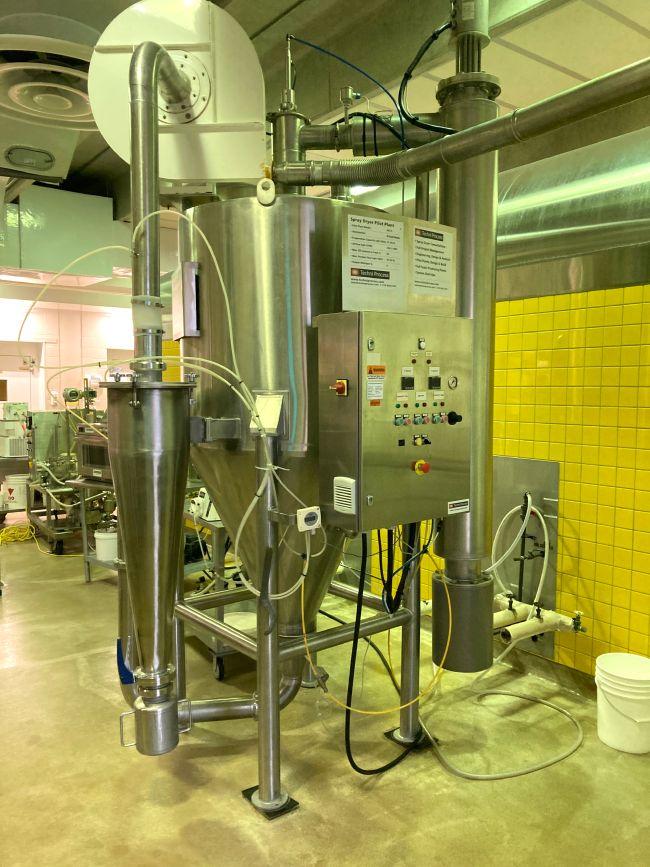
A spray dryer at the GFIC
Transforming student learning through real-world projects
Another powerful outcome of the collaboration between GFIC and its commercial partners like Index Biosystems lies in student development.
“I think that is one of the most beautiful parts of the story,” says Lopez Baron. “The students have that opportunity to go and see real industrial processes. They can interact with the entrepreneurs and understand their challenges. It’s a game changer and there’s no other facility quite like GFIC out there.”
According to Lopez Baron, GFIC integrates a great deal of experiential learning into each of its projects. For instance, through their BioTags validation work, Department of Food Science co-op students gained exposure to milk spray drying operations, cleaning-in-place protocols and a whole host of advanced food safety validation techniques.
Unlike hypothetical, classroom-based scenarios, projects like the BioTags validation require students to generate meaningful, defensible results that a company can use to prove commercial value.
“Through working with GFIC, we have a strong dataset that’s generalizable and shows BioTags’ efficacy across low-moisture food production systems,” adds Singer. “GFIC’s expertise and professionalism got us to this point, and we’re excited to continue this partnership as we look to expand use cases for our technology.”
The GFIC receives funding through the Ontario Agri-Food Innovation Alliance, a collaboration between the Government of Ontario and the University of Guelph.