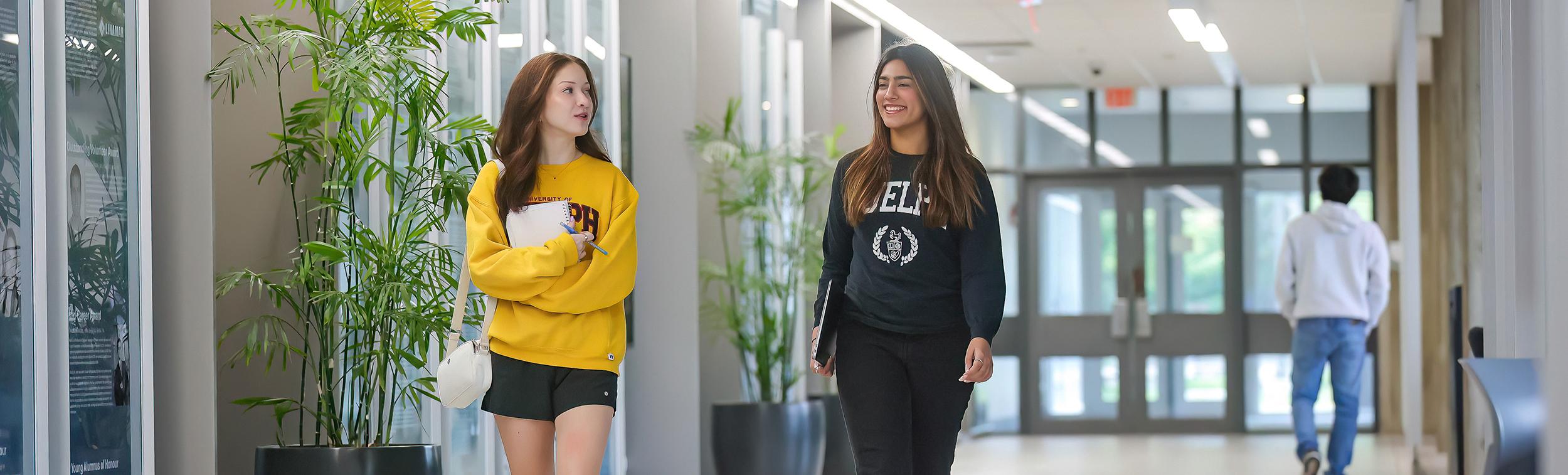
Get ready for an exciting journey into engineering at Guelph!
Our programs are designed to inspire and challenge you, providing an engaging learning experience every step of the way. As you begin your first year, we’re here to ensure you have everything you need to succeed. Check out the information below to kickstart your engineering adventure!
Our team of Academic Advisors is here to support your smooth transition from high school to the Guelph Engineering program. The Engineering Counselling Office is dedicated to assisting you with both academic and personal challenges that may impact your studies. Don’t hesitate to reach out for guidance and support at any time.
Engineering Academic Advising Office (Located in the hallway beside the Adams Atrium in Thornbrough Building) Albert A. Thornbrough Building Reception Office - THRN 1401 50 Stone Road East, Guelph Ontario N1G 2W1 519-824-4120 ext. 52436 engcouns@uoguelph.ca
The Academic Calendar outlines all your courses (both required and elective) to graduate with your degree. On a regular basis, you should review the calendar information for your major to ensure you are on track to graduate.
As an incoming first-year engineering student, your curriculum for both the Fall and Winter semesters has already been selected. You will be automatically registered in your courses during the week of June 8. You should review your registered courses prior to September. It should be consistent with your program course requirements as noted below.
If you wish to adjust your timetable (e.g., selecting different lecture or lab sections), you may do so based on availability using WebAdvisor. Refer to the Student Registration Handbook to review how to make changes to your course registration if needed. Be cautious about making changes to your course sections as space is limited and putting yourself on a waitlist does not guarantee you access to that section.
The courses for your first semester, are the following:
PROGRAM
#1
#2
#3
#4
#5
Biological
ENGG*1100
MATH*1200
PHYS*1130
CHEM*1040
ENGG*1500
Biomedical
ENGG*1100
MATH*1200
PHYS*1130
CHEM*1040
ENGG*1500
Civil
ENGG*1100
MATH*1200
PHYS*1130
CHEM*1040
ENGG*1500
Computer
ENGG*1100
MATH*1200
PHYS*1130
CHEM*1140
ENGG*1410
Systems and Computing
ENGG*1100
MATH*1200
PHYS*1130
CHEM*1140
ENGG*1410
Mechanical
ENGG*1100
MATH*1200
PHYS*1130
CHEM*1140
CIS*1500
Mechatronics
ENGG*1100
MATH*1200
PHYS*1130
CHEM*1140
ENGG*1410
Environmental
ENGG*1100
MATH*1200
PHYS*1130
CHEM*1040
ENGG*1500
Water Resources
ENGG*1100
MATH*1200
PHYS*1130
CHEM*1040
ENGG*1500
The courses for your second semester (Winter), are the following:
PROGRAM
#1
#2
#3
#4
#5
Biological
ENGG*1210
MATH*1210
PHYS*1010
CHEM*1050
CIS*1500
Biomedical
ENGG*1210
MATH*1210
PHYS*1010
CHEM*1050
CIS*1500
Civil
ENGG*1100
MATH*1200
PHYS*1130
CHEM*1040
ENGG*1500
Computer
ENGG*1210
MATH*1210
PHYS*1010
ENGG*1500
ENGG*1420
Systems and Computing
ENGG*1210
MATH*1210
PHYS*1010
ENGG*1500
ENGG*1420
Mechanical
ENGG*1210
MATH*1210
PHYS*1010
ENGG*1500
ENGG*2120
Mechatronics
ENGG*1210
MATH*1210
PHYS*1010
ENGG*1500
ENGG*2120
Environmental
ENGG*1210
MATH*1210
PHYS*1010
CHEM*1050
CIS*1500
Water Resources
ENGG*1210
MATH*1210
PHYS*1010
CHEM*1050
CIS*1500
During your degree, you'll use a wide variety of specialized software packages for design, simulation, and analysis. To access this software, the School of Engineering has ten computer labs with a total of 425 computers which are loaded with everything you'll need to complete your coursework. All students have 24/7 access to computer labs using their student card so you will be able to do your work at whatever time suits your schedule.
If you have more questions about the computer labs, the software you will use, or purchasing a laptop, please feel free to contact the Engineering IT help desk and they'll do their best to help you out. Computing and Communication Services provides IT services to the University of Guelph community. They have an IT support page for undergraduate students. This page provides useful information on network services, IT support and software available on campus.
Spring Academic Open House - Each year, the Future Gryphon Days Open House in May offers an exciting chance for students and their families to explore what Guelph Engineering has to offer. Get valuable insights on transitioning from high school to university and discover the academic and student support resources available to help you thrive. Don’t miss out—attend this open house to get ready for the fall and ask all your burning questions!
Orientation Week - Academic related events planned for orientation week will be updated in the summer.
Accessibility Services - Student Accessiblity Services (SAS) helps students who experience disabilities with full and equitable participation in academic life. You need to apply to Student Accessibility Services to access support and accomodations. More information can be found here: Student Accessibility Services
Mathematics and Statistics Learning Centre - If you find you are struggling with Calculus or Algebra, the Library operates a drop in centre staffed by Teaching Assistants. More information can be found here: Math and Stats Learning Centre
Academic Coaching - The transition from high school to university can be difficult especially for those who don't have strong study skills. Resources and workshops offered through the library can support students in academic skill development. More information can be found here: Library Study Resources and Workshops
Engineering Peer Helpers are experienced engineering students providing help to their peers. They offer drop-in and by-appointment study groups to help you develop your problem-solving skills. More information can be found here: Engineering Peer Helpers
International Student Advising (ISA) - The ISA provides advising to international students about housing, academic concerns, immigration, financial difficulties and culture shock. More information can be found here: International Student Advising
You can expect your courses will take you about 50 to 60 hours per week. This work includes attending classes, completing assignments and preparing for tests. You will have midterm exams to help you identify how well you understand the courses. Lectures are usually three hours per week and taught by our faculty. Seminars allow you to ask questions to Teaching Assistants. Labs provide an opportunity for group work and provide a hands on learning component to the course.
It is important to keep up with the coursework starting in the first week as it can quickly move from review into new material. University courses move much quicker than high school courses and the expectations are much higher. If you don't have strong study skills coming out of high school, now is the time to develop them. The library has excellent resources to help you: Effective Studying Resources. Developing a study group with peers can also be an effective way to keep yourself accountable and help you learn from each other.
Final exams for the fall semester run for two weeks. Your exams dates are scheduled at the start of the semester. As the exam period can be stressful for many, it is best to start planning your exam studying well before the exam period starts. There are many resources available through the library to help you prepare for writing exams: Exam Prep Resources. If you experience significant stress preparing and writing exams, it is strongly encouraged you reach out to counselling services to help you develop strategies to deal with this stress. Note if there is a winter storm in December and the university needs to close, the exam date would move to the end of the exam period. Keep this in mind if you are planning any trips following the final exams.
About
The College of Engineering combines hands-on learning and innovative research to prepare engineers who shape a better future.
Departments
Civil, Environmental, and Water Resources Engineering