Veterinary Teamwork Linked to Better Workplace Culture and Staff Retention, Study Finds
A recent study published in the Journal of the American Veterinary Medical Association (JAVMA) reveals that strong teamwork in veterinary practices -- specifically through a concept called relational coordination -- is linked to a healthier workplace culture, greater job satisfaction and reduced employee turnover.


Led by OVC post-doctoral fellow, Dr. Natasha Janke, and VCA Canada Chair in Relationship-Centred Veterinary Medicine, Dr. Jason Coe, the study marks the first time relational coordination has been measured in the context of veterinary medicine, though the concept has been studied extensively in human health care and other high-stakes industries such as aviation.
“Relational coordination describes the process of communicating and relating for the purpose of accomplishing tasks when work is interdependent, uncertain and time-sensitive,” explains Janke, whose role at OVC is generously funded by VCA Canada. “That’s veterinary medicine in a nutshell.”
The theory includes several key aspects: frequent, timely, accurate and problem-solving communication, along with shared goals, shared knowledge and mutual respect. The study found that when these elements are perceived to be strong among veterinary team members, employees tend to report more positive perceptions of their psychological climate, higher job satisfaction and lower intentions among staff to leave their roles.
“This really matters,” says Coe. “It confirms what many of us have long suspected: how well veterinary teams work together has a direct impact on the well-being of the people on those teams and the care they deliver.”
The research involved more than 100 clinics within a single veterinary organization. While the findings are promising, Janke and Coe noted that the next steps will be even more focused. They plan to examine relational coordination within individual hospitals to better understand day-to-day team dynamics and develop customized training programs that reflect each hospital’s specific needs.
“Our goal is to move beyond broad recommendations and create interventions that are rooted in each team’s actual experience,” says Janke.
Coe adds that this work has been decades in 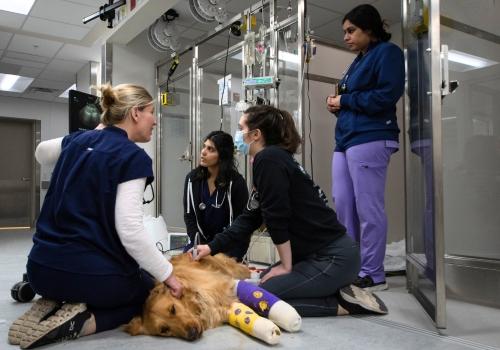
“The pandemic brought team dynamics and workplace strain into the spotlight,” he explains. “It also opened the door to new funding and opportunities, including my current role as VCA Canada Chair in Relationship-Centered Veterinary Medicine, which helped make this study possible.”
Janke and Coe also highlight the important role of clients in this framework. “Veterinary clients are part of the team too,” Janke says. “When clients share their goals and values with the team, it enhances communication and strengthens shared decision-making, especially around complex medical care.”
As the team looks to the future, Coe sees potential for artificial intelligence (AI) to support this work by helping clinics identify strengths and gaps in team dynamics and generating tailored strategies for improvement.
“Ultimately, enhancing how we work together as veterinary professionals isn’t just about staff satisfaction,” Coe says. “It’s about better outcomes for pets, clients and practices as a whole.”
The full study is available in the Journal of the American Veterinary Medical Association (JAVMA), Volume 263, Issue 6 (2025).
Listen to Drs. Janke and Coe discuss their study on a recent episode of the Veterinary Vertex podcast: