Communication Tools to Advance Spectrum of Care Approaches in Veterinary Medicine
Veterinary medicine is changing. For decades, the idea of a “gold standard” shaped how veterinarians approached treatment. This meant aiming for the most advanced or intensive medical option available. While this approach reflects strong medical ambition, it doesn’t always fit the realities of each client or patient. Today, veterinarians are moving toward a more flexible, inclusive model known as Spectrum of Care (SOC).
The heart of this new approach is simple: good veterinary care should balance medical evidence with the unique circumstances of each animal and their family. Cost, client expectations, cultural values and available resources all shape what “optimal care” looks like in practice. By embracing this broader perspective, veterinarians can make care more accessible, effective and sustainable for more pets.
But what does SOC look like in practice? How do veterinary teams integrate evidence-based veterinary care with situational circumstances to co-create a meaningful path forward with clients?


Dr. Jason Coe, VCA Canada Chair in Relationship-Centred Veterinary Medicine and professor at the Ontario Veterinary College (OVC), is helping to answer these questions.
Coe co-leads the Relationship-Centred Veterinary Medicine (RCVM@OVC) program, which focuses on improving veterinary care by strengthening communication, relationships and the human-animal bond so that SOC approaches are better integrated into veterinary practice.
“One of the most important aspects of Spectrum of Care is how veterinarians and clients talk to each other,” says Coe. “Our research aims to both understand and enhance communication in a way that supports veterinary professionals, client experience and health outcomes for animals.”
Coe and his colleagues, including former OVC post-doctoral fellow and former RCVM@OVC team member, Dr. Natasha Janke, recently published a paper in the journal Advances in Small Animal Care that offers a suite of clinical communication tools for veterinary professionals to support the delivery of SOC.
The publication explores the many facets of SOC, the importance of communication, the process of shared decision-making and a new suite of tools to contextualize conversations when practicing SOC.
Shared Decision-Making: A Critical Success Factor
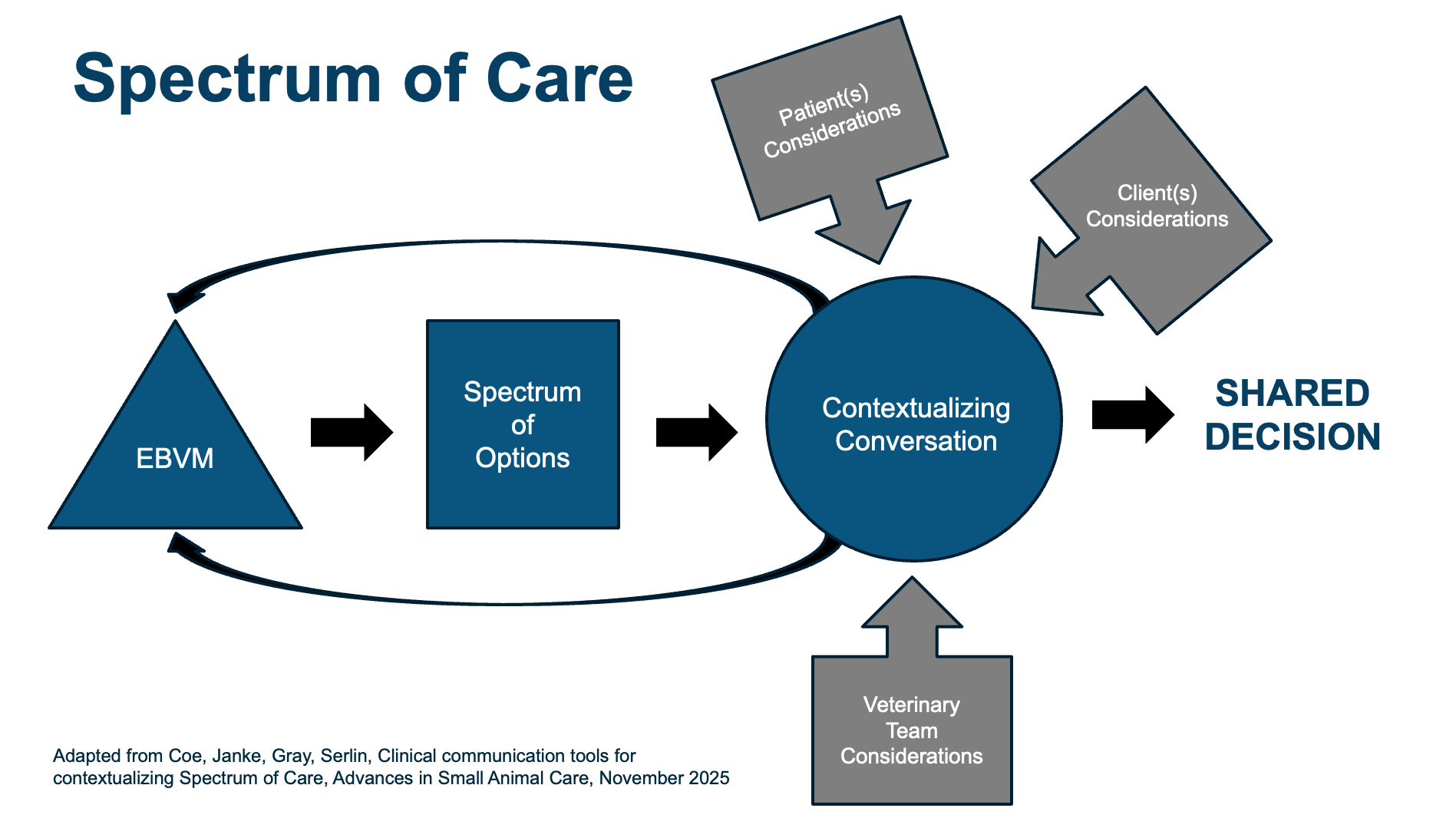
This process is called shared decision-making (SDM). Already common in human medicine, SDM is now gaining ground in veterinary care.
Studies in human health care show that SDM improves patient satisfaction, understanding and confidence in choices. In veterinary medicine, it has been linked to higher client satisfaction and stronger trust.
It is also an essential process when practicing SOC.
“SOC involves a series of complex, iterative processes, including communication that contextualizes decision making,” explains Coe. “SDM provides an opportunity for veterinary professionals to share their expertise while also listening to a client’s knowledge of their pet, their values and their unique situation to inform the spectrum of health care options.”
Arriving at that list of health care options – in which both clinical and contextual elements converge – is the essence of SOC.
“But SOC doesn’t end there,” cautions Coe. “It involves ongoing, thoughtful communication that continually contextualizes medical options and decisions.”
That’s where several clinical communication tools come into play.
The Communication-Skills Toolbox
The intentional use of communication skills to explore a client’s perspective, offer support and provide a tailored care approach begins long before specific tests or treatments are discussed. First, veterinary teams must gather a full picture of the pet and client: the animal’s medical history, the owner’s concerns and financial situation and the family’s values and expectations. Without this foundation, clients may feel disconnected or dismissive of professional advice.
Veterinary professionals must also consider their own perceptions as they initiate these conversations.
“It’s important for veterinarians to be aware of any personal assumptions, beliefs, values or ideologies that might influence their communication,” explains Coe. “These personal perceptions could potentially bias how they approach their initial discussion for presenting a spectrum of options, which is why the use of communication process tools becomes so valuable.”
Coe and Janke, along with UK-based collaborators Carol Gray and Ruth Serlin, have developed a Communication-Skills Toolbox for Contextualizing Spectrum of Care. The toolbox helps veterinary professionals take an open-minded, curious and humanistic approach to client conversations. It includes a selection of key clinical communication skills, describes the benefits of each, offers example phrases and provides a visual decision-making aid for supporting SOC conversations.
Key skills outlined in the toolbox include:
Introductions that acknowledge everyone present and set a respectful tone.
Open-ended questions like “Tell me about…” or “Describe what you’ve noticed…” that invite clients to share more fully.
Listening skills, including reflective listening and allowing pauses, to show attentiveness and respect.
Empathy, expressed verbally or through “I wish…” statements that recognize difficult emotions.
Partnership language such as “Let’s decide together” to reduce power imbalances.
Chunk and check, where information is presented in small steps with pauses, followed by checking in to confirm understanding.
Summaries and signposting, which help organize conversations and make sure everyone stays on the same page.
The publication also provides case examples demonstrating the application of the Communication-Skills Toolbox.
“It’s important to see, in detail, how the tools are used, what those conversations could look like and how they shape the collaborative decision-making process between client and clinician,” says Coe. “The case examples also highlight the iterative nature of SOC delivery.”
Providing Clarity During Complex Decision-Making

“The Value Matrix enables a fulsome snapshot of options that integrates a veterinarian’s medical knowledge with a client’s preferences, contextual components of the client’s situation, as well as the animal’s background and circumstances,” explains Coe.
Veterinarians and clients review the matrix together and arrive at a decision that best serves the client and their pet.
“In our publication, we’ve included a unique Value Matrix for each case study,” says Coe. “When applied in the decision-making process, this tool facilitates clarity and understanding for clients, it supports recall, and it promotes client agency when making important choices for their pets.”
A 2024 video manuscript published in the Journal of the American Veterinary Medical Association further explores the Value Matrix. The 20-minute tutorial presents a mock clinical scenario and hypothetical dialogue between veterinarian and client, where the two parties use the tool to arrive at a patient-care decision together.
A Collaborative Future
At its core, SOC is about relationships. By combining medical evidence with open, respectful communication, veterinarians and clients can work together to make the best decisions for each unique situation. This shift not only enhances animal welfare but also strengthens trust and accessibility in veterinary medicine. There is evidence to suggest that SOC may also reduce burnout by giving veterinarians and clients a greater sense of agency and shared responsibility, supporting sustainability in veterinary practice.
The shift toward SOC is not without challenges, however. For veterinarians trained under the gold-standard model, adapting to SOC approaches may cause discomfort or even moral distress when offering alternatives once viewed as “lesser.”
Encouragingly, regulatory bodies are expressing support for SOC, and this approach is now embedded in the curriculum of many veterinary schools, including OVC.
“SOC benefits patients, clients and veterinary teams alike,” says Coe. “I see value in continued research that will help us understand how best to support the integration of SOC in veterinary settings and to explore the evolving benefits to the profession in terms of veterinary mental health, client experience and patient health outcomes.”