One Health Research Aims To Punch Antimicrobial Resistance In The Gut
When bacteria reproduce, they typically make an identical clone of themselves that have the same traits as the original. But sometimes, they exchange genes with neighbouring bacteria to produce new, potentially harmful strains – and that process makes the whole phenomenon a One Health matter.
All elements of One Health are involved: environmental conditions influence bacterial conjugation rates and human and animal health are at risk of serious Salmonella infection from environmental exposure or handling and eating contaminated food.
“It’s a big food safety project,” says May, “which places it right in the middle of the One Health triad.”
And May finds One Health to be a useful tool for navigating this complex work. Though she focuses primarily on humans, she uses One Health to understand how her project is connected to animal and environmental health.
For instance, bacterial conjugation as a process occurs almost everywhere – in animals, in soil, on surfaces, in water – so plasmids are regularly and rapidly being transferred between bacteria. It’s difficult then to know which environments amplify conjugation rates and it’s important to consider the broader interactions contributing to the process.
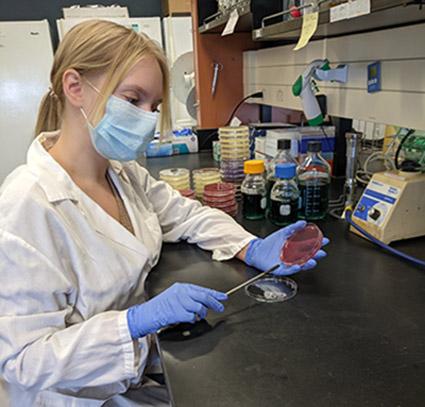
May hopes that gaining a better understanding of bacterial conjugation rates in the gut will contribute to the fight against antimicrobial resistance. She also envisions implications of her work in food production settings where Salmonella is a bigger concern. Knowing which environments increase conjugation rates will help public health and food safety experts adjust safety measures according to risk levels.
The applications of May’s work are broad, reflecting the interdisciplinary nature of her project and of One Health. Her degree falls within the pathobiology domain, but May is also enrolled in the Collaborative Specialization in One Health, where she takes classes with other graduate students enrolled but working on different projects.
May feels lucky to be a part of this group, attributing a significant amount of growth to it.
“I think [the courses] have made me a better learner and a better listener as well as a better scientist,” says May.
Whether she continues to pursue academia through a PhD or if she goes into policy making, the lessons she has learned through the Collaborative Specialization will carry forward into that work. May isn’t exactly sure where the future will take her, but she knows that her options have widened because of her experience studying One Health.
“I really want to build interconnections between different parts of the government or different parts of academia,” says May, “and facilitate communication between the two.”
Funding for May’s research is provided by the Food from Thought program at the University of Guelph.
This article, written by Anna McMenemy, was adapted from the One Health Institute’s, University of Guelph webpage for use on the OVC’s website.