CreatedAtGuelph™ Annual Report 2024-2025
Welcome Message
It is my pleasure to welcome you to the CreatedAtGuelph™ Report 2024–2025.
At the University of Guelph (U of G), innovation is not an outcome that happens by chance, it is the result of curiosity, collaboration and a shared commitment to creating positive change. Every day, our researchers, students, staff, entrepreneurs, and partners work together to transform knowledge into solutions that strengthen communities, drive economic growth, and address some of society’s most pressing challenges.
This report highlights the many ways innovation was advanced across our campus-linked ecosystem. From new technologies and industry partnerships to startups, licensing activities and knowledge mobilization initiatives, these stories reflect the breadth of talent and ambition that define the U of G. They also demonstrate the power of collaboration between academia, industry, government and community partners in accelerating the journey from discovery to impact.
As you explore the stories and performance dashboards that follow, I hope you will see not only the accomplishments we have achieved together, but also the momentum we are building for the future. Our success is made possible by the dedication of our researchers and innovators, the support of our partners and funders and the collective belief that knowledge can be mobilized to create meaningful benefits for society.
Thank you for being part of this journey. Together, we are strengthening Ontario’s and Canada’s innovation ecosystem and ensuring that ideas created at U of G continue to make a difference locally, nationally and globally.
Jump to section
- Innovation of the Year
- Bringing Robotics to the Field
- Project SOY Plus
- Innovation Begins with Connection
- AG-ACt: Mobilizing Knowledge
Leading Photo: A student wearing a VR headset immersed in a Shakespeare-themed VR experience (courtesy of Nakita Byrne-Mamahit).
- 164
- REPORTED INVENTIONS
- 30
- NEW LICENSES/OPTIONS
- 293
- ACTIVE LICENSES/AGREEMENTS
- $1.4 M
- LICENSE INCOME
- 28
- SUCCESSFUL RESEARCH PROJECTS SUPPORTED
- 6
- POLICY FELLOWS
2025 Innovation of the Year

A groundbreaking virtual reality project that transforms classic plays into immersive, interactive experiences for students has been recognized as the U of G's 2025 Innovation of the Year.
Designed to make Shakespeare accessible and engaging, the Shakespeare VR experiences allows learners to step inside the world of the plays, interact with characters, and experience scenes firsthand.
Developed by Dr. Peter Kuling from the College of Arts in collaboration with Ottawa-based VR company Calian (prev. SimWave), the project began during the COVID-19 pandemic, launching first Hamlet VR and then Macbeth VR, enabling players to assume roles such as Bernardo or one of the witches, make choices, and explore scenes from multiple perspectives.
Freely available to Ontario schools and adopted internationally, Shakespeare VR has transformed classroom engagement, allowing students connect with Shakespeare’s language and storytelling in ways that traditional methods cannot match.
PHOTO: Dr. Peter Kuling posing with a prop skull fitted with a VR headset (courtesy of Nakita Byrne-Mamahit).
*This research was funded by the Ontario Exchange Network.
Bringing Robotics to the Field: Automating Weed Scouting in Lima Beans
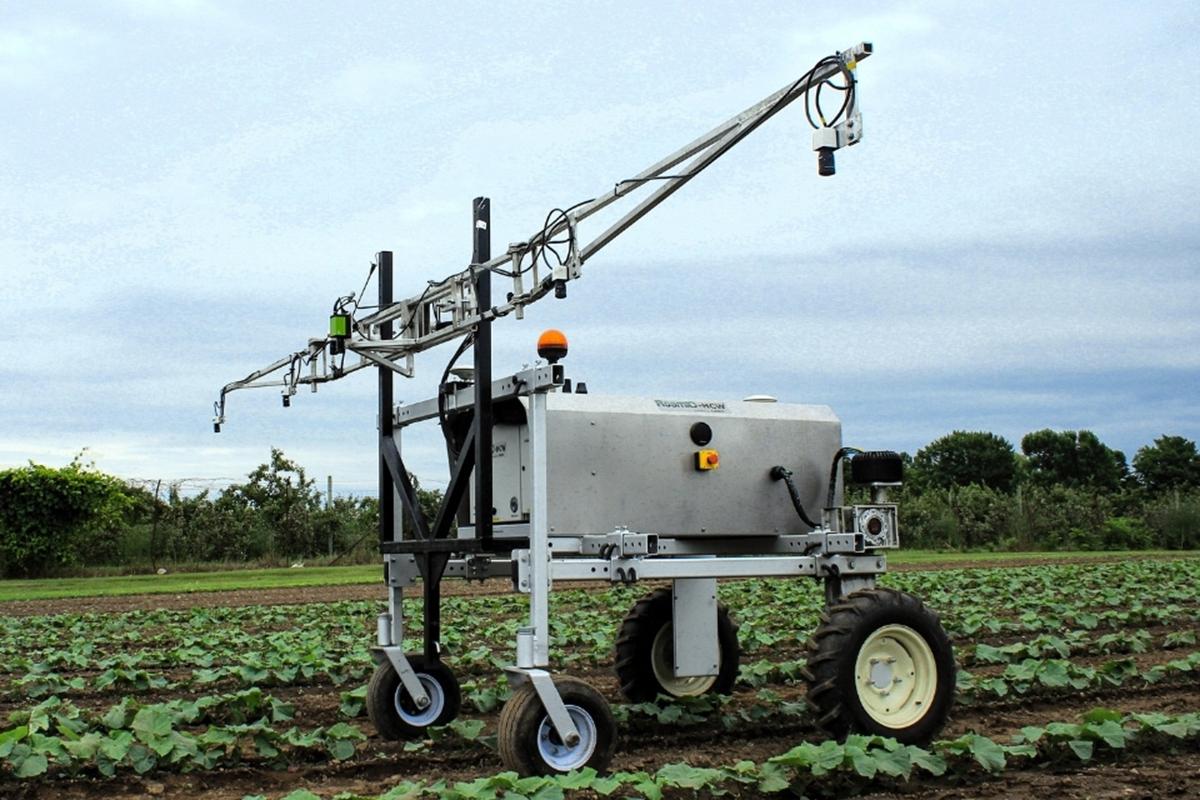
An innovative partnership has formed between industry leaders Nortera Foods and Haggerty Ag Robotics, along with Dr. Medhat Moussa from the Robotics Institute of Guelph. Together, they are using cutting-edge robotics and artificial intelligence to transform weed scouting in lima bean fields, a serious problem in crops like lima beans.
Traditionally, farmers rely on manual weed scouting, a process that is both time-consuming and prone to inconsistencies. This collaboration, formed under the AgRobotics Working Group, is pioneering a smarter approach. By integrating vehicle-mounted cameras with advanced AI processing, the team is developing precise weed density maps that guide targeted herbicide application.
By automating weed scouting, this initiative aims to reduce production losses by minimizing the need for harvest avoidance due to weeds, increase efficiency, and maintain high-quality yields.
PHOTO: Robot equipped with cameras for weed scouting in field (courtesy of Jason Gharibo).
*This research takes place, in part, at the Ontario Crops Research Centre - Elora, which is owned by Agricultural Research and Innovation Ontario (ARIO), an agency of the Government of Ontario, and managed by U of G through the Ontario Agri-Food Innovation Alliance.
Project SOY Plus

With the largest competition turnout since the pandemic, Project SOY Plus continues to engage students with an interest in exploring unique and creative solutions for a more sustainable future. The 2024-2025 competition year challenged students to pursue sustainable solutions and creative explorations of the United Nations Sustainable Development Goals: Zero Hunger (SDG 2) and Life on Land (SDG 15).
20 teams took part in the Project Stream of the competition, strengthening their research and development skills while shaping shaping solutions for a sustainable future. Projects ranged from collapsible greenhouse kits to a surplus food redistribution platform, with winners Skytree (Graduate), Nutrispice (Undergraduate) and Scrappy Snacks 2.0 (Diploma) focusing on tree planting drones, a fortified spice blend, and a household resource for waste free cooking, respectively.
Three creative proposals were submitted drawing esthetic, material, and metaphoric lines of connection between the annual theme, innovation, and research. Verena Brysch's proposal Perspectives was awarded the commission to create paintings that look at the paradox of consumer driven culture and encourages viewers to consider how they can be part of the solution.
Photo: Close-up of a student from NutriSpice presenting during the 2025 Project SOY Plus finale (courtesy of Vutsup Media).
Innovation Begins with Connection
At the U of G, we often talk about the importance of innovation and entrepreneurship, but sometimes the biggest opportunities don’t come from formal programs or planned projects. They come from unexpected conversations with people we barely know.
That’s exactly the idea behind the Innovators & Entrepreneurs Social, a casual networking event hosted by the Research Innovation Office (RIO). Held twice a semester at the Lookout on campus, these gatherings are simple by design - just 90 minutes of conversation and connection over coffee and snacks. What makes them different is who’s in the room: graduate students, postdoctoral researchers, faculty members, and others who share an interest in creative thinking, problem solving, and making research useful beyond the lab.
The event started from a simple observation, innovators and entrepreneurs on campus often work in isolation, scattered across departments and programs. By bringing these people together regularly, we hoped to break down silos and spark new ideas. And it’s working.
How a Casual Chat Sparked a Startup
One clear example is the story of Abdullah, an engineering graduate student who attended the social. During his master’s, Abdullah developed an algorithm to reduce errors in prostate MRI screenings. With guidance from Dr. Graham Taylor and support from RIO, he explored commercialization, but soon realized there wasn’t a market for his invention.
Instead of giving up, Abdullah stayed open to new opportunities. At one of the Innovators & Entrepreneurs Socials, he struck up a conversation with another attendee who encouraged him to consider veterinary clinics as a potential market. That simple chat led him to co-found Dice Health, a company that automated note-taking for veterinarians. The idea quickly took off, he advanced through U of G’s Hub Incubator and the Next AI program in Montreal. Within just a couple of years, Dice Health achieved success internationally and was acquired for an undisclosed amount.
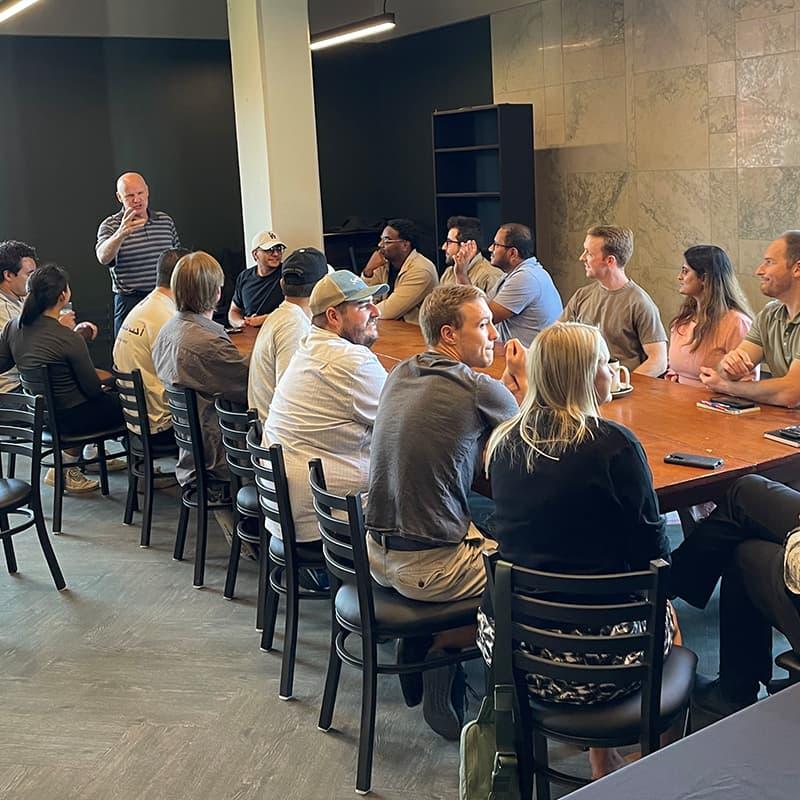
PHOTO: David Hobson speaks to a group at the Innovators & Entrepreneurs Social (courtesy of Tyler Zemlak).
AG-ACt: Mobilizing Knowledge to Strengthen Canada’s Food Systems

As climate change reshapes the agri-food sector, the Agricultural Genomics Action Centre (AG-ACt), a Genome Canada-funded knowledge mobilization hub, is accelerating the translation of research into actionable solutions. By connecting researchers, industry, communities, and policymakers, AG-ACt ensures that scientific insights in genomics inform real-world decisions and foster meaningful impact across Canada’s agri-food systems.
Through its work, AG-ACt enables climate-smart solutions that reduce emissions, enhance sustainability, and strengthen economic resilience. By mobilizing research outputs effectively, AG-ACt helps Canada meet its net-zero goals and positions the country as a global leader in sustainable agriculture.
Get Involved: Join the Climate-Smart Agri-Food Network to stay connected with network engagements, including policy dialogues, industry roundtables, portfolio news, research updates, and collaborative opportunities. Together, we can ensure Canadian agriculture adapts, innovates, and thrives.