A strong food system depends on getting the most from the land we have while protecting it for the future. For Jack McNichol, that means finding a better balance in how farmers use one of agriculture’s most important inputs: fertilizer.
Jack is a student in the MSc Plant Agriculture program at the U of G’s Ontario Agricultural College, where he is researching how phosphorus - a critical nutrient found in fertilizer - varies across farmland and how that variability affects crop response in corn and soybean.
Phosphorus is essential for healthy crops, helping support strong roots and plant growth. But too little can limit yields, while too much can leave nutrients in the soil that can move into nearby waterways and contribute to environmental problems.
Jack’s research is focused on understanding that balance.
“One field isn't uniform and it won't have the same phosphorus and other soil properties across the entire field,” Jack McNichol.
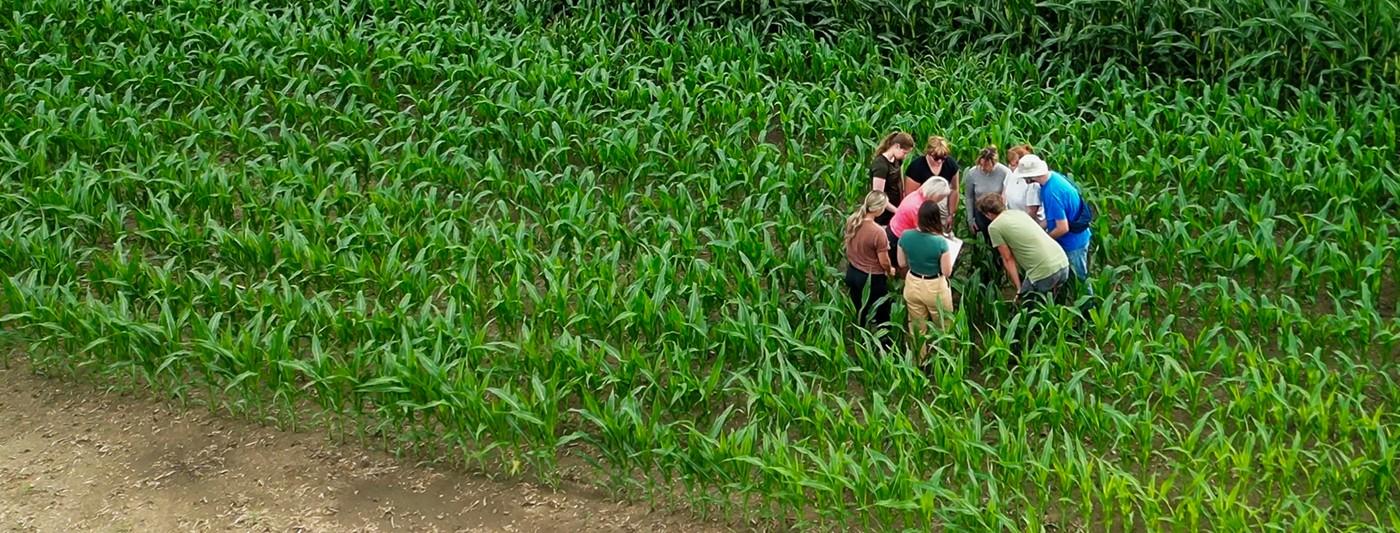
His research trials are being conducted at the Ontario Research Centre in Elora*, and additional on-farm trials in Caledon, Bellwood and Stratford, where Jack is studying how different levels of phosphorus and other soil variables affect crop response to fertilizer. By better understanding these variations, his work could help develop more precise fertilizer recommendations, allowing farmers to apply the right amount while maintaining yields and reducing unnecessary fertilizer use.
“I’m helping improve Canada's food future by better utilizing sources and rates of fertilizer,” he says. “It's important that we're not under fertilizing or over fertilizing and maintaining high crop yields to continue growing food here in Ontario.”
Jack's research, under the supervision of OAC's Dr. Adrian Correndo and Dr. John Sulik, is examining two phosphorous fertilizers**, supported by OCP Group, a global leader in phosphate-based plant nutrition.

For Jack, having access to agricultural research facilities, expertise and field trials is an important part of his graduate experience.
“The University of Guelph is the perfect place to conduct agricultural research,” he says. “There’s amazing facilities on campus and research centres, professors and support.”
Jack is part of a new generation of agricultural researchers working to solve the challenges facing Canada’s food system. His research is helping advance the knowledge farmers need to grow food efficiently, protect natural resources and build a more sustainable agricultural future.

*This research is funded, in part, by the Ontario Agri-Food Innovation Alliance, a collaboration between the Government of Ontario and the University of Guelph, and takes place at the Ontario Crops Research Centre – Elora, which is owned by Agricultural Research and Innovation Ontario, an agency of the Government of Ontario.
**TSP 0-46-0 (triple superphosphate) and MAP 11-52-0 (monoammonium phosphate)
Take the next step
Interested in pursuing your masters or PhD? Discover graduate programs in food, agriculture, communities, the environment and beyond at U of G's Ontario Agricultural College.
OAC's NextGen Newsletter
Highlighting the people and innovation making an impact across the agri-food sector.