John Barta
BSc (Distinction), PhD Toronto
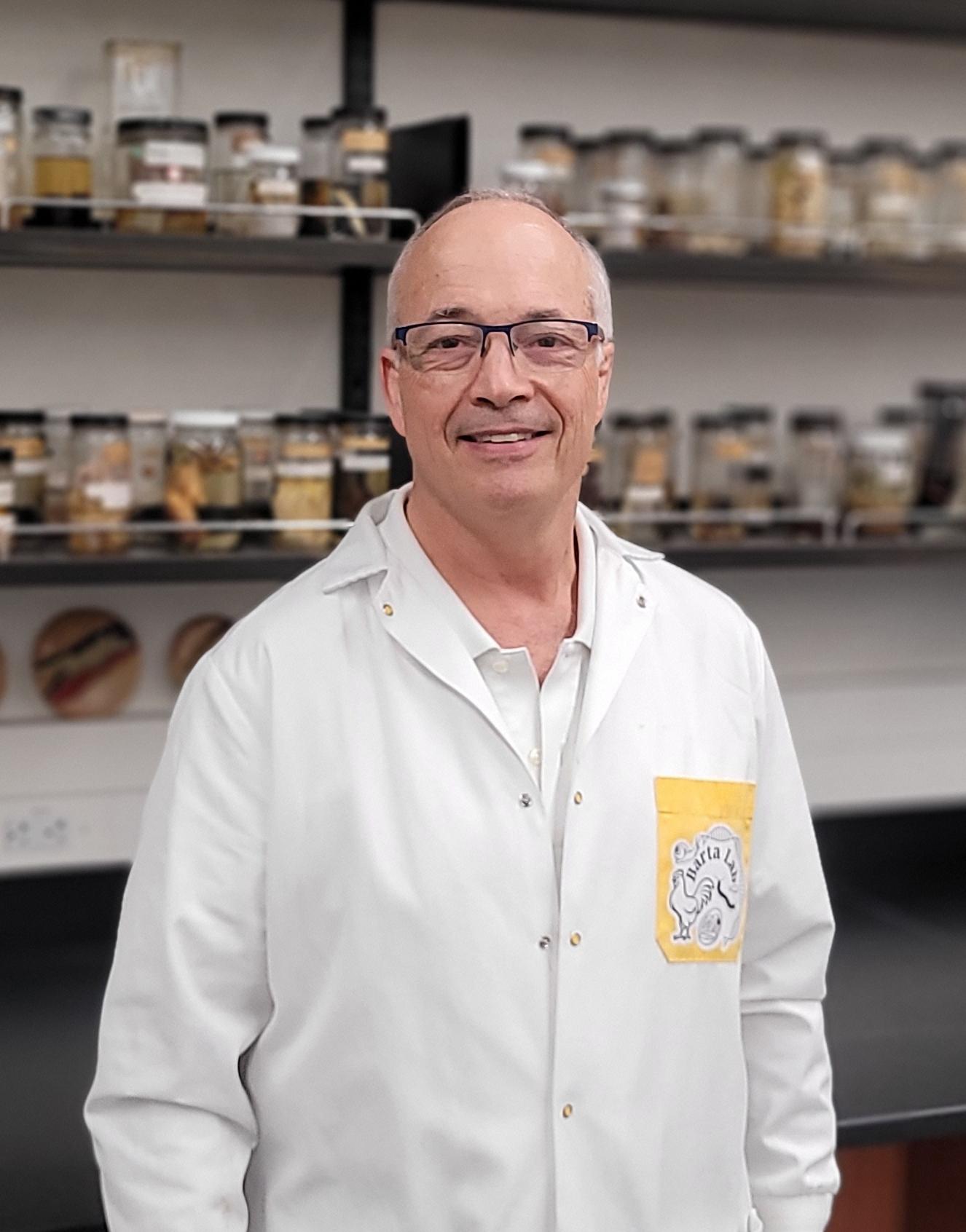
Professor
Ontario Veterinary College, Department of Pathobiology
Research Profile
My graduate students and I are interested in protozoan parasites of the phylum Apicomplexa. These parasites are cosmopolitan in their range of hosts infected and geographic distribution. Some are the causative agents of major diseases of humans (malaria in otherwise healthy individuals [Plasmodium spp.]; toxoplasmosis and cryptosporidiosis in the young or immunocompromised). Others are a tremendous financial burden to food producers because of the effects these parasites have on domestic animals (coccidiosis, sarcocystosis and cryptosporidiosis of livestock and poultry). All members of the phylum are parasitic. One of the most commonly encountered groups of Apicomplexa are the Coccidia. These ubiquitous parasites of vertebrates have a complex intracellular life cycle within infected intestines involving penetration by a sporozoite into a host cell, several cycles of asexual replication (merogony) forming numerous merozoites and finally a sexual cycle which produces infective stages (containing sporozoites) which pass between vertebrate hosts. Species of the genera Toxoplasma and Sarcocystis (among others) infect two or more hosts in their life cycles; Eimeria spp. only infect a single host species with few exceptions.
The long term goal of my research program is to understand the interactions which exist between parasites of the Phylum Apicomplexa (Plasmodium, Eimeria, Isospora, Toxoplasma gondii, Cryptosporidium and related organisms) and their vertebrate and invertebrate hosts at the historical, organismal and molecular levels. Currently we are examining:
- apicomplexan phylogeny in the context of host associations (host-parasite co-evolution, i.e. historical associations of populations) as well as infraspecific variation within species of coccidia infecting poultry using molecular and immunological measures of variation;
- parasite organellar cell biology and the role of organelles in host cell invasion and parasite survival (individual cell to cell associations) using sporozoites of Eimeria tenella and merozoites of a recently described apicomplexan parasite, Neospora caninum, in an in vitro system; and
- the cellular and soluble factors responsible for immunological modulation of coccidial infections during primary and secondary infections in mice and in poultry (associations between the parasite and an individual host).
- the effect that various immunization routes have on the ability of native and recombinant antigens to elicit a protective immune response in poultry.
Professional Activities & Honours
H.B. Ward Medalist, American Society of Parasitologists
Current Graduate Students
- Taylor Lane - MSc
- Elizabeth Cohen - PhD
Other Lab Personnel
- Jessica Rotolo - Post Doctoral Researcher
Former Graduate Students
- Justin Carpani, MSc - Graduated W25
- Liam Landry, MSc - Graduated F25
- Daniel Lindo, MSc - Graduated F25
- Jessica Rotolo, PhD - Graduated S25
- Natasha Slawynch, MSc - Graduated W25
- Elizabeth Zeldenrust, PhD - Graduated W25
Selected Publications
- Barta JR, and RCA Thompson 2006. What is Cryptosporidium? Reappraising its biology and phylogenetic affinities. Trends in Parasitology 22(10):463-468.
- Girdhar SR, JR Barta, FA Santoyo, and TK Smith. 2006. Dietary putrescine (1,4-diaminobutane) influences recovery of Turkey poults challenged with a mixed coccidial infection. Journal of Nutrition 136(9):2319-2324.
- Basak S.C, S. Lee, J. R. Barta and M. A. Fernando. 2006. Differential display analysis of gene expression in two immunologically distinct strains of Eimeria maxima. Parasitology Research 99: 28–36.
- Adl SM, AGB Simpson, MA Farmer, MA Andersen, OR Anderson, JR Barta, SS Bowser, G Brugerolle, RA Fensome, S Frederico, TY James, S. Karpov, P Kugrens, J Krug, CE Lane, LA Lewis, J Lodge, DH Lynn, DG Mann, RM McCourt, L. Mendoza Ø Moestrup, SE Mozley-Standridge, TA Nerad, CA Shearer, AV Smirnov, FW Spiegel and MFJR Taylor. 2005. The New Higher Level Classification of Eukaryotes with Emphasis on the Taxonomy of Protists. Journal of Eukaryotic Microbiology 52(5):399–451.
- Barta, J. R., R. A. Carreno, B. A. Rideout and M. D. Schrenzel. 2005. The genus Atoxoplasma (Garnham 1950) as a junior objective synonym of the genus Isospora (Schnieder, 1881) species infecting birds and resurrection of Cystoisospora (Frenkel, 1977) as the correct genus for Isospora species infecting mammals. Journal of Parasitology 91(3):726-727.
- Desser, S. S., Koehler, A., J. R. Barta, J. Kamyar and M. J. Ringuette. 2004 Trichonosema algonquinensis n. sp. (Phylum Microsporidia) in Pectinatella magnifica (Bryozoa: Phylactolaemata) from Algonquin Park, Ontario, Canada. Journal of Eukaryotic. Microbiology 51(4): 389–393.
- Siddall ME and JR Barta. 2004. Introduction of Sherwin S. Desser, recipient of the Clark P. Read Mentor Award. Journal of Parasitology 90(6):1204.
Search PubMed for additional publications by Dr. Barta.