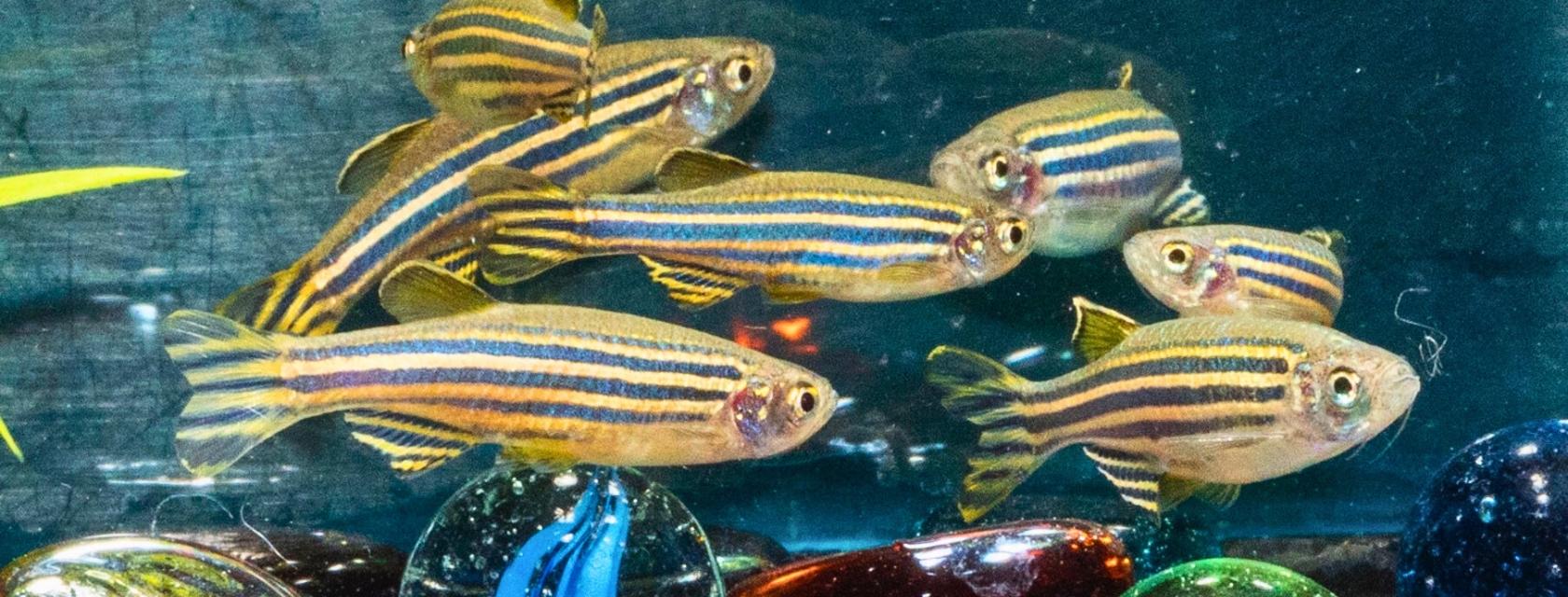
Zebrafish Facility
A state-of-the-art zebrafish facility located in the renowned Hagan Aqualab.
We are able to provide zebrafish to academic institutions, government facilities and private industry. We provide the Tubingen (TU) wild-type strain, which is the source strain for the zebrafish genome project. Fish are available at any life stage and either gender.
Zebrafish are raised in a Tecniplast Habitats system with environmental enrichment. Zebrafish are fed a mix of standard fish flakes and artemia (brine shrimp).
We routinely perform pathogen analysis. Please contact us for our latest results.
We also provide custom services using the Crispr/Cas9 system to generate zebrafish models of human disease. Please contact us for details.
Who we are:
- Jazmin Wynter: Zebrafish Resources
- Mike Davies: Hagan Aqualab Coordinator
- Terry Van Raay: Director of the AquaLab Zebrafish Facility
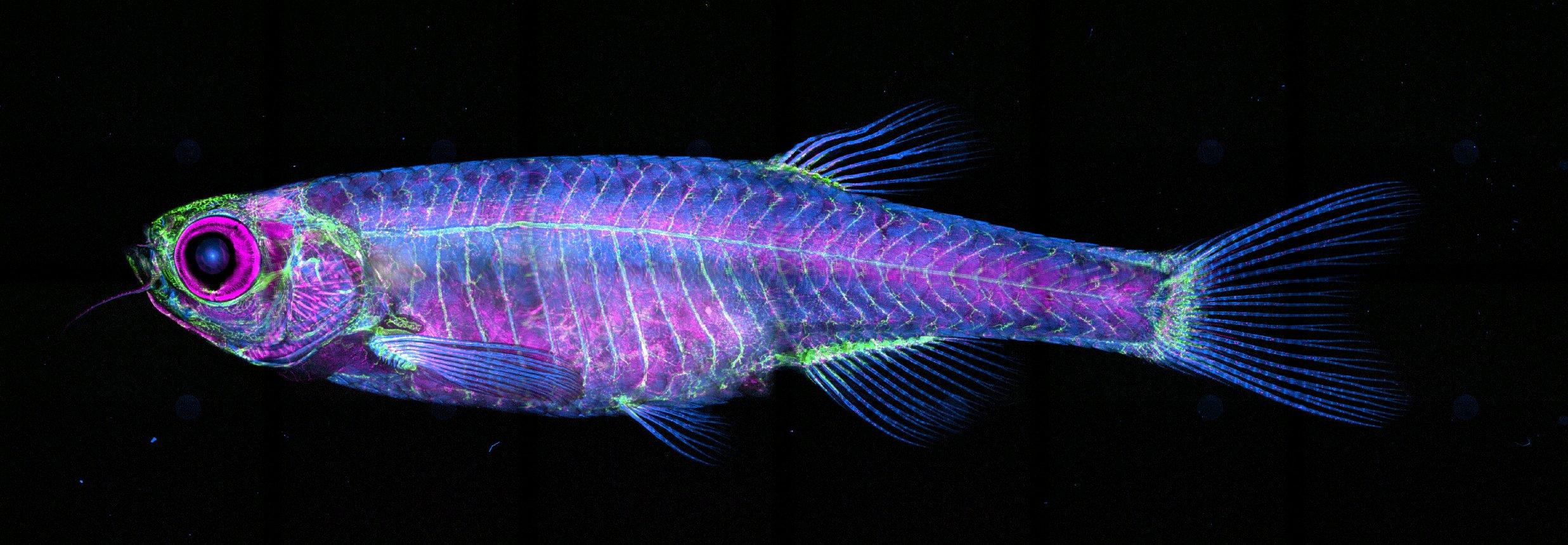
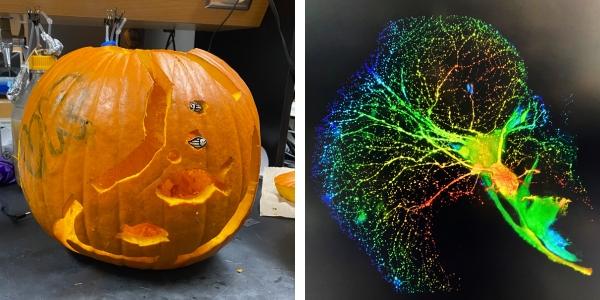
Above: Zebrafish are model organisms for studying development, injury, and disease. In this fluorescent microscopy image of an adult zebrafish, blood vessels are labelled pink, lymphatic vessels are green, and scales and bone are blue. Credit: D. Castranova, Weinstein Lab, NICHD/NIH. CC BY-NC-ND 2.0
Left: Zebrafish-themed pumpkin.
Right: Projection image of zebrafish head at 2 days post fertilization from a transgenic line that labels isl2b neurons with GFP. Pseudocoloured to show depth of neurons.
Zebrafish Procurement
We provide embryos, larvae, fry and adults at all life stages.
Here is a price list for 2026. All zebrafish are of the TU wild-type line. To order, please use the order form link.
| Item | Internal Academic | External Academic | Industry |
| Each 100 embryos (0-days post-fertilization), not sorted, provided on day of fertilization (internal only) | $8.50 | N/A | N/A |
| Each 100 embryos (any stage, <5 dpf.), cleaned and guaranteed fertilization | $20.00 | $35.50 | $60.00 |
| Per adult zebrafish (>3 months post-fertilization), either sex | $8.00 | $12.00 | $20.00 |
| Weekend setup surcharge | $20 | $30 | $40 |
| Live artemia culture (2.5g of cysts minimum) | $2.00/2.5g/day | N/A | N/A |
| Administration/handling fee (per order) | $10 | $20 | $50 |
| Shipping | $0 | Shipping O/N rate | Shipping O/N rate |
Housing/Month (internal only)
| Nursery (0-3 months of age) per 3.3L tank | $20 |
| 8.0 L large tanks (31-75 adults) | $20 |
| 3.5 L medium tanks (5-30 adults) | $15 |
| 1.1 L small tanks (1-4 adults) | $5 |
Why Use Zebrafish?
Zebrafish possess many key attributes that make them excellent models for studying development and human disease.
- Zebrafish are more cost effective than generating and housing alternative models. A 3.5 Litre tank can house up to 35 adult zebrafish about $0.50 a day.
- Zebrafish share many of the same organ systems and physiology with humans and more than 80% of human disease genes have a zebrafish counterpart.
- Zebrafish can produce large clutches of eggs every week. Up to 300 embryos from a single pair.
- Zebrafish embryos are transparent and you easily see the heart beating after 24 hours with a simple dissecting microscope.
- It is relatively easy to manipulate the zebrafish genome, creating specific mutant or transgenic lines.
Zebrafish in Education
Zebrafish are becoming an excellent educational tool. There are several undergraduate labs here at the University of Guelph that incorporate zebrafish.
- ZOO*3610 Lab Studies in Animal Physiology I
- ZOO*4170 Experimental Comparative Animal Physiology
- ZOO*4330 Biology of Fishes
- ZOO*3050 Developmental Biology
If you would like to know more about how zebrafish are used in these labs please reach out, we would be happy to share protocols and provide you with all your zebrafish needs.
In addition, there are numerous sites dedicated to using zebrafish in education from K through grade 12.
- Special Issue on Zebrafish in Education
- Zebrafish in the Classroom
- Using Zebrafish to Spark Student Interest in Science
- Behavioural/Cognitive Neuroscience lab YouTube Video
- Zebrafish in the Undergraduate Classroom
- Teaching Zebrafish Development in a STEM-Based Science Camp for Middle School Students
- A video showing the first 18 hours of development
Zebrafish Resources
- Zebrafish International Resource Center
- Zebrafish Husbandry Association
- Zebrafish Information Network
- Zebrafish in Scientific Publications (>4,400 science publications involving zebrafish in 2023)