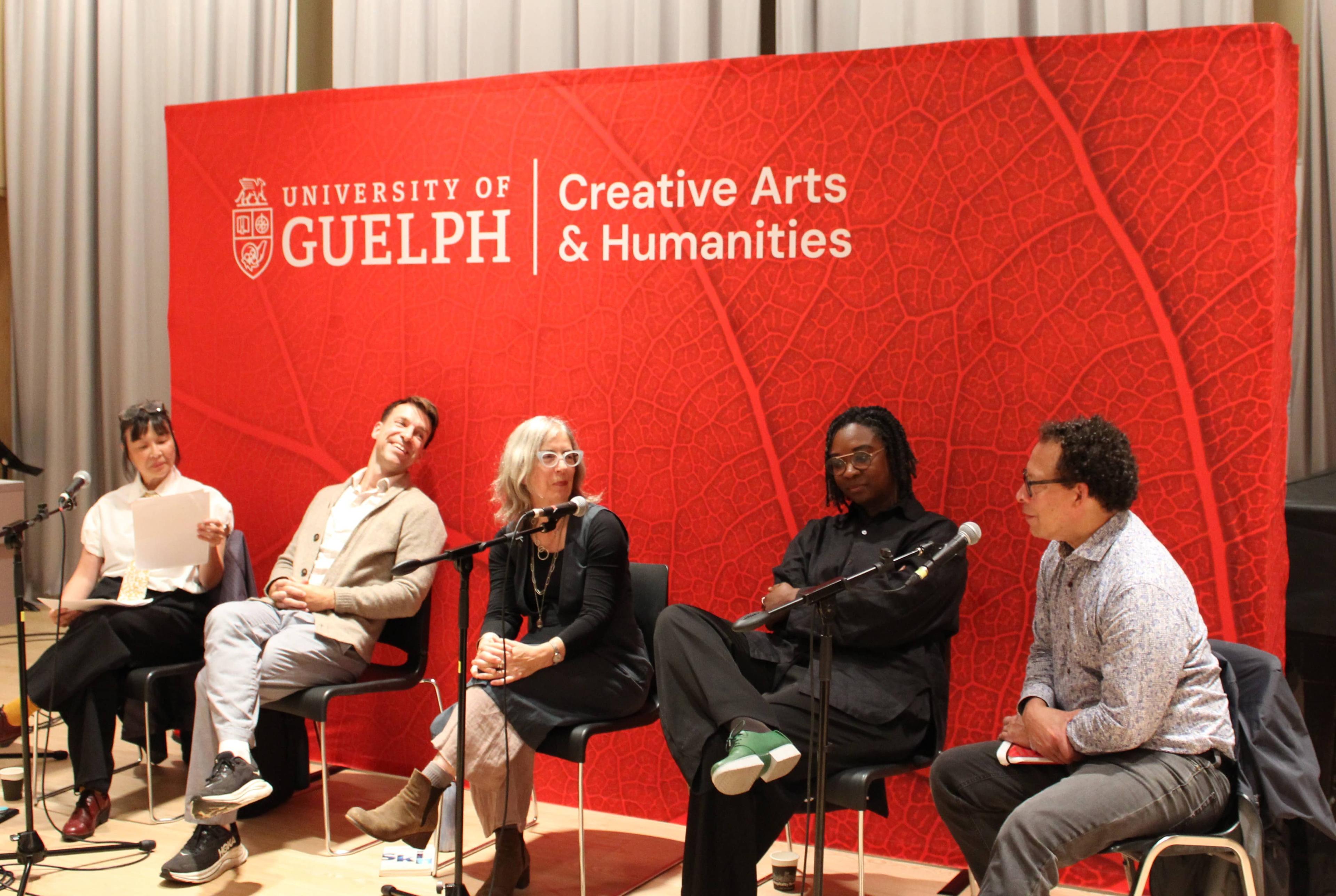
Earlier this month, members of the University of Guelph community gathered in the College of Arts (COA) for the Gryphons Read 2026 Creative Writing event which coincided with the 20th anniversary of the College's renowned Creative Writing MFA program. Accomplished Creative Writing faculty members discussed writing, creating, teaching and their acclaimed publications in an in-depth conversation in the auditorium in the Arts Research Centre.

Featured faculty included:
Lawrence Hill, professor, School of Theatre, English, and Creative Writing (SOTEC), COA
Canisia Lubrin, associate professor, SOTEC, COA/graduate program coordinator, Creative Writing MFA Guelph/Humber
Catherine Bush, associate professor, SOTEC, COA
Blain Watters, assistant professor, SOTEC, COA
Carrianne Leung, assistant professor, SOTEC, COA
When the doors opened, guests had an opportunity to purchase copies of publications by the featured faculty members which were provided by The Bookshelf in Guelph.
The formal event began with opening remarks from COA Dean Dr. Samantha Brennan, followed by an acknowledgement of the 20th anniversary of the Creative Writing MFA program by Dr. Sally Hickson, director of SOTEC and associate professor in the School of Fine Art and Music in COA.
Next, Bush co-presented undergraduate student, Jaye Willison, with the Creative Writing Undergraduate Award which was sponsored by Steph and Ben Minett, owners of The Bookshelf bookstore in Guelph, who accompanied Bush in presenting the award.
The Many Layers of Writing
Throughout the conversation, which was moderated by Leung, faculty members explored the innerworkings and intentions of their works and provided insights into their unique creative processes and motivations.
Bush read an excerpt from her book, Skin, which explores storytelling through sensations, followed by Lubrin who read an excerpt from her upcoming publication Bright Machine, which examines human cohabitation within warcraft.
Watters narrated an excerpt from the screenplay he wrote for the film, Sleeping Giant, which demonstrates comedic storytelling. Next, Leung read an excerpt from her publication, Wonderland Road, which delves into themes of death and mortality.
The Individuality and Collectiveness of Writing and Teaching

The authors' ideas about and motivations for writing were varied. Bush noted she writes for pleasure and as a means to reach out to others, contemplating the relationship between the reader and the author. She also shared that she is consistently trying something new when she writes. Watters mentioned that he was inspired by his father's work. He remarked that he writes for himself and shared his view that we learn from each other. Hill described writing as an introspective process for him and noted his motivations for writing involve worldbuilding and holding life then losing it, whereas Lubrin shared she feels most whole when she writes as her matter is language. She also shared that, from her perspective, you relearn to write a book every time. Leung commented that she needs to write to understand and finds a solitude in writing.
The authors' approaches to starting projects were wide-ranging, too. Lubrin noted that fascination plays a large role while Hill shared that, for him, finding something new and dramatic is important. Bush shared that liveliness and energy are important factors for her, Watters mentioned that he values brainstorming and the flowing of ideas and Leung commented that the concept of "unprettiness" along with the act of chasing an idea are significant factors for her. When reflecting on teaching, Bush, Watters, Hill and Lubrin each expressed uniquely that teaching encompasses having an impact on others in some way.
At the end of the discussion, guests were invited to stay and connect with one another and have their books signed by the authors.