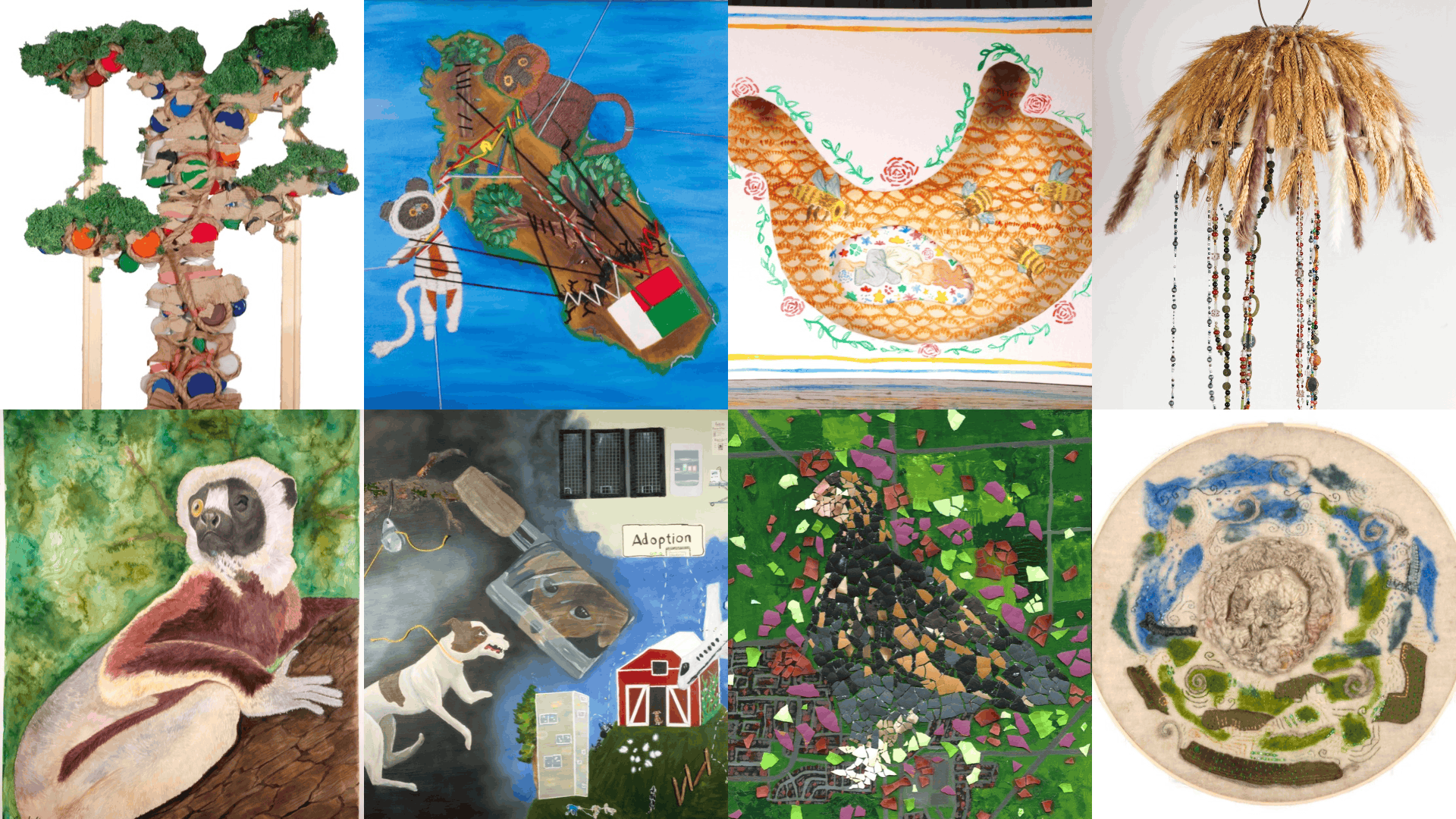
"Common Ground: Visualizing One Health Research," an upcoming exhibit in the Zavitz Gallery, is the result of a collaboration between Bachelor of Creative Arts, Health and Wellness (BCAHW) students and students in the Collaborative Specialization in One Health (CSOH) graduate program.
“I was really interested exploring the possibilities of accessible and engaging ways to communicate about the diversity of One Health research on campus,” says Dr. Elizabeth Finnis, director of the One Health Institute and faculty member in the Department of Sociology and Anthropology. “And I wanted to bring people in different programs together to talk about the importance of a One Health approach,” she says.
She connected with Dr. Michelle Wilson, a faculty member who teaches in the BCAHW program, and they discussed knowledge mobilization through art and what that could look like at U of G. Wilson has previously been involved with connecting art with conservation and Indigenous communities.
“Students in the BCAHW program are already thinking about understanding health through art; it is spread throughout the program,” Wilson says. “Why not connect these students with One Health graduate researchers in a creative workspace?”
Wilson reached out to her BCAHW students and found eight who were willing to participate as collaborators. At the same time, eight CSOH graduate students volunteered to be paired with an undergraduate artist. “It was great that we ended up with equal numbers of volunteers on each side,” says Finnis. “We weren’t sure what we would have done if interest had been skewed in favour of one group.”
In the spring, artists assembled samples of their work and researchers wrote blurbs about their projects. The two groups were introduced to each other and shared their work in an online meeting. Students were asked to pick their top three potential collaborators; and each subsequent assigned pair had the summer to work on their projects.
Finnis says this meeting has been one of her favourite parts of the project so far. “I loved seeing the passion of the artists and the graduate students as they presented their portfolios and research. It was energizing and exciting to see the enthusiasm that they all had for the project.”
“The graduate students were so generous with their time and sharing ideas,” says Wilson. “They were open to talking with the artists to get at the emotional heart of their research.”
“It was challenging yet I enjoyed thinking about and interpreting my research in a different way beyond traditional academic approaches,” says Gabriella Salvadore, a lemur researcher and graduate student in Sociology and Anthropology. “I enjoyed collaborating with my artist Darah (Rosenblatt), and learning about the creative process involved in developing the artwork. I love that art offers a more accessible and inclusive way to communicate research, engaging people across different age groups, genders, educational backgrounds, and literacy levels.”
The feeling was mutual for Rosenblatt. “Gabriella’s research is really interesting and I loved collaborating with her,” Rosenblatt says. “I had learned about other arts-based research in my program and it sparked my curiosity. When I heard about this new One Health collaborative project, I jumped at the opportunity.”
“It was so much fun being part of the creative process,” says Alaina McDonald, a graduate student in Population Medicine. “Emma (Cloutier) approached her piece in a very thoughtful way and was determined to represent our community research story with integrity. Art can force us, in the best way, to examine our goals from a different lens and challenge our assumptions - thereby making us better One Health practitioners.”
Sujani Rathnayake, a graduate student in Molecular and Cellular Biology, is passionate about translating complex research for lay and broader audiences and had been actively looking for such opportunities at U of G. “I enjoyed working with Maya (Stone), especially explaining my research to her and considering it from both her perspective as an artist and the perspective of an audience member.”
While "Common Ground" is a new initiative, Wilson sees many possibilities for expanding these One Health collaborations in the future including building them into an existing course and introducing upper year Arts students into the project. While the submissions this year include media such as textiles, sculpture and paint, she thinks there is potential to explore other media including film-making, animation and audio design.
Finnis says the project offered students an opportunity to develop their professional practice. The artists received an honorarium for their works which will later be installed on campus. "'Common Ground'" will help the artists build their portfolio,” she adds. The final pieces span a range of artistic media and demonstrate how research ideas and findings can be mobilized in evocative and engaging ways.
While it is too soon to decide if "Common Ground" will continue next year in its current form, Finnis is committed to finding ways to continue to merge disciplines to explore the depth and breadth of One Health research at U of G.
"Common Ground: Visualizing One Health Research" will be available for viewing the week of November 30 in the Zavitz Gallery with a reception on December 3 at 5 p.m.