On July 14, the Ontario Veterinary College (OVC) Graduate Student Research Symposium brought together graduate students, faculty and staff for a day celebrating research across animal, human and environmental health. The symposium featured a panel discussion, oral presentations and poster sessions showcasing research from across OVC’s four departments.
Transforming Tomorrow: Becoming Future-Ready in a Changing World
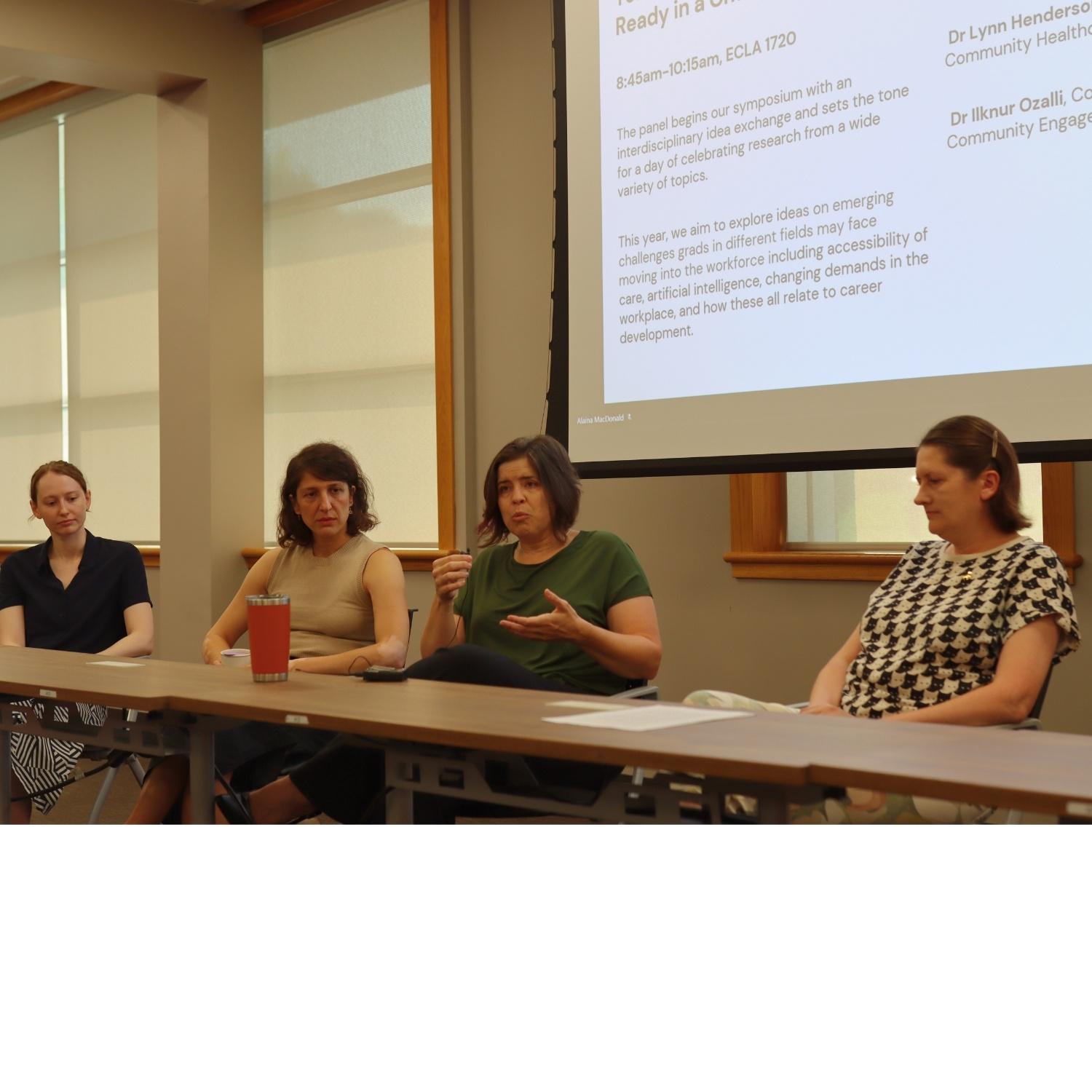
The symposium began with a panel discussion focused on preparing graduate students for the opportunities and challenges they may encounter as they transition into the workforce.
Panelists discussed topics including career development, changing workplace expectations, artificial intelligence and accessibility, while also sharing practical advice from their own professional experiences.
A central theme of the conversation was navigating uncertainty early in a career. Panelists spoke candidly about imposter syndrome and emphasized that feelings of self-doubt can persist even as careers progress. Students were encouraged to recognize these feelings without allowing them to limit their willingness to pursue opportunities or contribute their perspectives.
The discussion also highlighted the importance of building meaningful professional relationships. Panelists encouraged students to approach networking as an opportunity to form genuine connections, remain curious about the experiences of others and build relationships that can continue beyond graduate school.

Panelists:
Dr. Julia Montgomery – Dean of the Ontario Veterinary College.
Dr. Kat Sutherland – assistant professor in OVC’s Department of Population Medicine, with a focus on veterinary communications.
Dr. Lynn Henderson – veterinary director of the Kim & Stu Lang Community Healthcare Partnership Program.
Dr. Ilknur Ozalli – community engaged learning manager with the University of Guelph’s Community Engaged Scholarship Institute.
Oral and Poster Presentations
Throughout the day, graduate students presented research spanning oncology, farm and large animal health, infectious disease, pathways of disease, canine health and mixed methods research, alongside morning and afternoon poster sessions.
First- and second-place awards were presented in both the oral and poster presentation categories. First-place winners received a cash prize and an invitation to attend the Canadian Emerging Vet Scholars Summit (CEVSS) at the University of Calgary.
Oral Presentation Winners
First place: Shannon Wallace, Department of Biomedical Sciences

Advisor: Pavneesh Madan
Investigating the effects of polystyrene micro- and nanoplastic exposure in Bos taurus preimplantation embryos
Wallace’s research investigated how exposure to polystyrene micro- and nanoplastics affects early bovine embryo development. Embryos produced through in vitro fertilization were exposed to different concentrations and sizes of plastic particles. The study found decreases in cleavage and blastocyst development in several exposure groups, along with delays in embryos reaching key developmental stages. The findings contribute to a growing understanding of how environmental plastic pollution may affect mammalian reproduction and cattle health.
Second place: Samantha Dobson, Department of Pathobiology

Comparing temporal and regional patterns of H5Nx avian influenza virus detections through wildlife and domestic bird surveillance in Canada, 2021–2025
Dobson’s research compared patterns of highly pathogenic avian influenza H5Nx detected through Canadian wildlife and domestic bird surveillance systems. More than 53,000 wildlife samples were examined alongside detections from infected domestic bird premises. Both surveillance systems captured recurring seasonal waves of H5Nx activity, although differences emerged in the timing and magnitude of detections. The findings demonstrate the value of complementary wildlife and domestic bird surveillance systems for understanding avian influenza activity during prolonged outbreaks.
Poster Presentation Winners
First place: Samantha Mohr, Department of Biomedical Sciences

PFOA exposure affects oocyte in vitro maturation and developmental competence
Mohr’s research explored how perfluorooctanoic acid (PFOA), a persistent environmental chemical belonging to the PFAS family, may affect reproductive health. Using bovine oocytes as a translational model, the study found reduced rates of oocyte maturation across PFOA exposure groups, with preliminary findings also suggesting changes to spindle formation, chromosome organization and early embryo cleavage. Further research will examine additional effects of PFOA exposure on fertility and embryo development.
Second place: Fatima Askary, Department of Biomedical Sciences
Optimization of dorsal root ganglia conditions for applications in an innervated skin model
Askary’s research focused on developing a more physiologically relevant model for studying the role of nerves in skin and wound healing. The project optimized laboratory conditions that support the growth of dorsal root ganglia, which transmit sensory information and contribute to processes involved in wound healing. Ongoing work will integrate nerve cells with skin cells to create an in vitro model that more closely represents the organization of human skin and could provide a new platform for studying wound healing.
Excellence in Inclusive Research Award
Julia Garisto, Department of Biomedical Sciences

L-lactate Administration in the ACC Rescues the Aversion Response Lost After MCT4 Knockdown in Male but Not Female Mice
The Excellence in Inclusive Research Award was presented to Julia Garisto in recognition of research that thoughtfully incorporated equity, diversity and inclusion principles into its experimental design.
Garisto’s research investigated mechanisms involved in pain-related aversion and, importantly, examined differences between male and female mice. Historically, female animals have been underrepresented in pain research, despite chronic pain disproportionately affecting females. The study found sex-dependent differences in responses following disruption of lactate transport in the anterior cingulate cortex, highlighting the importance of considering sex as a biological variable in pain research.
By including both male and female animals and examining differences in their responses, the project contributes to a more inclusive and comprehensive understanding of pain biology and helps improve the relevance and applicability of scientific findings.
Thank You to Everyone Who Contributed to the Event
Thank you to all the graduate students, faculty, staff, judges and guests who participated in and supported the 2026 OVC Graduate Student Research Symposium. The breadth of research shared throughout the day highlighted the contributions OVC graduate students are making across animal, human and environmental health.
The symposium provided an opportunity not only to celebrate research, but also to exchange ideas, build connections and recognize the next generation of researchers advancing scientific discovery at OVC.