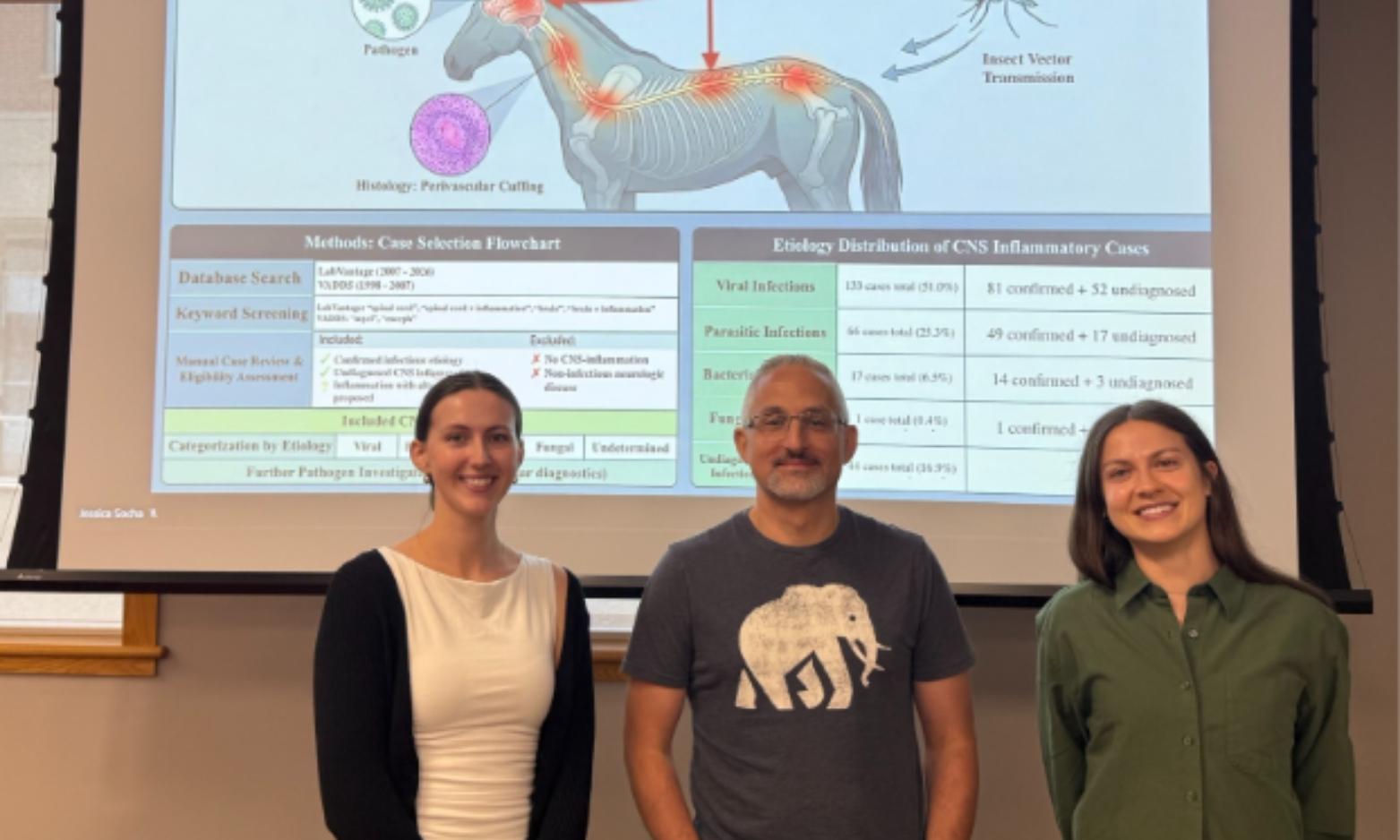
Through research mentorship, regular programming and presentation opportunities, SCORE gives students the chance to explore areas of interest while building skills that extend beyond the laboratory. Students gain experience navigating the research process, communicating complex scientific ideas to different audiences and connecting with researchers and peers across OVC.
This year’s program was coordinated by Matthew Scroggie, Academic Coordinator- Experiential Learning, who took on the role of leading SCORE for the first time.
“SCORE was an exciting way to begin my work in Experiential Learning. Seeing the enthusiasm, curiosity and growth of our summer research students throughout the program highlighted the impact that meaningful research experiences can have on their development,” says Matt. “It was a privilege to be part of their journey and to see another successful year of SCORE come together.”
For many participants, the program also serves as an introduction to research and the opportunities it can create.
“SCORE was my first experience with research, and it made the process feel much more approachable,” says DVM student Jessica Socha. “The weekly meetings and presentations provided ongoing support, kept me on track and gave me the opportunity to learn from both faculty and classmates working on a wide range of projects.”
Socha explored equine encephalomyelitis during her summer research and says the experience helped her build connections across the College while increasing her confidence in pursuing research throughout her education and career.
The program culminated in a presentation competition where students translated their summer research into three-minute oral presentations, followed by questions from a judging panel. With this year’s results separated by only decimal points, the program recognized four top presenters in each of the DVM and undergraduate categories.
DVM Student Category
Eric Lu
Characterizing Sleep-Wake Patterns in Dogs with Idiopathic Epilepsy using Actigraphy
Jessica Socha
Do We Understand Equine Encephalomyelitis? Neigh!
Karson Theriault
Going with the Flow: Can Flow Cytometric Markers Predict Prognosis in Canine B-cell Chronic Lymphocytic Leukemia?
Katya Douchant
What’s in the Water: Exploring Water Quality and Calf Health on Ontario Beef Farms
Undergraduate Student Category
Abhi Sethi
Evaluation of the Neutrophil-to-Platelet Ratio and Lactate Concentration to Predict Sepsis in Neonatal Foals: A Retrospective Case-Control Study
Mashaal Zuberi
A Gut Feeling: Why Definitions Matter in Acute Equine Colitis
Roocha Shukla
The Role of miRNAs in Colony Formation in Canine Osteosarcoma Cells
Sara Terier
Investigating Clients’ Expectations of Communication from the Veterinary Team When Caring for a Cat with Chronic Kidney Disease
Beyond the presentation competition, students say SCORE helped them better understand how research connects to their education and future careers.
“The OVC SCORE program is an incredible opportunity that allows you to take your research a step further,” says Sara Terier. “I really valued the opportunity to explore my research in a structured and engaging way, and to develop my confidence in communicating it in different ways.”
For Mashaal Zuberi, the experience provided an opportunity to develop both technical and communication skills.
“I learned how to apply inclusion and exclusion criteria and discuss my research with different audiences,” says Zuberi. “I also gained a deeper appreciation for the research process and its importance in clinical practice.”
Some participants discovered an interest in research they plan to continue beyond the summer. Undergraduate student Lily Copp entered SCORE without previous research experience and is now continuing to work with her advisor during the academic year.
“It was a great introduction to the world of research and academia,” says Copp. “I ended up really enjoying it and learning a lot, and I’m continuing to work with my advisor in his lab throughout the school year, so I think that says a lot about how much I enjoyed the experience!”
For returning participant Eric Lu, SCORE provided another opportunity to continue developing his research skills while exploring an area of personal interest.
“This is the second year that I’ve been privileged to participate in the SCORE program, and it continues to be a great opportunity for students like myself to be introduced to and develop skills that lay a solid foundation for understanding research,” says Lu.
The program also provided flexibility for students participating from outside Canada. Paloma Ricardo, who returned to Brazil during the program, was able to participate online and present her project to a broader audience.
“I truly enjoyed my experience with SCORE,” says Ricardo. “The program provided an excellent opportunity to learn, improve my scientific communication skills and present my project to a broader audience. I was also very grateful for the opportunity to participate online after returning to Brazil.”
Select SCORE students also represented OVC at research conferences beyond the University of Guelph this season. Shelby Duggan and Spencer King participated in the National Veterinary Scholars Symposium in Raleigh, North Carolina.
Amelie Mahrt-Smith, Noah McMaster and Eric Lu were also selected to represent OVC at the Canadian Emerging Veterinary Scholars Summit (CEVSS) in Calgary, Alberta.
The SCORE program is supported by faculty, staff and graduate student judges who provide students with feedback on their presentations, along with faculty supervisors who mentor students throughout their summer research experiences.
Congratulations to all of the students who participated in SCORE 2026 and contributed to another summer of research, collaboration and learning at OVC!