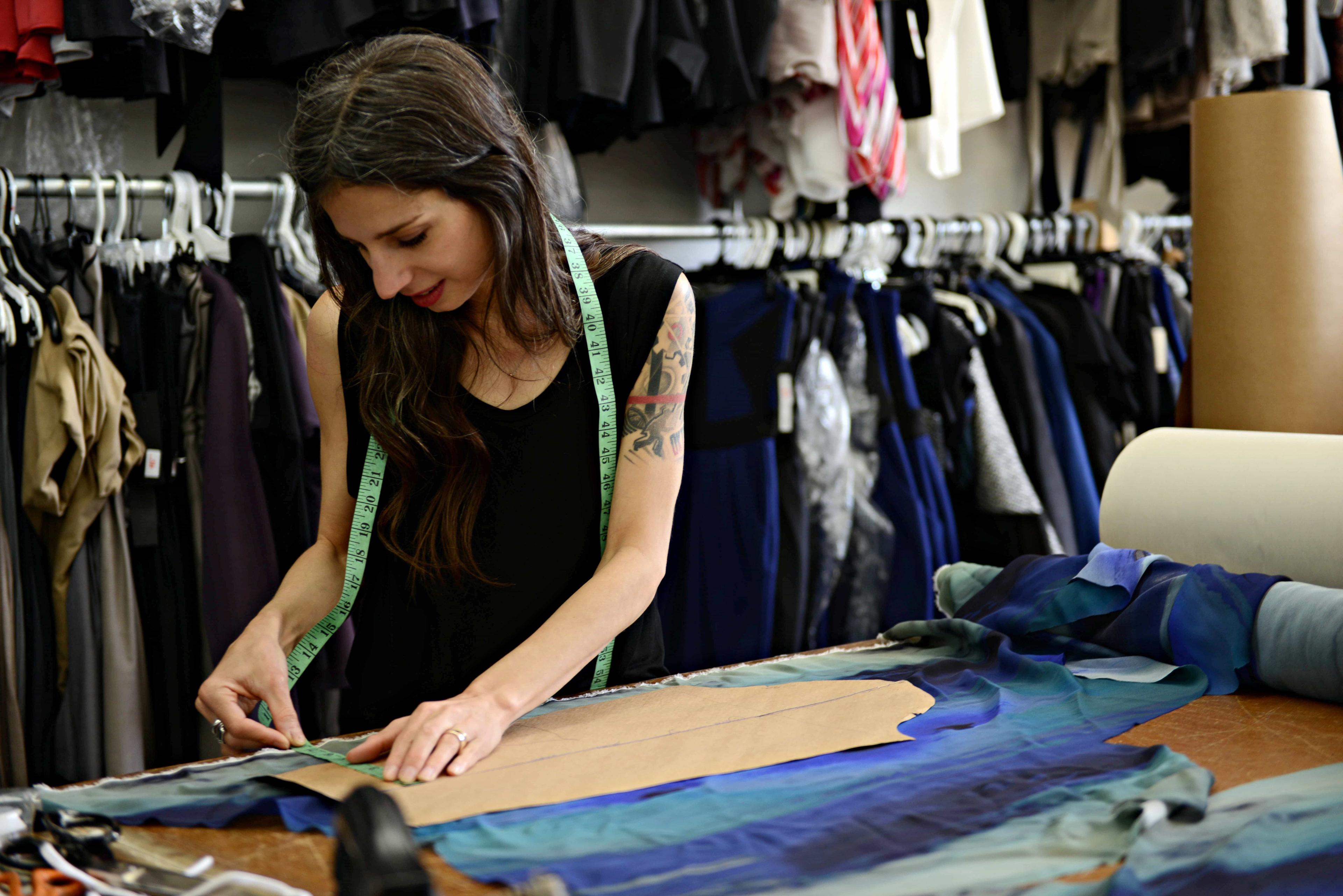
An improved and more sustainable future for costume design and production along with robust plans for collaboration spanning many disciplines have been strongly established for the College of Arts (COA) at the University of Guelph thanks to a generous donation from Dr. Eric Fillion, director of the International Institute for Critical Studies in Improvisation and assistant professor in the School of Languages and Literatures at U of G.

Tragically, Fillion lost his wife, Valérie Dumaine, a much-loved Canadian fashion designer, last year, shortly after moving to Guelph. In Fillion’s words, “Valérie was authentic, kind and generous, inspired and inspiring, with an insatiable curiosity, a contagious positive mindset, an abundance of talent and an unflinching love for people” and “firmly believed in the value of what today we call Experiential Learning (EL).”
Dumaine was born in Montreal, where she completed and later taught in the Fashion Design program at LaSalle College and created an enormously successful, ecologically grounded fashion line in her name. Her core values, Fillion explained, included sustainability (she was a champion of eco-fashion, working to reduce waste and experimenting with upcycling), education (throughout her [twenty-year] career, she supported the next generation of fashion designers, notably through mentoring and apprenticeships) and the worldmaking power of the creative arts (he saw her work always evolving at the intersection of other art forms including photography, music and cinema). “I shared, of course, these values with Valérie,” Fillion expressed.
In Dumaine’s honour, Fillion donated over 350 bolts of fabrics, buttons and zippers, thread, scissors and other tools as well as industrial sewing machines, a straight stitch machine, a serger and a buttonhole machine from her studio to the Isobel (Timmy) Laidlaw Theatre Design Studio in the Arts Research Centre in the COA at U of G.
When asked why he chose the Isobel (Timmy) Laidlaw Theatre Design Studio as the recipient of this gift, Fillion noted that though he had made donations in his wife’s memory in Montreal, he also felt it was important to make a contribution in Guelph, in the spirit of a life that they had planned to build here together. Fillion also shared that Dumaine had “expressed an interest in supporting the theatre design studio” in the past so, in some ways, he was following her cue.
“I could not think of a better home than the Isobel (Timmy) Laidlaw Theatre Design Studio for this donation because of the place it occupies in the Arts Research Centre, a vital hub for the continued expansion of interdisciplinary work and research-creation at the University of Guelph,” Fillion explained.
Immeasurable Impact

Experiential, or hands-on, learning plays a pivotal role in many COA and U of G courses. Simon Flint, costume coordinator for the Theatre Studies program in the COA, explained that the donated materials and machines have already provided many practical learning opportunities and benefits to students in COA courses like Theatre Workshop Three and Four, Introduction to Production and Design and Costume Construction, an EL course that Flint instructs which is focused on learning and working in the Isobel (Timmy) Laidlaw Theatre Design Studio and on the machines and equipment within it. Flint also shared that the donated materials and equipment were used extensively in large scale COA productions like Little Shop of Horrors, The Late Wedding and the College’s most recent production Into the Woods.
From Flint’s perspective, the donation has proven to the University that there’s an overwhelming student interest in courses involving costume design and even led to the creation of the EL course that he instructs, along with another EL course that focuses on costume design and construction.

The donation has also been an impetus for many improvements to the Theatre program. “Access to industrial machines has significantly increased our ability to produce fully built costumes from scratch as well as our ability to do full alternations,” shared Flint. He went on to note that the donation has also facilitated opportunities for students to work on a wider range of materials and increase their individual abilities and uses of non-traditional materials and modern, state of the art machines that they may not otherwise have had access to. From Flint’s point of view, having opportunities to use the donated materials and equipment renders students career ready. Grace Tinning, who is pursuing a Major in Theatre Studies in the COA, is one of these students.
Tinning, who was involved in building costumes for the Theatre Workshop Three and Four courses and a COA musical theatre production, shared that the donated materials and equipment have made a very positive impact on her and the program. From her perspective, the new equipment allowed a lot more people to work at one time. “More sewing machines, more sergers so there wasn't a wait to use a machine...,” she explained.

The positive impact of Fillion’s donation is certainly widespread. Flint mentioned it has led to collaboration with the Department of History in the COA and has also decreased the bottom line for himself and his colleagues in the wardrobe by providing them with readily available materials that they would typically need to go out and purchase.
Flint also shared that in the summer of 2025, Two Planks and a Passion Theatre in Nova Scotia, a COA Theatre Studies program community partner, visited the College to work with students to use the donated materials to produce custom costumes which won Best Costume Design at the Merit Awards in Nova Scotia.
Looking Forward
The donation will undoubtedly continue to benefit students like Tinning who shared that she plans to work in theatre or film wardrobe in the future. “I think the materials and machines really helped me broaden my horizons for what I can use and what is possible with different materials and I believe that they can help tons of future students going through the [Isobel (Timmy) Laidlaw Theatre Design Studio,]” she noted.

Demonstrating the breadth of use that the donation will see, Flint shared that “every student who is taking a Theatre Major or Minor will have the opportunity to [be introduced to the donated materials and equipment] in the [Isobel (Timmy) Laidlaw Theatre Design Studio].” Also, students entering the Bachelor of Fine Arts – Music Theatre program, set to launch in the COA in Fall 2027, will have many opportunities to work with the equipment and materials in a variety of capacities.
On a larger scale, the impact of the donation will carry across the University and into the community, along with Dumaine’s legacy.
Fillion intentionally framed the donation “to support the theatre design studio in the College of Arts, including research, teaching and creative works at both the undergraduate and graduate level.”
“My wish is for this equipment and the materials to support the theatre program but also—and this is more than important—to provide the conditions for building additional momentum around interdisciplinary projects that can engage students and faculty in the School of Theatre, English, and Creative Writing and in the School of Fine Art and Music (e.g., the production Into the Woods) as well as in the International Institute for Critical Studies in Improvisation and its corresponding PhD program.””

Flint shared that the donation has also contributed to enhancements of the Theatre Program’s community partnerships with organizations like Two Planks and a Passion Theatre who visited the COA and worked with students to use the donated materials to build costumes once again this past summer. He went on to say that he, his colleagues and Theatre Studies students also partnered with a local high school and used the donated materials and equipment to produce costumes for a production of Robin Hood performed by another COA community partner, King’s Christian Collegiate College.
With a focus on the future, Flint, Fillion and their colleagues are in the process of developing the Valérie Dumaine Fabrics Library, which they envision as an on-campus resource where groups and students can request access to materials needed to aid them in their creative endeavours. They envision the library as a space which will drive the expansion of possibilities for how the donated materials and equipment can be used and help others learn both about and from Dumaine’s incredible work in the realm of Canadian ethical fashion.
"Not only can this donation sustain teaching and productions in theatre and musical theatre for years to come but there are also enough materials to support other units and departments who may need to use fabrics for in-class and extracurricular activities... We are also imagining the Valérie Dumaine Fabrics Library being used to facilitate arts-based community making workshops and programs in partnership with local organizations and artists collectives, thereby helping develop and nurture the connections that give meaning to the work that we do,” commented Fillion.
Over the summer, an installation in tribute to Dumaine was put in place in the Isobel (Timmy) Laidlaw Theatre Design Studio. This year, community members will be welcomed to visit the space to learn more about her and see the array of donated fabrics and equipment in person.
If you are interested in supporting the Arts Research Centre, you can make a donation online or connect with Erica Charlesworth, senior development manager, at charlese@uoguelph.ca.