Lang BComm majors offer students flexibility
Lang Bachelor of Commerce majors offer students the flexibility to find themselves
Ava Overholt may be poised to graduate from the Gordon S. Lang School of Business and Economics with a Bachelor of Commerce focused on Hospitality and Tourism Management (HTM) with a minor in Sport and Event Management, but she started out in real estate. Realizing it wasn’t for her, she began exploring the new major by joining the for the HTM student association. That clicked.
“I switched my major in second year, took the intro courses, which I loved, and it piqued my interest. Career-wise, I felt like I was finally in the right path,” says Overholt. She added the minor later, and now aspires to pursue her dream of travelling to support sporting events like the Olympics or World Cup.
Mark Holmes, director of the School of Hospitality, Food and Tourism Management (HFTM), says what Overholt experienced is by design. “The beauty of LANG is that we have different majors. Students can major in Economics, Accounting, Real Estate, Marketing and other areas. It's really a Build-Your-Own-Adventure, an opportunity for students to come in and get that solid business foundation, but then to strengthen that with interests in other areas.”
Furthermore, students can even enter with an undeclared major and choose after first year. “So, they come in, get to know the general business core, and take a few electives in different areas, to make the decision on where they want to specialize. That first year is really their opportunity to try a few different courses they think they might like, and then pick a specialization,” adds Holmes.
Finding support from profs and peers
Another element that Overholt says she appreciated about LANG were the small class sizes, particularly in upper year, and the relationships she developed with both faculty and peers. “You're not just getting overlooked in a lecture of 300 people. You're getting that one-on-one experience, and the professors are always there, willing to help you,” says Overholt. “I was able to get close with all the faculty, which has been really awesome throughout.”
She also remained active with the HTM student association that she joined initially. “As a first-year being able to go to HTM student association events, I was able to talk to older students who shared their experiences. Seeing what everyone else was doing made me sit back and think, ‘I don't have to follow what everyone else is doing,’” she said, noting that knowledge bolstered her confidence to build her own path. “That's when I decided to take this Event minor and to tie in together to make my own niche that I would love to be in, in sports tourism,” she says.
Holmes notes that the benefit of the business foundation means that students are versatile even after graduation. “It really is the benefit of having that core, foundational business degree is that you can walk out and work in any business because you understand and have the skills that every business needs to succeed.”
Embracing opportunity
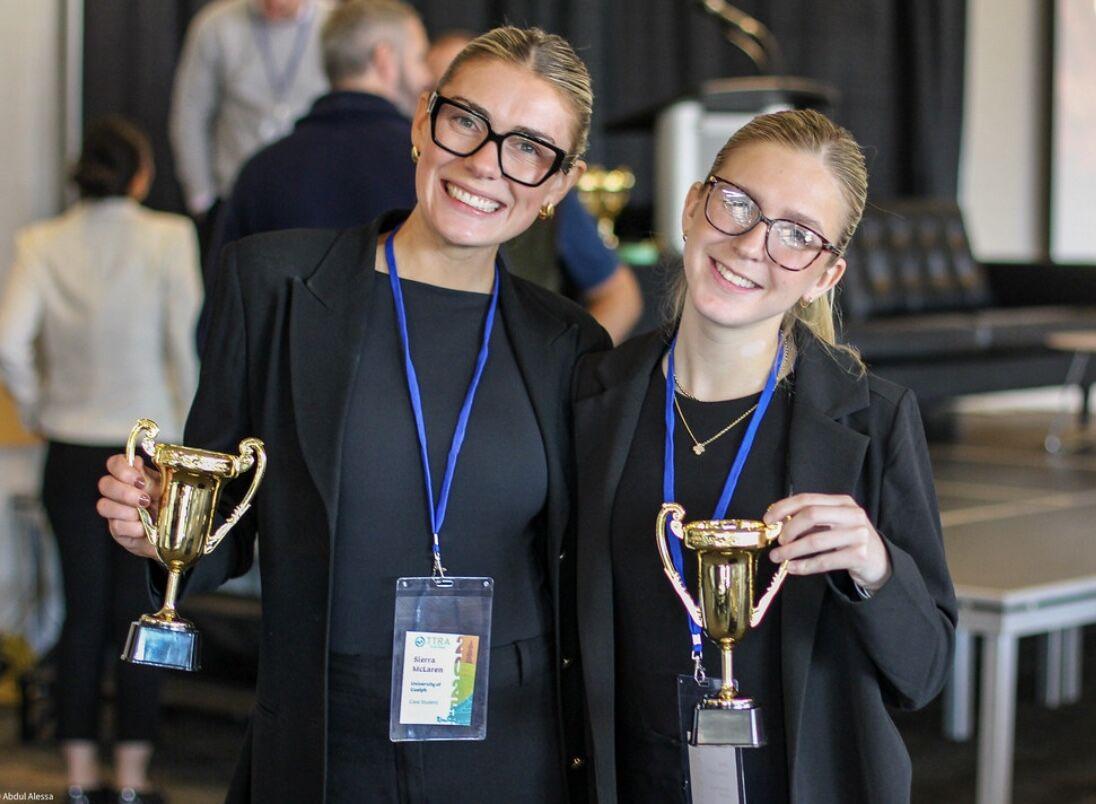
Overholt also embraced case competitions as an extracurricular during her studies, a learning opportunity she highly recommends. For the national Travel and Tourism Research Association case competition, she and her team flew out to British Columbia to compete, winning first place in November 2025. Overholt also competed in the annual Hospitality and Tourism Student Case Competition, an annual competition hosted in rotation between LANG, Toronto Metropolitan University and UQAM in Quebec.
“These experiences have also been really helpful for me to see where I want to go, because it takes what you're learning and applies it in a real-world context,” says Overholt, adding that she developed her public speaking skills and got the chance to network with both peers and competition judges. “I made so many connections through doing that. I would stress to new students, if you ever see the case competition opportunity, just do it because it's going to be so rewarding.”
Between connecting with her professors and peers, joining the student association and her case competition experience, Overholt says she’s built not only a network of colleagues but a circle of friends. She considers that to be a serious advantage as she pursues next steps, and advises others to similarly look to carve out their own pathways through the business world. “Put yourself out there, meet people, connect. You have all these events right at your feet, you can help run them, it looks great on a resume. It's just honestly been an awesome experience for me.”
About the Lang School of Business and Economics: Learn more about our mission to make business a force for good.