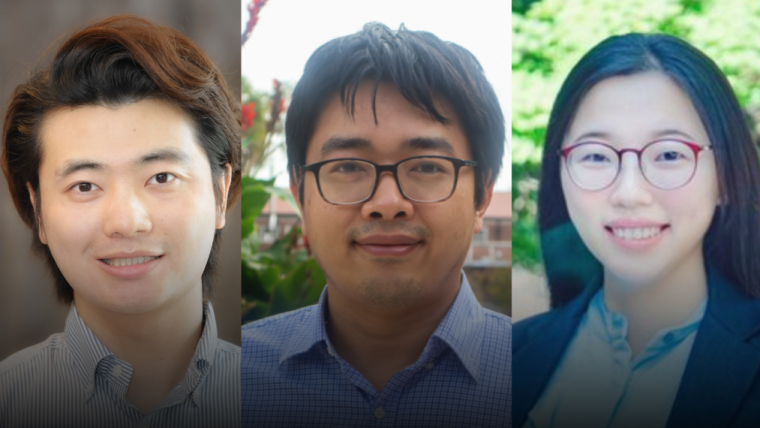
The Ontario Agricultural College’s Department of Food, Agricultural and Resource Economics (FARE) [1] is welcoming three new faculty members whose work examines some of the biggest challenges facing food systems today: how food gets from farm to table, how climate change is affecting agriculture and communities, and how environmental and agricultural policy can better protect natural resources and improve human welfare.
Their research focuses on real-world issues that affect farmers, businesses, consumers, and policymakers, both in Ontario and around the world. While their methods are data-driven, their goals are practical, helping decision-makers understand what’s happening and what can be done to build a more resilient and sustainable agri-food system.
Understanding food systems, from policy to the checkout aisle – Dr. Wenjie Zhan
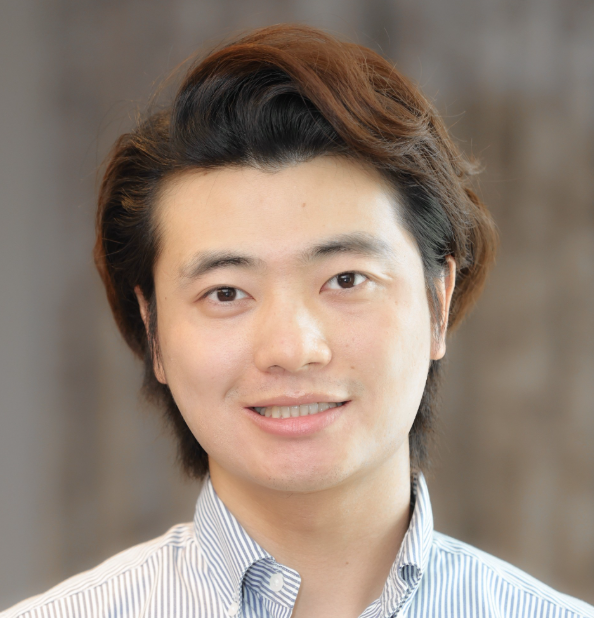
Dr. Wenjie Zhan [2] joins FARE as an Assistant Professor in Quantitative Methods for Agricultural Economics. He recently completed his PhD at the University of California, Davis, and brings expertise in analyzing how food and agricultural businesses respond to policy, technology, and climate pressures.
Much of Zhan’s work focuses on retailers and consumers—an often-overlooked part of the food system. He uses large datasets and modern analytical tools to study how changes in policy or global markets show up in grocery stores and affect prices, jobs, and consumer choices.
“I’ve just started a project looking at how trade conflicts between the U.S. and Canada affect retailers,” Zhan said. “The goal is to understand how governments can design policies so these transitions don’t have negative effects on people’s everyday shopping experiences.”
Zhan is eager to connect his research directly to public decision-making.
“I’m really looking forward to interacting with policymakers in agriculture and food in Ontario,” he said. “U of G has a unique opportunity to do research that directly impacts people through its work with OMAFA. There’s also a strong group of experts in agri-food economics in FARE, and I’m excited to learn from my colleagues and grow here.”
Measuring the hidden costs of climate change- Dr. James Ji
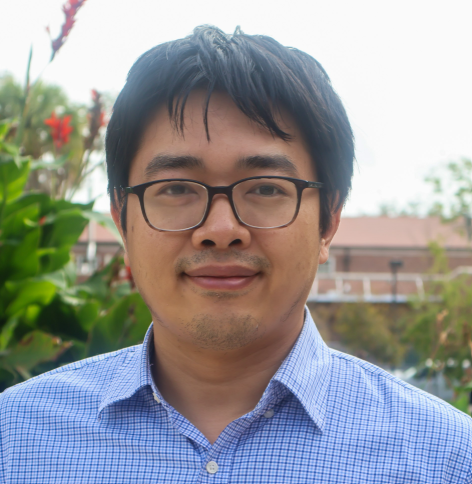
Dr. James Ji [3]joins FARE as an Assistant Professor specializing in climate change economics and policy. He earned his PhD from Virginia Tech and has held faculty positions at the University of Florida and Brandeis University. His research examines how climate and environmental changes affect agriculture and human well-being across the globe, including in North America, China, and South and Southeast Asia.
Ji’s work looks beyond obvious climate impacts to measure less visible damage such as how extreme heat affects farmers’ health, family life, and productivity.
“Climate change affects everyone,” he said. “Extreme heat harms farmers, reduces crop yields, and also affects mental health and family relationships. These are real impacts that often don’t show up in simple economic numbers.”
He was drawn to OAC because of Canada’s growing leadership in environmental research.
“I see Canada as a leader in environmental policy and research,” Ji said. “My work has a global focus, and Canada has an increasing footprint in addressing environmental challenges. I’m excited to work with partners across OAC and the broader Guelph community to strengthen research in environmental and climate economics.”
Informing environmental policy through freshwater research – Dr. Weizhe Weng
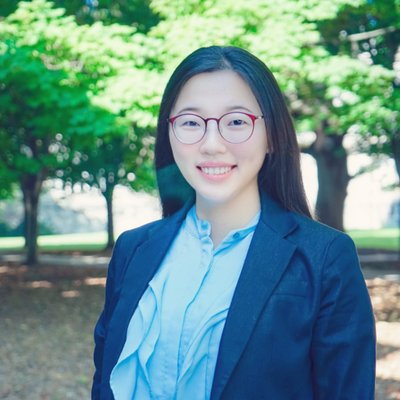
Dr. Weizhe Weng [4] joins FARE as an Assistant Professor in environmental and natural resource economics. She holds a PhD in Economics from Virginia Tech and brings extensive experience from previous faculty roles at SUNY Geneseo and the University of Florida. Her research centers on evaluating the impacts of environmental and agricultural policy, valuing ecosystem services, and examining the complex interactions between human behaviors and natural systems.
Weng is particularly interested in the translation of academic findings into actionable tools for decision-makers.
“I really enjoy working on environmental and agricultural policy research that empowers stakeholders make informed decisions,” she said. “The goal is to drive improved environmental outcomes by providing clear, evidence-based insights.”
Currently, her work focuses on freshwater resources, an issue she sees as especially relevant in Canada.
“I’ve worked on water issues in multiple states of the U.S., such as Wisconsin, New York, and Florida, and freshwater is such a major issue in Canada that it’s a great opportunity to apply and expand this work here.”
She is also looking forward to building international collaborations.
“This is a critical time to work with both Canadian and global partners on freshwater policy research,” Weng added, noting that climate change is intensifying the shared challenges of water management and environmental protection.
Together, Zhan, Ji, and Weng bring new perspectives and expertise to FARE, strengthening the department’s ability to address pressing food, climate, and environmental challenges in ways that matter to everyday life.