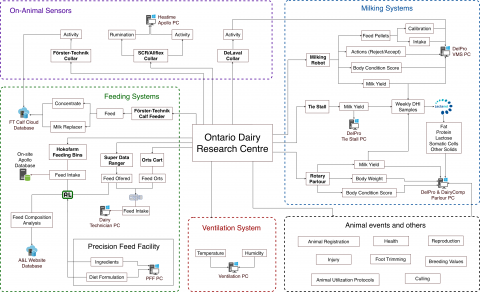
University of Guelph staff have developed a centralized data system that transforms how dairy research data is managed, reducing risk and error while ensuring research is reliable, consistent and usable across teams.
At the Ontario Dairy Research Centre, which is owned by Agricultural Research and Innovation Ontario and managed by U of G through the Ontario Agri-Food Innovation Alliance, researchers generate vast amounts of data every day. Sensors, cameras and scales track everything from feed intake to milk yield.
Until recently, managing this volume of information was complex and time-consuming.
The team addressed this by building an automated data pipeline that pulls, cleans and organizes information in one place.
“Previously, researchers had to track down files across different machines, and data often came in messy, duplicate or unreliable formats. Errors occurred, and valuable knowledge risked leaving with graduates,” says Lucas Alcantara, manager, Systems, Data & Research Technologies. “It was time-consuming, frustrating and inefficient.
“This is why the centralized system was essential.”
A New and Improved Data System
The new data system made dairy research faster, more reliable and less risky. Researchers spend less time managing files and more time on discovery, while cleaner, more accurate data strengthens results, protects valuable long-term datasets, and enables broader collaboration and larger-scale research questions. There are already 55 active users in dairy alone.
“The impact of the new data system was immediate,” says Alcantara. “Researchers are spending less time managing files and more time doing research, with cleaner, more reliable data and far less risk. At the same time, easier access to historical data is opening new opportunities for collaboration and large-scale analysis.”
The project began in 2017, when a PhD student created early scripts that laid the groundwork for a centralized system. It expanded with Dr. Christine Baes’ vision for a central repository, as research programs increasingly required consistent, long-term, high-quality datasets.
It was piloted and refined through close collaboration among researchers, including pioneering work by Dr. Rozita Dara, the Ontario Agri-Food Innovation Alliance and the Agri-food Data Canada team, including Alcantara.
A Shared Infrastructure
Support from the Office of Research helped carry the system across student turnover and early pilot stages, providing the coordination needed to scale it into a shared, institution-level research infrastructure.
Today, the system is administered by Dr. Michelle Edwards and the Agri-food Data Canada team, who ensure it continues to run smoothly.
Alcantara says that the system has expanded from dairy to beef, and swine is almost ready for inclusion. Eventually, all research stations will be connected.
“Few institutions in North America have anything like this,” he says. “This work positions U of G and its partners at the forefront of agricultural data innovation.”