Master of Fine Arts in Studio Art
Refine your Artistic Voice. Build a Creative Career.
Are you an emerging artist looking to hone your practice and gain professional experience? The MFA in Studio Art at the University of Guelph offers a dynamic environment for cross-disciplinary exploration and critical engagement. You will fine-tune your artistic voice through seminars in contemporary theory, teaching preparation and intensive critiques with faculty and visiting professionals.
Throughout the program, you will have opportunities to work in your own studios and access technical labs with support from expert technicians. The MFA program at the University of Guelph offers graduate students an individually tailored education that is fundamentally concerned with the development of an informed, relevant, and professional level of studio art practice. The program of study accommodates specialized media concentrations within an interdisciplinary educational context. Rigorous research and intensive studio art production is actively supported by dedicated advisory committees, in conjunction with group seminar courses.
If you are looking for space to take creative risks and make a meaningful impact in today’s art world, this program is for you.
Program Overview
- Study Option: Thesis Exhibition and accompanying support paper
- Delivery: In-Person
- Duration & Start Terms: 24 months, Fall semester start
- Admission Average: A BFA degree or an honours BA in fine or visual arts; in exceptional cases, the holder of a degree in another field
- Deadlines: January 15, 2027
School of Fine Art and Music, located within the College of Arts.
Take a Closer Look at the MFA Studio Art
Program Structure
You can complete the Studio Art MFA in 24 months. You will study through a single stream which consists of a Thesis Exhibition and accompanying support paper.
You will require a total of 10.00 credits to complete this program. In addition to individually oriented studio courses, you will be required to complete:
- Eight MFA seminars that dive into contemporary art discourse and practice teaching art at the post-secondary level.
- Six graduate courses in art theory and criticism and
- Two teaching practicum courses.
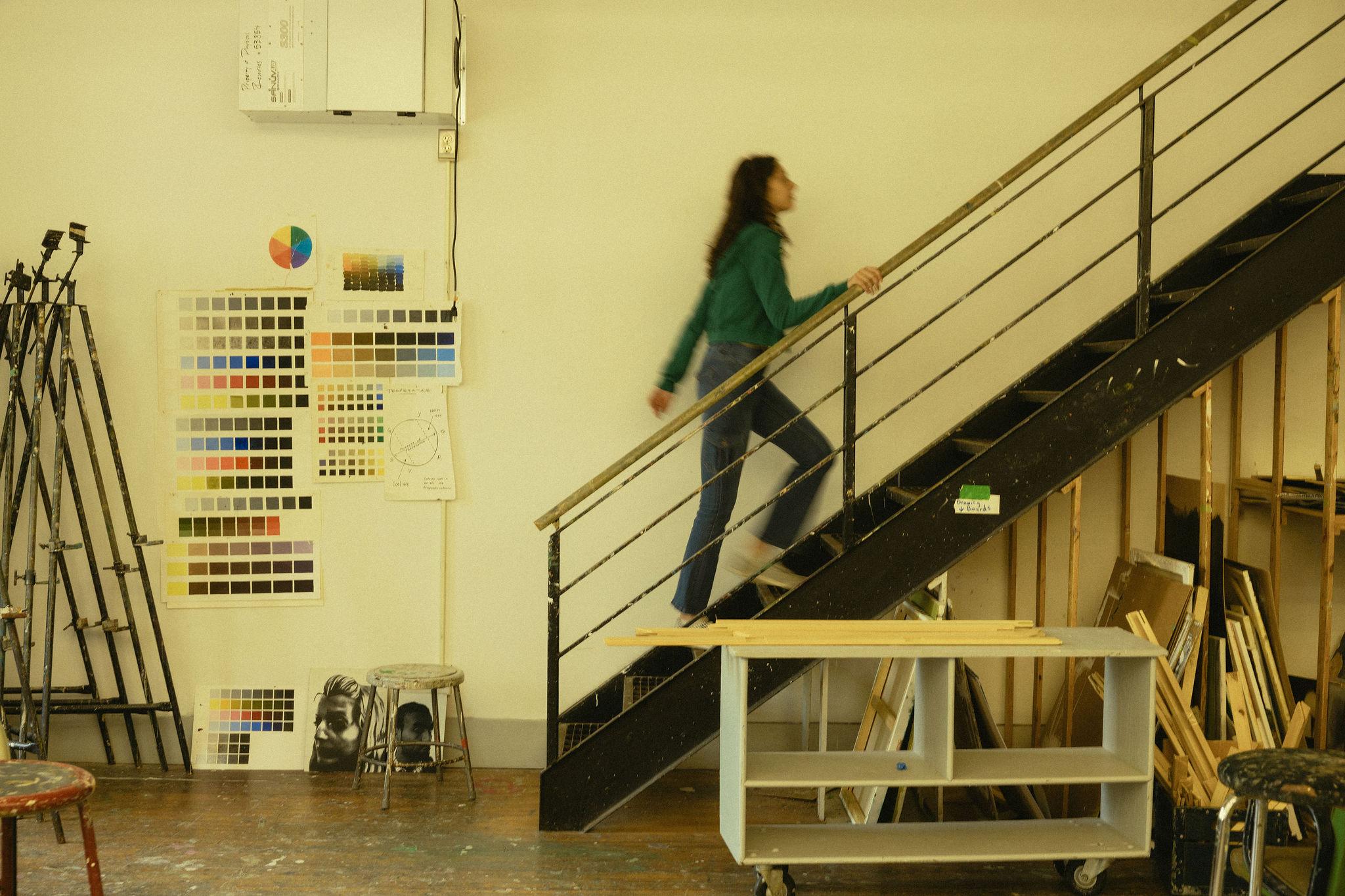
Graduate students at the University of Guelph are provided with exceptionally spacious, individual studios which can accommodate a variety of media requirements.
You will present a thesis comprised of an exhibition of artwork, a 4,000-5,000-word support paper outlining the aesthetic, historical, theoretical and formal issues relevant to your work and an oral examination devoted to the MFA Exhibition with reference to the paper.
The Thesis Exhibition is the culmination of the student’s work in the program. Thesis defenses are scheduled between late-April to mid-May. Defending candidates can organize their presentation in the form of a traditional, cohesive gallery show, or as a conceptual overview of their visual research over the two-year program.
Studio Courses
A professional level of studio practice is required for the completion of the MFA degree. The 1.5 credits each for Introduction to Studio, MFA Studio I, MFA Studio II, and MFA Studio III recognizes that the major emphasis is to be placed on studio work.
Seminar Courses
Seminars in art history, theory and criticism, studio practice and pedagogy offer academic support for studio research. Students participate in two seminar courses each semester as a mandatory program requirement. MFA Seminars explore critical issues in the visual arts that are relevant to studio practice (Fall & Winter). These seminar courses are taught by different Studio Art Graduate Faculty each semester and will reflect different approaches and issues in the arts.
Pedagogy Courses
The MFA Program offers two Teaching Practicum courses in preparation for teaching at the university level. At the time of their introduction in 1992, these courses in pedagogy were unique to the Guelph MFA program. The Teaching Practicum courses are designed to combine theory and practical experience as they relate to the teaching of studio art.
Visit the Graduate Calendar for more information on the program courses.
*A maximum of two courses outside the School of Fine Art and Music may be taken in art history, theory and criticism in addition to Studio Art (SART) courses. The courses selected must be acceptable to the School of Fine Art and Music and the Assistant Vice-President (Graduate Studies) for graduate credit. All 12 "substantive" courses comprise your prescribed studies, in which you must obtain an overall average grade of B- or higher.
Year 1, semester 1 - Fall
UNIV*7510 - Full Time Active
FINA*6510 - Introduction to Graduate Studio
FINA*6530 - Teaching Practicum
FINA*6540 - MFA Seminar
Year 1, semester 2 - Winter
UNIV*7510 - Full Time Active
FINA*6515 - MFA Studio I
FINA*6545 - MFA Seminar II
FINA*6551 - Seminar in Art Theory & Criticism
Year 1 - Summer
UNIV*7510 - Full Time Active
UNIV*7500 - Research Writing
Year 2, semester 3 - Fall
UNIV*7510 - Full Time Active
FINA*6610 - MFA Studio II
FINA*6640 - MFA Seminar III
FINA*6531 - Teaching Practicum II
Year 2, semester 4 - Winter
UNIV*7510 - Full Time Active
FINA*6615 - MFA Studio III
FINA*6641 - MFA Seminar IV
FINA*6652 - Individual Study in Art Theory & Criticism
Year 2 - Summer
UNIV*7510 - Full Time Active*
UNIV*7500 - Research Writing*
*Contingent upon approval from or recommendation by the MFA Committee and the Office of Graduate and Postdoctoral Studies
The faculty members of the MFA program are active artists with prominent reputations. They offer a wide range of media expertise involving extensive theoretical and aesthetic perspectives. At an optimal size for effective student-faculty interaction, the program readily accommodates cross-disciplinary exchange, a condition which is a defining feature of contemporary art. With an exceptionally committed graduate faculty and limited student enrolment, the MFA program is conducive to active dialogue and mutual participation. Graduate students are encouraged to experiment with confidence and to pursue their development as artists in an environment of flourishing intellectual, cultural, and social exchange.
When considering your future, the MFA in Studio Art not only develops your art practice but also opens the door to a variety of fulfilling career opportunities:
Practicing Artist: Showcase your work in galleries, museums and cultural venues, building a reputation in the contemporary art world.
Art Education: Share your expertise by teaching art at universities, colleges or in community programs, inspiring the next generation of artists.
Creative Roles: Use your visual skills in fields like art direction, curation and digital media, collaborating with organizations that value innovative thinking.
Arts Administration: Lead initiatives in galleries, cultural institutions or arts organizations, shaping the development of artistic projects and events.
- A Top Comprehensive University in Canada
- Macleans, 2025
- 55% of world leaders
- are humanities and social sciences graduates (Universities Canada)
- Top 10 in Canada for Reputation
- Times Higher Education, 2025
Meet our Faculty
How To Apply
Students in our graduate programs work with an Advisory Committee usually made up of one main Advisor and one to two additional Advisory Committee members depending on the program. These Advisors are faculty members whose research is in an area related to your interests. They will guide you as you prepare your Thesis, Major Research Project or Major Research Paper. It is a good idea to introduce yourself as early as possible to faculty members who you think might be interested in your work.
Once you start your program, you will have plenty of opportunities to get to know the faculty members in your department or area. Faculty are well used to being sought out by students who might want to work with them. They will welcome hearing from you and can help you focus your ideas. Students are expected to meet with all faculty members for studio visits in the first semester
Towards the end of your first semester, the MFA Coordinator will ask you who you think you would like to have on your committee and they will help you as necessary to get everything set up. You should have your committee formally established by the middle of your second semester at the latest so that they can work with and support you as you plan your project.
The deadline for the receipt of your complete application package for admission in the Fall semester is January 15.
Documentation of artwork: 20 digital images or up to 10 minutes of audio or video or a combination of both (Please note that one minute of video equals two images).
Acceptable formats include jpg, png and gif for images; mov, wmv, flv, and mp4 for videos; and mp3 for music. To optimize image quality and upload speed, please ensure that image files are approximately 1024 x 768px at 72dpi and please keep video files under 60MB each. Our SlideRoom portal offers additional instruction for submitting work and links for technical assistance.
Submissions are made through SlideRoom, where additional details and specific instructions are provided.
- Please note that SlideRoom will allow you to log in and edit your portfolio as much as you like, but no more changes are allowed after you click submit. A US$10 fee will be charged to each applicant at the time of submission.
A single-page statement of interest outlining the direction of your studio practice and your interest in the MFA program at the University of Guelph. The statement of intent should concisely and articulately discuss the concepts and ideas behind the visual work you have submitted. The statement should also, where applicable, demonstrate historical and theoretical awareness of contemporary art and your relationship to it.
Two letters of reference should be written by studio professors who are familiar with you and your work. As an acceptable alternative, one such letter may come from the department chair on behalf of the department where you have studied, or from a professional in the field of contemporary art who is familiar with your abilities.
A current curriculum vitae, including education, exhibitions, grants, residencies and involvement in the art community, including volunteer work.
If your first language is not English, a certification of English language proficiency must also be included e.g., Test of English as a Foreign Language (TOEFL), International English Language Testing System (IELTS), Michigan English Language Assessment Battery (MELAB) test scores for applicants whose first language is not English.
Note: The University of Guelph no longer accepts Duolingo test results.
- Completion of an Honours BFA or BA in Fine/Visual Arts or a related field.
- In exceptional cases, candidates with degrees in other fields may be considered if they demonstrate a strong portfolio and relevant experience.
Most Offers of Admission that we make for our graduate programs include an offer of funding and as part of your admission offer you will receive a detailed break-down of what that funding will include over the whole time you are in the program. Most funding consists of a mix of a guaranteed offer of paid work for the University, usually as a Graduate Teaching or Service Assistant, and scholarship income. You will need to pay your tuition and fees as well as your living expenses from this funding so you may need to supplement it with savings, loans or other income. Once you enroll in your program, you will be set up with an account with Student Financial Services; your funding will be paid into this account (every two weeks in the case of employment income) and you can pay your tuition and fees from this account and then move the rest into your own bank account.
Please visit the University of Guelph’s Guelph Graduate Tuition and Fees website to find tuition and fee information specific to your program.
Have Questions?
Graduate Program Coordinator:
John Kissick
519-824-4120 Ext 53191
jkissick@uoguelph.ca
Graduate Program Assistant:
Kate Artuso
519-824-4120 Ext 54671
sofamacademic@uoguelph.ca
Discover More Options
Master of Fine Arts in Creative Writing
The Master of Fine Arts in Creative Writing offers genre-based workshops, mentorships with professional writers, and teaching practicums. Students participate in literary festivals, collaborate with Toronto theatres, and engage in community-based writing workshops.
Master of Arts in Theatre Studies
The Master of Arts in Theatre Studies provides students with opportunities to engage in both theoretical and practical approaches to theatre. With guidance from award-winning faculty, students explore topics like performance theory and dramaturgy, preparing them for careers in academia, arts administration, and the performing arts.