By Cate Willis
A state-of-the-art facility high above campus is opening new avenues for research and innovation.
The controlled environments at the University of Guelph’s Phytotron allow researchers and students to conduct precise, high-quality research that drives discovery and innovation across disciplines.
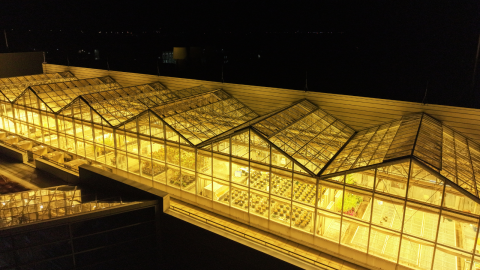
Located on the roof of the Summerlee Science Complex, the Phytotron features a climate-controlled greenhouse, 45 high-tech advanced growth chambers and an outdoor growing area.
The facility enables experiments that wouldn’t be possible outdoors or in standard labs. Researchers can manipulate light, temperature, humidity and carbon dioxide to mimic a wide range of climate conditions, from deserts to tropical environments.
For example, some researchers use its controlled environments to model rainfall and soil erosion, investigate pollinator health and test engineering and food science innovations. Others are exploring the role of mycorrhizal fungi in shaping plant communities and the postharvest preservation of fruits and vegetables.
“The Phytotron is more than a greenhouse; it’s a hub for discovery, education and cross-disciplinary collaboration that directly contributes to the U of G’s research and teaching mission,” says Michael Mucci, Phytotron coordinator.
“From plant growth to food science and engineering projects, we provide the conditions needed to explore new questions and train the next generation of scientists.”
A Hub for Diverse Research and Experiential Learning
Established in 2005, the Phytotron is one of six highly specialized facilities within U of G’s Advanced Analysis Centre and spans over 1,200 square metres
Originally designed for plant growth research in the College of Biological Science, the Phytotron has evolved into a key resource supporting a diverse range of research exploring how plants, ecosystems and environments interact.
Researchers conduct studies in plant genetics, pollination biology and ecology, as well as food science, engineering and agri-food systems.
The Phytotron is also used for undergraduate learning, supporting plant biology courses taught by Dr. Chris Meyer, where he integrates research and experiential learning, providing students with hands-on learning experiences.
In his second-year botany courses, Meyer’s students focus on plant anatomy and microscopy, studying species such as corn, soybeans, geraniums and petunias to understand plant cell structures and functions. In his third-year courses, students investigate mutations in Arabidopsis thaliana, a model plant species widely used in research, developing critical thinking and research skills through guided experimentation.
“It’s about the journey and not the destination,” says Meyer. “They get to conduct experiments and learn how a researcher thinks. It’s about the skills and mindset they develop during the process.”
Mucci says that the Phytotron is also crucial for advancing teaching and training.
“These facilities support faculty, graduate students, postdocs and undergraduates across multiple disciplines, giving them hands-on experience with cutting-edge research methods.”
Supporting a Wide Range of Research Activities
Mucci says the Phytotron’s stable, customizable environments allow multiple researchers and departments to work together efficiently.
“The Phytotron takes the pressure off individual labs by providing a centralized, communal facility,” Mucci says. “Researchers can access advanced resources as needed, while staff keep the infrastructure reliable and on the cutting edge.”
Looking ahead, the Phytotron’s ability to adapt will be central to its continued success
“What began as a facility for plant research has expanded to support unexpected projects in food science, entomology and engineering, and that adaptability is key to keeping the facility active, relevant and positioned for the future,” says Mucci.
“With its flexible spaces, expert staff and hands-on opportunities, the Phytotron continues to support research and training that drives discovery and innovation.”