U of G Professors are Bridging the First-Year Calculus Knowledge Gap
The knowledge gap between high-school and university calculus
A new approach from University of Guelph mathematics professors explored the use of low-stakes, optional quizzes aimed at evaluating pre-requisite math skills to help support the transition of first-year students into university-level math.
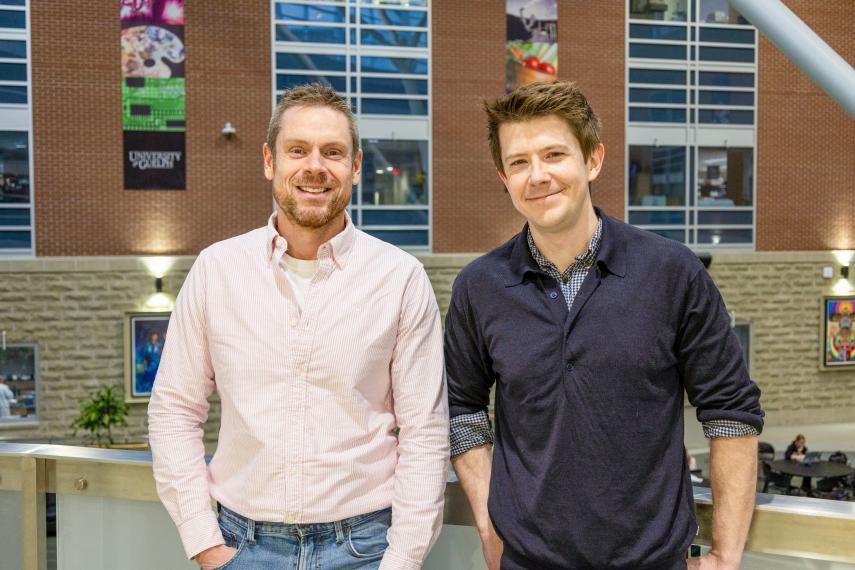
Dr. Matthew Demers and Dr. Geordie Richards in the Department of Mathematics and Statistics observed that post-pandemic first-year students taking Calculus I (MATH*1200) are not coming into university with consistent mathematical backgrounds, which supports broader studies that showed remote schooling worsened learning gaps. Traditional diagnostic testing can help identify the gaps, however, math anxiety has been linked to reduced confidence and achievement in university level math courses. To evaluate the prerequisite skill level of incoming students, both professors incorporated a new diagnostic tool into their curriculum.
Stress-free evaluation of math prerequisite knowledge
Beginning in Fall 2023, Dr. Demers began offering low-stakes, optional and incentivized online quizzes hosted on the educational platform MathMatize. Dr. Richards began using those quizzes the following year and shared the class data with Demers. The 13 quizzes provided randomized math exercises to test a student understanding of high-school-level precalculus knowledge. The quizzes were algorithmically designed to produce new problem sets with each attempt, which offered different variables and questions.
“The transition from high-school to university-level calculus can feel challenging for incoming undergraduate students and math anxiety is particularly common among first-year students,” says Richards, “MathMatize aims at easing their transition into university level calculus while also providing us with information.”
To help alleviate quiz anxiety, students could use notes, had unlimited attempts, no time limits, and got instant feedback with correct answers upon quiz completion. Collectively, the quizzes also accounted for 10 per cent of the student's final grade, incentivizing them to utilize the tool without heavily weighting their overall class grade. Students who chose not to participate had another grading scheme available to them.
Low-stakes learning led to higher achievement
Demers and Richards found that the participation in these optional quizzes was very high - about 89 per cent for the Fall 2023 semester and 78 per cent in Fall 2024. Demers and Richards found that for the Fall 2023 semester, MathMatize participants tended to overall have higher grades in the course, with a final exam average more than 10 per cent higher for MathMatize participants vs. non-participants, despite the fact that final exam problems did not mimic the format of the quiz problems. A similar (though less pronounced) pattern was observed in Fall 2024 as well.
Students reported that they appreciated the opportunity to refresh themselves on high-school concepts while also earning marks outside of high-pressure midterms and exams.
"Even though there is only data for two semesters so far, MathMatize has proven to be a successful tool that combines diagnostic assessment and active learning support," says Demers. "MathMatize is not merely a testing tool but a curricular approach that cultivates mathematical confidence and equity during an already crucial educational transition for first-year students."
This work was presented at the 11th International Conference on Higher Education Advances (HEAd’25).
Demers M. & Richards G. Supporting the Transition to University Calculus using MathMatize. In: 11th International Conference on Higher Education Advances (HEAd’25). Valencia, 17-20 June 2025. https://doi.org/10.4995/HEAd25.2025.20125
This story was written by Jamie Dawson as part of the Science Communicators: Research @ CEPS initiative. Jamie is an M.Sc. candidate in the Chemistry Department under Dr. Mario A. Monteiro. Her research focus is on characterizing bacterial cell-surface carbohydrate structures to ultimately develop glycoconjugate vaccines.