U of G Professor Uses Machine-Learning to Predict NBA Superstars
The untapped potential of predictive modelling in sports analysis
Predicting who will become the next NBA star player has long relied on a mix of experience, intuition and traditional statistics. The NBA generates increasingly detailed player data each season, which has fueled rapid growth in sport analytics, pushing the adoption of machine learning and advanced statistical tools. Using aggregated player data on the team level, sports analysts have applied these methods to identify high-potential players and predict team-level outcomes. For player development, team strategies and even fan engagement, being able to predict a player's points per game is highly valuable.
Despite the advances in sports analytics, accurately predicting a player's points per game is still a challenge. Previous studies’ machine learning and statistical modelling did not account for redundancies amongst individual player metrics, and did not focus solely on individual player metrics. Researchers in U of G’s School of Computer Science have introduced a new way of modelling and predicting player points per game that minimizes bias from overlapping metrics, improving the reliability of the prediction model.
A reliable and accurate framework that better predicts player PPG
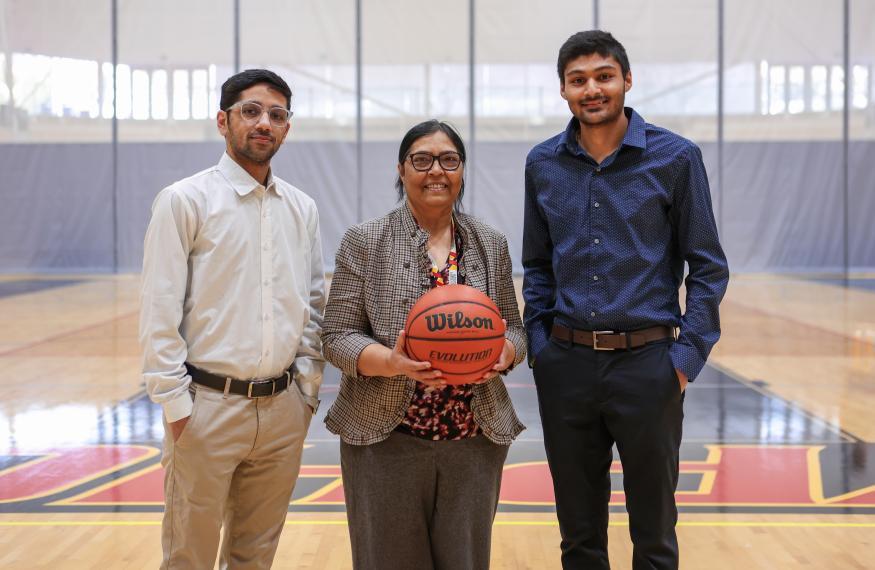
School of Computer Science professor Dr. Ritu Chaturvedi, undergraduate Computer Science student Neh Desai and Master of Data Science graduate Chirag Rathi developed a Correlation-Optimized NBA Scoring Estimator (CONSE) model framework. CONSE is not a single algorithm, but a structured way of selecting player statistics, and using those filtered metrics in machine learning and statistical models to make better player predictions, like player points per game.
CONSE explicitly focused on individual NBA player performance prediction using a compiled dataset spanning 10 NBA seasons (2013-23) from Basketball-Reference and official NBA statistics. Chaturvedi and team pre-processed the decade of NBA player data to address missing shooting percentages, combine the data for players traded mid-season, and to convert categories like player positions into numerical values that the model can process. The result was 18 carefully selected player metrics that can predict player points per game.
Chaturvedi and her researchers used those 18 player metrics to evaluate four regression models, from simple statistical formulas to more advanced machine-learning approaches, to determine which one most accurately and reliably predicted player points per game.
Careful processing and model selection is key to accurate predictions
The Random Forest regression model consistently outperformed the others, with reliable accuracy that was not skewed by outliers like elite scorers. The team showed that careful feature selection is just as important as model choice when predicting player performance. By focusing on individual player metrics rather than the team, the CONSE framework is valuable for coaches, scouts, sports analysts and even fans. It also provides a foundation for player performance prediction in other professional sport leagues.
“By removing highly correlated player metrics before modelling, we were able to build a model framework that is not only more accurate, but also easier to interpret,” says Chaturvedi.
“Our approach helps reveal what truly contributes to a player’s scoring potential and provides a more reliable way to identify the NBA’s next rising stars.”
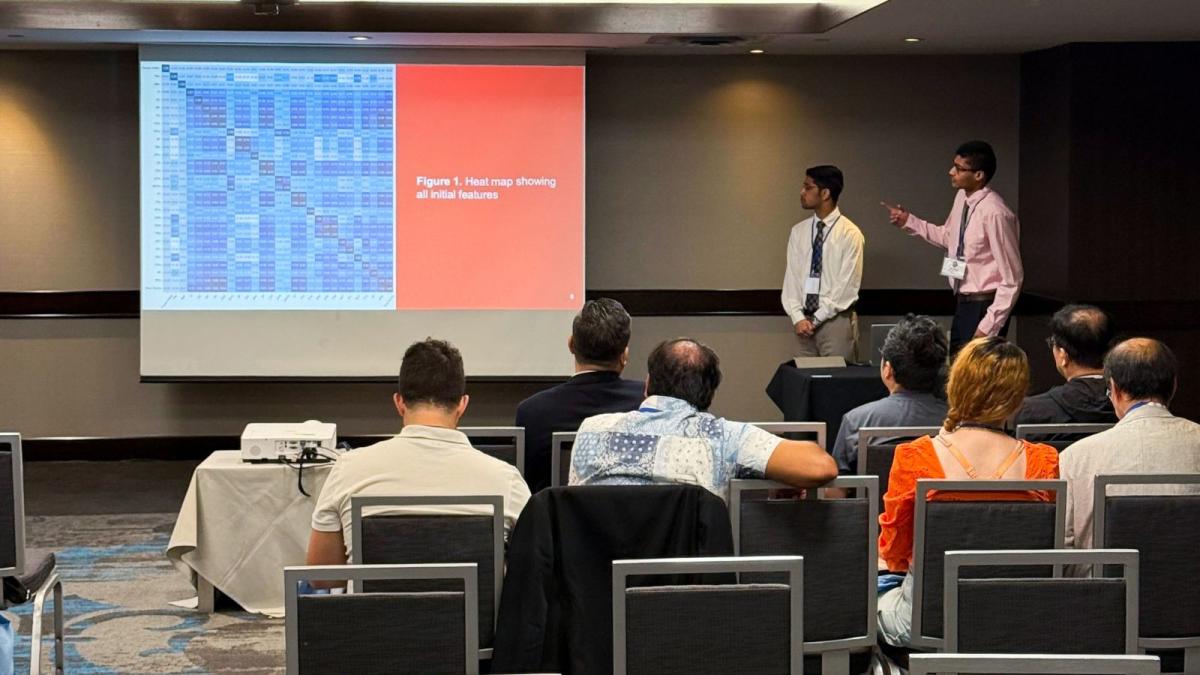
This work was presented at the 17th International Conference on Advances in Social Networks Analysis and Mining (ASONAM 2025)
Desai N, Rathi C, Chaturvedi R. Shooting Stars: Predicting the NBA Gems of Tomorrow. In: 17th International Conference on Advances in Social Networks Analysis and Mining (ASONAM 2025). Niagara Falls, 25-28 August 2025. Cham: Springer Nature Switzerland (pp. 169-179). https://doi.org/10.1007/978-3-032-13509-4_14
This story was written by Jamie Dawson as part of the Science Communicators: Research @ CEPS initiative. Jamie is an M.Sc. candidate in the Chemistry Department under Dr. Mario A. Monteiro. Her research focus is on characterizing bacterial cell-surface carbohydrate structures to ultimately develop glycoconjugate vaccines.