The Master of Medical Foundations Program
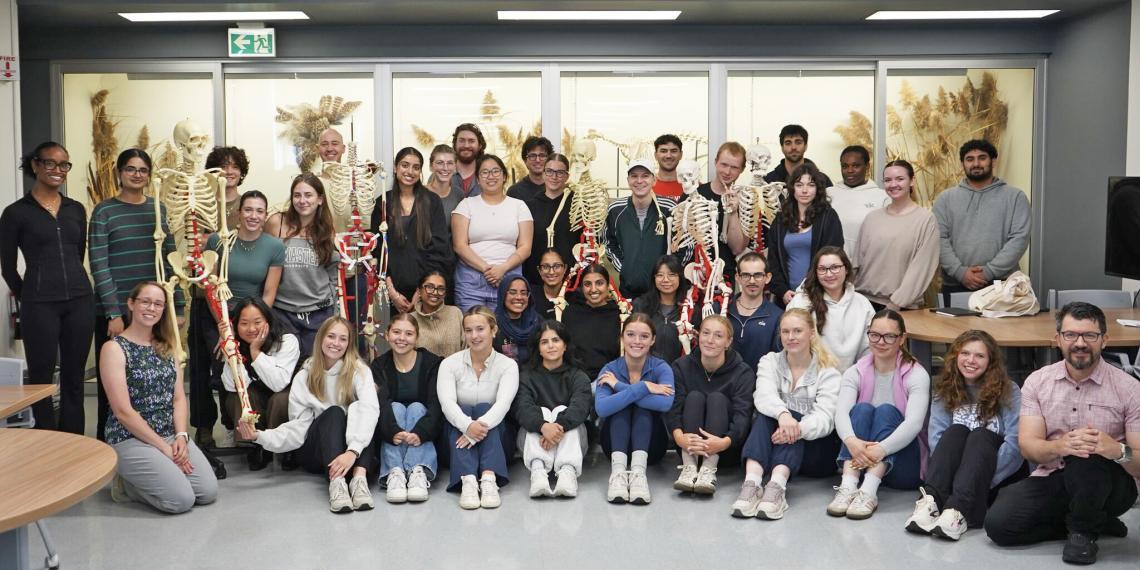
Last month, the Master of Medical Foundations (MMF) program officially welcomed its inaugural class of 36 graduate students, pictured above. This 11-month, course-based master's program is the result of years of collaborative curriculum design between the departments of Human Health Sciences and Molecular and Cellular Biology at the University of Guelph, resulting in a dynamic interdisciplinary degree that helps to prepare graduates for their futures in healthcare. Thus far, students and faculty share great enthusiasm about beginning the MMF program.
Why MMF? “The Master of Medical Foundations program offers a unique opportunity to tie together knowledge in the biological sciences and social aspects of human health while expanding our skills in a collaborative, hands-on environment,” says Georgia, a current student in the MMF program, when asked why she chose to enroll in the MMF program. “I was particularly drawn to the MMF program’s interdisciplinary approach, which recognizes that health care extends beyond biology alone and is influenced by a wide range of social, cultural, and environmental factors. The opportunity to learn from experienced faculty, collaborate with a close-knit cohort, and gain meaningful clinical exposure made this program an exciting next step in my academic and professional journey.”
During the summer term, MMF students take two advanced classes: multisystem physiology and clinical anatomy. Tanvi, a current MMF student, has expressed her enjoyment and excitement about her learning thus far, saying, “I have enjoyed the dissections and anatomy class. Learning through hands-on experiences has made the material much more engaging and helped me better understand human anatomy.” This unique opportunity for hands-on human anatomy learning through full-body dissection is an experience made possible through the generous gift of whole-body donation to the Human Anatomy program at the University of Guelph. Georgia also expressed, “the opportunity to learn anatomy through donor-based education is incredibly valuable, not only in deepening our understanding of the human body, but also in reminding us of the generosity and selflessness of those who choose to contribute to medical education.”
James, a member of the human anatomy laboratory teaching team, shares his experience with the MMF laboratory. “For students to have the opportunity to complete full body dissections in groups of four is rare, an opportunity each student is taking advantage of. I have really enjoyed watching these students from diverse academic backgrounds come together in the anatomy lab, sharing their undergraduate experiences, exploring structures, and leading their own learning.”
When initially designing the anatomy and physiology courses, Drs. Danielle Bentley, Everson Nunes, and Angela Scott wanted the students to understand how body structure and function are intimately related, serving as a basis by which we can understand both health and disease. As such, MMF students participate in problem-based learning through case studies, simulations, and evidence-based research, providing the students with strong scientific knowledge and technical skills. “A strength of the MMF program is the integration of anatomy and physiology.” says Dr. Scott, “It is beneficial for students to learn both anatomy and physiology side-by-side to help form a holistic learning experience and create a deeper understanding of health and disease.” Dr. Nunes continues by adding, “The clinical case studies were designed to reflect the way scientists and healthcare professionals’ approach complex problems ... My hope is that students move beyond memorizing information and instead develop the ability to apply physiological concepts to unfamiliar situations.”
“… I was excited that the University of Guelph had created a program that would allow me to explore my interest in medicine,” says Brandon, a current MMF student. “My goal in taking the MMF program is to strengthen my knowledge and transition into a medical career ... I’m [also] excited to learn more about other allied health professions.” Through both course-integrated clinical cases and program-specific interprofessional hospital placements, the MMF program provides students with a deep understanding of how social, economic, cultural, and behavioural factors can impact human health. In this way, the MMF program is providing students with a unique opportunity to explore human health in a holistic, compassionate, and human-centred way. Dr. Scott concludes, “Overall, the MMF program is meticulously designed and well thought-out. The program is filling a need not currently met for students looking to continue their education in healthcare-related fields.”