Archived Newsletters - Issue 11
July 2026
Index
- UofG at CALAS
- CCAC Annual Report 2025-2026 and Strategic Plan 2026-2031
- RAIMS Program Update
- Animal Facility Site Visit Series – CCAC Assessments
- ACS on the AIR - Podcast with Dr. Sarah Baert
- Register Early for Training
- Animal Observations
- Introducing Dr. Deborah Pakes
University of Guelph Representation at the CALAS Symposium
The University of Guelph had an outstanding presence at the 2026 Canadian Association for Laboratory Animal Science (CALAS) Symposium, with a number of faculty, students, and staff members attending to share knowledge, connect with colleagues, and celebrate excellence in laboratory animal science.
Dr. Janet Sunohara-Neilson (ACS) served as Scientific Co-Chair for the symposium, helping shape the program and moderating numerous scientific sessions.
The scientific program featured several University of Guelph presenters, including Dr. Derek Haley, the kneynote speaker, who spoke on Farm Fresh Reflections on Practical Animal Welfare Assessments and Dr. Georgia Mason who presented Good Welfare is Attractive: How Housing Quality Affects Male Success with Females in Mink, Mice and Zebrafish. Michaela Randall (CAF) presented Cages to Colonies: Feasibility and Benefits of Free-Range Rat Housing, while Jana Michaud (HHS) delivered The Progression of Cardiovascular Function in Rats Post Splenectomy. Theresa Martin (CAF) also shared her poster, How to Build Intentional Community.
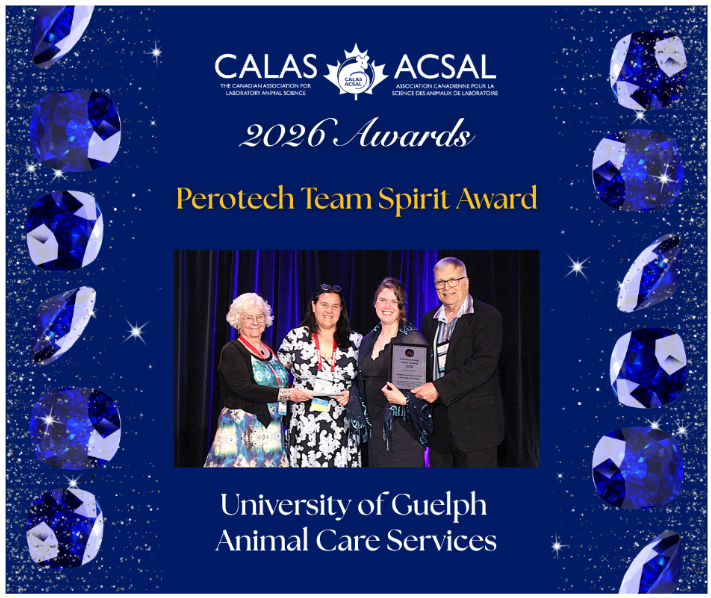
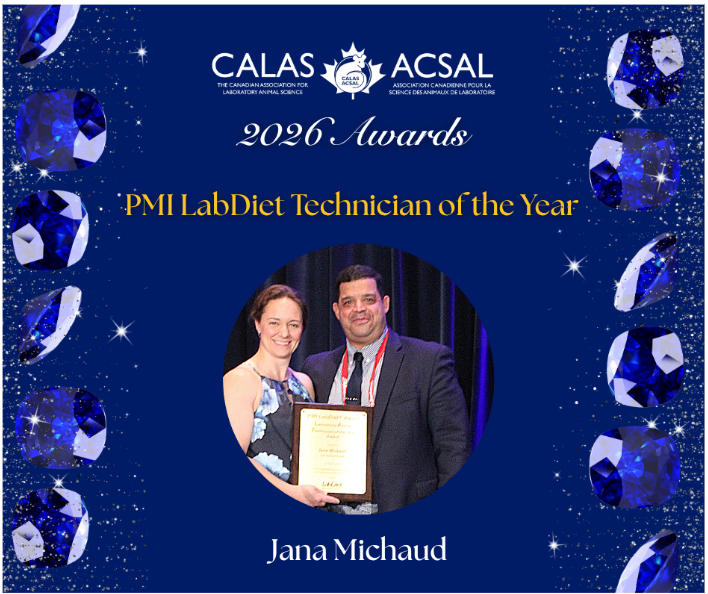
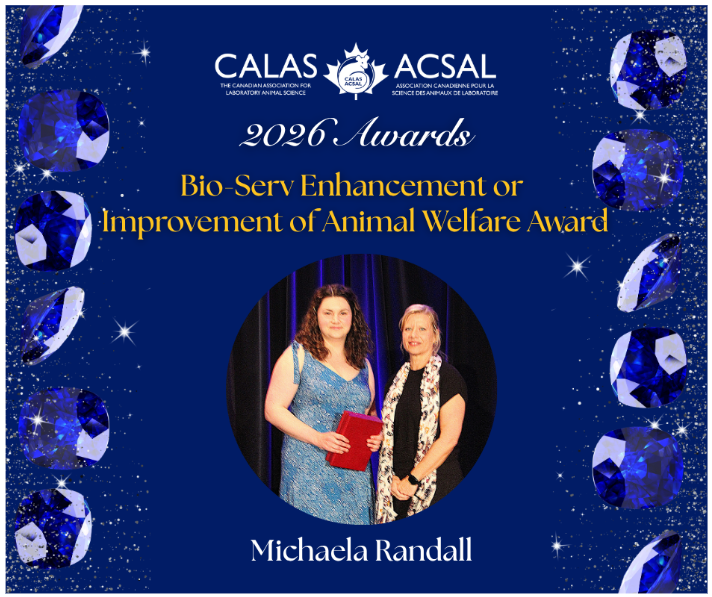
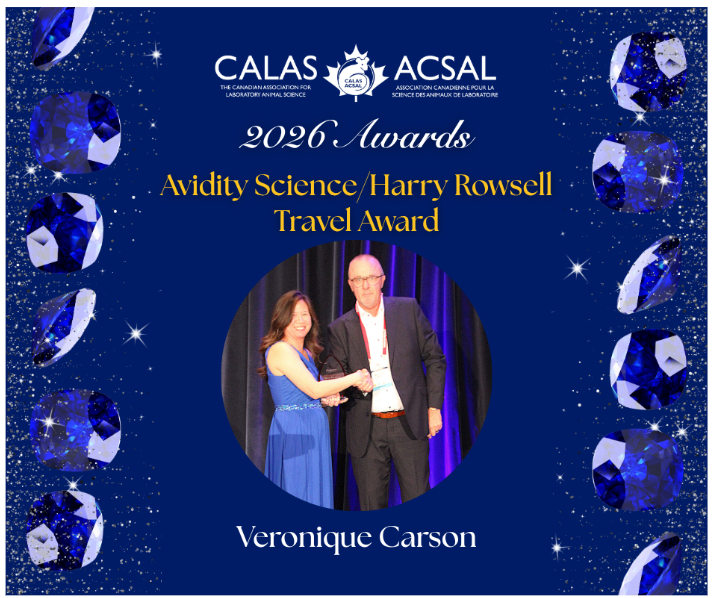
The symposium also brought well-deserved recognition to the University of Guelph community. The ACS team received the Perotech Team Spirit Award, recognizing exceptional collaboration, respect, inclusivity, and dedication to operational excellence. Jana Michaud was honoured with the PMI LabDiet Technician of the Year Award for her outstanding contributions and dedicated service. Michaela Randall received the Bio-Serv Enhancement or Improvement of Animal Welfare Award for work that advances animal welfare while reflecting the principles of the 3Rs and Vicki Carson (PAIF) was awarded the Avidity Science/Harry Rowsell Travel Fellowship Award, supporting continued learning and participation within the laboratory animal science community.
Congratulations to all who attended, presented, and received awards. Your contributions continue to showcase the University of Guelph as a leader in laboratory animal science, animal welfare, and research excellence.
Canine Nutrition Study Seeking Anxious or Fearful Dogs
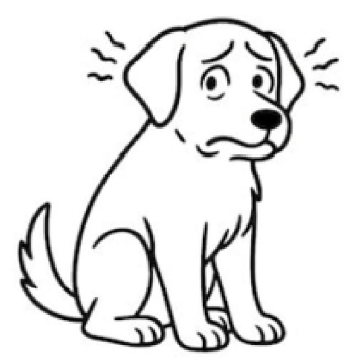
Researchers at the University of Guelph are seeking dogs with signs of fear or anxiety to participate in nutrition studies exploring natural approaches to reducing anxious behaviours. Eligible participants may receive premium kibble and complimentary bloodwork while contributing to important animal health research. Click this flyer link to learn more about the study and eligibility requirements, or contact Pauline Kosmal at pkosmal@uoguelph.ca.
General
ACC
New Members Needed! If you believe that you or someone you know could bring valuable insights to the committee, click to find out more!
We are especially seeking community representatives with no affiliation to the University of Guelph to help represent the interests and perspectives of the broader community. If you know someone who may be interested in joining the committee, please encourage them to contact acc@uoguelph.ca to learn more.
CCAC Annual Report and Strategic Plan
The CCAC has released its 2025–2026 Annual Report, Reflecting on Ethical Animal Care. The report highlights the organization's key accomplishments over the past year, including updates to standards and guidance, education and outreach initiatives, and ongoing efforts to support the ethical care and use of animals in science across Canada.
Alongside the annual report, the CCAC has also launched its 2026–2031 Strategic Plan, which outlines the organization's priorities for the next five years, with a focus on strengthening organizational resilience, optimizing program delivery, and enhancing support for program participants.
RAIMS Program Update: Vendor Negotiations Underway
Following a thorough and competitive Request for Proposal (RFP) process earlier this year, the University has entered the final stages of vendor negotiations for the new electronic AUP system. We’ll continue sharing updates through this newsletter, but please watch for Research Alerts between issues to communicate important project milestones, including details on the selected vendor and next steps as they become available.
In the meantime, project planning and preparation activities continue, positioning the team to engage the research community and leverage your valuable insights as the project moves forward.
Thank you for your patience and ongoing support as we work toward a modernized solution that better supports animal-based research and teaching at UofG.
Compliance and Facilities
Animal Facility Site Visit Series
CCAC Assessments
The Canadian Council on Animal Care (CCAC) provides national oversight of animal-based scientific activities in Canada. A CCAC Certificate of Good Animal Practice (GAP) is mandatory for institutions that conduct research with animals and receive tri-council funding (CIHR, NSERC, SSHRC). The CCAC staff, together with volunteers from many sectors, develop evidence-informed standards for the ethical use of animals in research, teaching and testing. Assessment visits are conducted by the CCAC every three years at certified institutions. Alternating between a regular assessment, conducted by a panel that is comprised of at least one scientist, a veterinary and a community representative overseen by a CCAC associate director of assessment, and an interim assessment visit, conducted by the CCAC associate director of assessment alone or with one or two peer reviewers. The University of Guelph will have an interim CCAC assessment in October.
CCAC assessment visits are announced well in advance allowing for preparation and review of extensive documentation prior to the in-person visit. The CCAC reviews the entire animal care program, how the ACC oversees the program, reporting structures within the institution, facility conditions and standard operating procedures. Following the assessment, a report is provided with commendations, serious and regular recommendations, and the institution is expected to provide implementation responses with a time-frame set by the CCAC. The ACS Compliance and Facility Coordinator acts as the liaison between the institution and the CCAC preparing documentation, planning the visit and coordinating responses.
ACS on the Air!
Animal Care Services' Dr. Sarah Baert recently joined the Vet Sessions podcast to discuss laboratory animal medicine, animal welfare, and the role
of veterinarians in supporting ethical animal-based research. In Season 5, Episode 12 – Lab Animal Medicine and Animal Welfare with Dr. Sarah Baert, they explore how animal welfare principles are applied in research settings and why they matter. The episode, released on May 11, 2026, is approximately 24 minutes long and is available on major podcast platforms, including Spotify and Apple Podcasts.
Training
Please refer to the Facility Orientation and Workshop Schedule page on the Animal User Training Program website for all training schedules. For specific guidance on what training you require to work with or care for animals at UofG, contact us at training@uoguelph.ca.
Have ideas for training? We'd love to hear from you at training@uoguelph.ca.
Register Early for Training
Getting ready for fall projects? Planning ahead helps ensure all required training, including Core modules, ACS hands-on workshops, facility orientations, and any AUP-specific training, is completed before research begins.
Before you start your research, please contact the Training Office at training@uoguelph.ca at least 3 weeks in advance. Early registraiton is required to secure a spot for all workshops. Drop-ins cannot be accommodated.
Visit the Facility Orientation and Workshop Schedule page on the Animal User Training Program website for upcoming training dates, including the Fall 2026 Training Schedule, or contact us at training@uoguelph.ca for guidance. The earlier you reach out, the easier it is to keep your project timelines on track.
Animal Utilization Protocols
AUP help drop-in sessions held every Wednesday from 1:00-2:30pm in-person with ACS or virtually on Teams. Check out the Interactive Support Sessions for Researchers page for more information.
Animal Observations
There are two sections in the AUP that address animal observations. Section 6.1.3 describes the daily observations required for all animals while Section 8.5 describes additional observations that may be needed to evaluate the potential impacts of approved procedures on the animals.
The routine daily observations required for all animals used in research, teaching, or production at the University of Guelph must be performed by the individual(s) identified in Section 6.1.3. These observations are typically conducted by facility staff and include:
- A visual check of the animals' health and welfare
- Confirmation that food and water are available
- Verification that environmental parameters (e.g., temperature, humidity, and lighting) are appropriate
If these daily monitoring responsibilities are performed by personnel outside of the animal facility staff, how daily checks are done must be identified in Section 6.1.3a) of the AUP.
The Category of Invasiveness (COI) listed on the AUP will impact the degree of animal monitoring required. For many COI B protocols, where little or no distress is expected, routine daily monitoring is sufficient to identify any concerns. Protocols involving greater potential for pain, distress, or adverse effects, COI C-E, require more detailed or more frequent observations to ensure animal welfare is maintained throughout the study and are designed to assess the impact of animal use in relation to the experimental context. These observations are described in Section 8.5 and are accompanied by assessment sheets which include endpoints and interventions. Assessment sheets should be attached in Section 8.6 and outline:
- What parameters will be assessed
- How often assessments will occur
- Who will perform them (also listed in Sections 8.7 and 8.8)
- What records or assessment sheets will be used
Sections 8.5 and 8.6 of the AUP are intended to capture any protocol-specific assessment requirements beyond routine daily monitoring. It is the responsibility of the PI to ensure that all required assessments are completed, whether by members of the research team or, where arranged, as a technical service provided by facility staff.
ACS Veterinarians are available to assist with the development of assessment sheets and to answer any questions regarding animal observations.
Community Spotlight
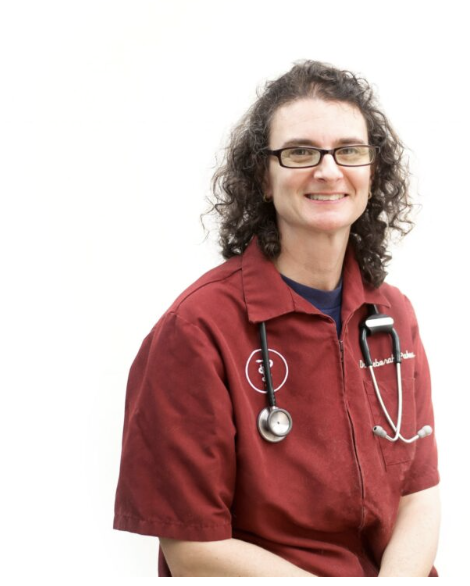
Please join us in welcoming Dr. Deborah Pakes as Animal Care Services’ new Protocol Review Veterinarian in an independent contract role.
Dr. Pakes brings more than 16 years of laboratory animal medicine experience across university, hospital, industry, and teaching settings, including experience as a Clinical Veterinarian at the University of Toronto, Sanofi, and Seneca Polytechnic. She holds a Master’s degree in Zoology from the University of Guelph, with a background in marine field research involving invertebrates and fish, and also has experience in small animal practice. In addition to her work with ACS, Dr. Pakes currently serves as a Compliance Support Veterinarian at SickKids Animal Research facility and as a Clinical Veterinarian at Nucro-Technics (a contract research organization).
We are excited to welcome Dr. Pakes to the ACS team and look forward to the expertise and perspective she will bring to protocol review and animal care oversight.
To have your work or a fun photo of your animals highlighted, share it with us. Each issue will include one submission as we champion our community and the amazing animals that make our work possible.
Upcoming Events

CALAS Webinar:
- Sept 23, 2026
1-2pm
Virtual
Register Here
(Non-CALAS members contact ACS for help registering)
Resource Corner

Contact Us
- Newsletter - acc@uoguelph.ca
- AUP - acc@uoguelph.ca
- Training - training@uoguelph.ca
- Post-Approval Review - accpost@uoguelph.ca
- ACS Veterinarians - acsvets@uoguelph.ca
- Chair of the ACC - chairacc@uoguelph.ca