Tier II Canadian Research Chair In Computational Food Systems & Precision Nutrition
Email:
donwude@uoguelph.ca
Phone number:
519-824-4120 Ext. 55414
Office:
Food Science Building - Room 126
Website links:
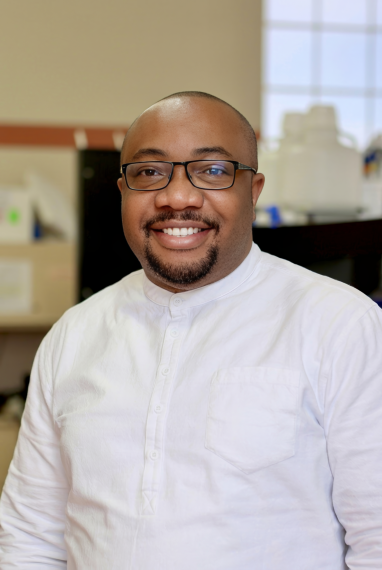
Dr. Daniel Onwude is an Assistant Professor in the Department of Food Science, University of Guelph. Prior to joining the University of Guelph, he spent over seven years in Switzerland, serving as a lecturer at ETH Zürich, a Senior Scientist and Team Lead at Empa – Swiss Federal Laboratories for Materials Science and Technology. His research focuses on developing new ways to process and preserve foods through a systems approach that reduces food loss and waste while improving nutrition, sustainability, and food system resilience. He studies how foods change as they move from production through processing, storage, and transportation to our plates, and how these changes influence the nutrients our bodies ultimately absorb. He does this by creating physics-based digital models that act like virtual copies of real foods and food processing systems, integrated with data and artificial intelligence. By testing ideas in these virtual environments before applying them in the real world, he helps design better ways to make and preserve food, so it remains healthier, safer, and more sustainable.
Academic History
Post-Doctorate in Food Processing, ETH Zürich - Federal Institute of Technology, Zürich
Ph.D. in Agricultural Process Engineering (Specialization in Food Process Engineering), University of Putra, Malaysia
M.Sc. in Agricultural Process Engineering (Specialization in Food Process Engineering), University of Putra, Malaysia
Research area
The interdisciplinary lab applies computational and experimental approaches to understand and improve how foods are processed, preserved, and distributed across the food system. The lab develops digital twins (so virtual models), data-driven tools, and advanced processing technologies to study food quality, nutrient retention, and waste across supply chains. By integrating food science, engineering, and data analytics, the lab aims to design innovative processing and preservation strategies that support sustainable food manufacturing and resilient food systems. ComputFood Lab’s current research themes include:
Featured publications [Full list in Google Scholar]
Onwude, D., Hashim, N., Janius, R. B., Nawi, N. M., and Abdan, K. (2016). Modeling the Thin-Layer Drying of Fruits and Vegetables - A Review. Comprehensive Reviews in Food Science and Food Safety, 15: 599-618. DOI
Onwude, D., Iranshahi, K., Martynenko, A., Defraeye, T., (2021). Electrohydrodynamic drying: Can we scale-up the technology to make dried fruits and vegetables more nutritious and appealing? Comprehensive Reviews in Food Science and Food Safety. 202120:;5283–5313. DOI
Onwude, D., Cronje, P., North, J., Defraeye, T. (2024). Digital replica to unveil the impact of growing conditions on orange postharvest quality. Scientific Report 14, 14437. DOI
Onwude, D., Bahrami, K., Shrivastava, C., Schudel, S., Crenna, E., Shoji, K., Cronje, P., Berry, T., North, J., Kristen, N., & Defraeye, T. (2022). Physics-driven digital twins to quantify the impact of pre- and postharvest variability on the quality evolution of orange fruit. Resources, Conservation and Recycling, 186, 106585. DOI
Onwude, D., Iranshahi, K., Rubinetti, D., Martynenko, A., Defraeye, T., (2021). Scaling-up electrohydrodynamic drying for energy-efficient food drying via physics-based simulations. Journal of Cleaner Production 329, 129690. DOI
Wittkamp, T., Defraeye, T., Yegon, R., & Onwude, D. (2025). Enhancing postharvest storage in low-and middle-income countries: Evaluation of the passive evaporative cooling blanket for fruits and vegetables. Energy for Sustainable Development, 88, 101787. DOI
Defraeye, T., and Onwude, D. (2020). The future of digital twins for drying. Drying technology, 1-2. DOI
Odion, D., Defraeye, T., Evangelista, R., & Onwude, D. (2004). Towards economic, nutritional, and environmental sustainability for small-scale farming businesses using a mobile-powered impact dashboard. Science Talks. DOI