
Research Support Fund
The Research Support Fund assists Canadian postsecondary institutions with the costs associated with managing their research enterprise, helping them to maintain a world-class research environment.
Grants are intended to make Canada a world leader in research and development:
- maintain modern labs and equipment;
- provide access to up-to-date knowledge resources;
- provide research management and administrative support;
- meet regulatory and ethical standards; or
- transfer knowledge from academia to the private, public and not-for-profit sectors.
Definition of Indirect Costs
There are a number of centralized institutional activities and services that support the research mandate of the University. These vary in scope and size but are critical to our success.
Institutional activities and support services include the following areas:
- Library: operations and information acquisitions and resources
- Computing and Communications: computing infrastructure including central services, telecommunications and data services
- Physical Plant: utilities, housekeeping, maintenance, grounds and planning services (excluding ancillary operations)
- Research Administration: Research Services Office including central animal services, grants and contracts administration and legislated requirements for reporting on grants and activities, communications and business development
- Central Support Services: a wide range of services ranging from payroll, accounting including research accounting, audit, environmental and occupational health, security services and purchasing to institutional costs such as legal and insurance costs
Each of these activities is vital to the overall effectiveness of the institution. Coordinating and delivering these services is a complex task and there are significant efficiencies to be obtained by managing them centrally.
Overview of how the University of Guelph Allocates the Research Support Funds grant
In general, the allocation of the RSF grant to specific units that support research activity at the University is calculated as:
RSF Allocation = (Total Unit Costs * Percentage of Research * Percentage of Federal * RSF Grant) / RSF Eligible Costs
Units incurring indirect costs of research are identified within the broad categories outlined as eligible by the RSF program. The specific units, by category, are as follows:
- Research Facilities (Utilities, Physical Resources, Waste and Chemical Resources, Advanced Analysis Centre)
- Research Resources (Library Operations, Library Information Resources, Central Computing Systems)
- Management and Administration of the Institution’s Research Enterprise (Office of Research, Research Financial Services, Administrative Offices, Insurance, Research Administration Information Management System)
- Regulatory Requirements and Accreditation (VP Research-General Risk, Animal Care Services, Environmental Health & Safety)
- Intellectual Property and Knowledge Mobilization (Research Innovation Office)
It is then determined what portion of the unit costs are used to support research activities, using various assumptions depending on the specific unit.
The total research costs determined above are prorated to reflect the portion of research that is federally funded using a three-year average of total funding received from NSERC, SSHRC, CIHR and Networks of Centres of Excellences, as reported to the University in the RSF credit data, divided over total received from external sponsors (excluding RSF & CFI). This represents total costs eligible for RSF funding.
The actual amount of the RSF grant that the University receives does not cover the total amount of eligible costs, so the grant is attributed on a pro rata basis to the eligible costs of each of the units.
Use of Funds
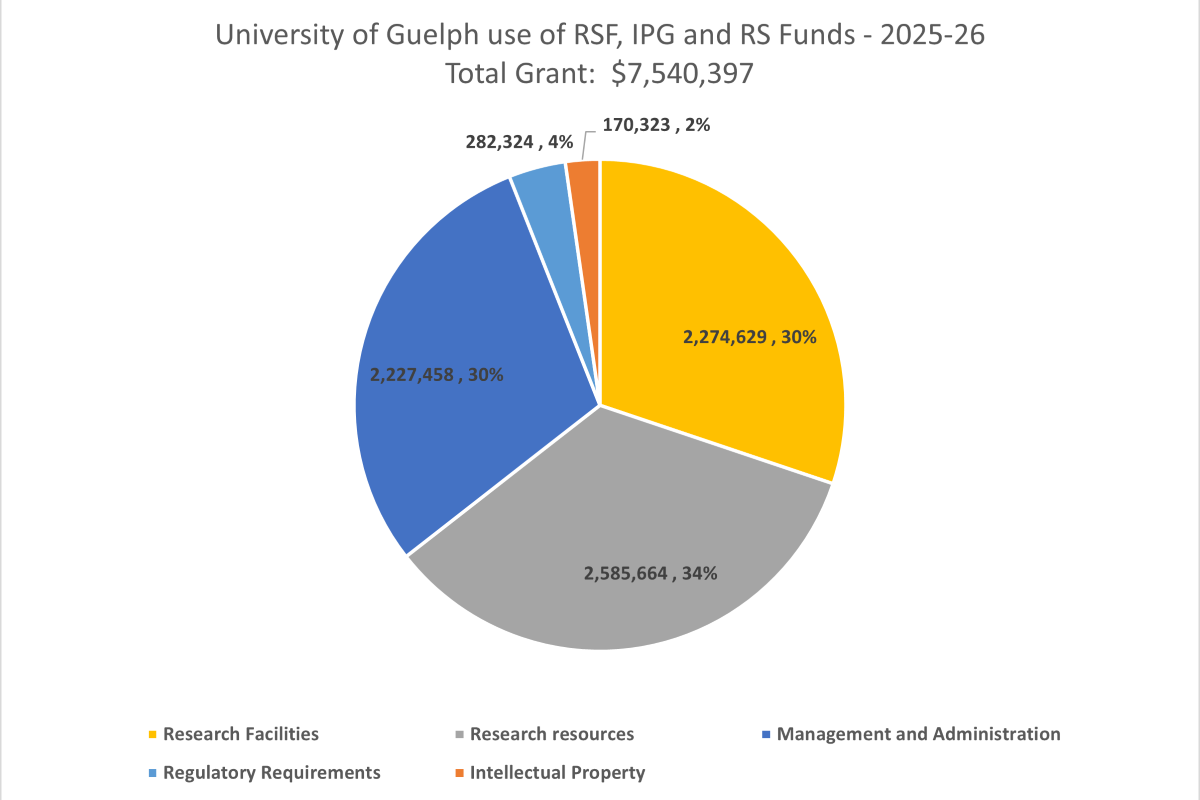
Reported RSF Expenditure 2025-26
University of Guelph Use of Funds: 2025-26 - Total Grant $7.54M
- RSF Amount: $5,972,216
- IPG Amount: $1,204,202
- Research Security Amount: $363,979
Included in pie chart:
- Research Facilities: $2,274,629 – 30%
- Research Resources: $2,585,664 – 34%
- Management and Administration: $2,227,458 – 30%
- Regulatory Requirements: – $282,324 – 4%
- Intellectual Property: $170,323 – 2%
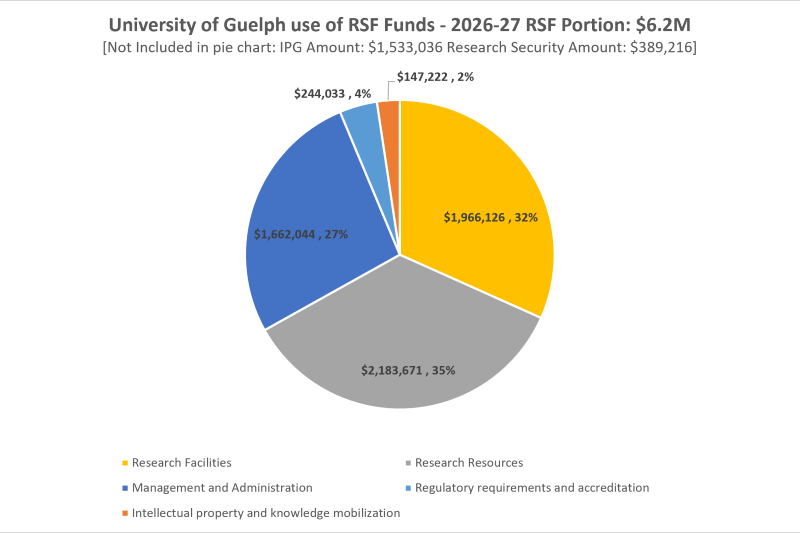
- RSF Amount: $6,203,096
- IPG Amount: $1,533,036
- Research Security Amount: $389,216
Included in pie chart:
- Research Facilities: $1,966,126 – 32%
- Research Resources: $2,183,671 – 35%
- Management and Administration: $1,662,044 – 27%
- Regulatory requirements and accreditation: $244,033 – 4%
- Intellectual property and knowledge mobilization: $147,222 – 2%
Previous Use of Funds
Total RSF, IPG and RS Grant: $7.5M
Use of Funds Breakdown:
| Performance Objectives and Indicators | Dollar Amount ($) | Percentage (%) |
|---|---|---|
| Research Facilities | $2,274,629 | 30% |
| Research Resources | $2,585,664 | 34% |
| Management and Administration | $2,227,458 | 30% |
| Regulatory Requirements | $282,324 | 4% |
| Intellectual Property | $170,323 | 2% |
Total RSF Grant: $5.8M
Not included:
- IPG Amount: $746,885
- Research Security Amount: $347,980
Use of Funds Breakdown:
| Performance Objectives and Indicators | Dollar Amount ($) | Percentage (%) |
|---|---|---|
| Research Facilities | $1,838,947 | 31% |
| Research Resources | $2,342,036 | 39% |
| Management and Administration | $1,460,873 | 25% |
| Regulatory Requirements and Accreditation | $186,491 | 3% |
| Intellectual Property and Knowledge Mobilization | $143,869 | 2% |
Total RSF and IPG Grant: $6.6M
Use of Funds Breakdown:
| Performance Objectives and Indicators | Dollar Amount ($) | Percentage (%) |
|---|---|---|
| Research Facilities | $2.0M | 30% |
| Research Resources | $2.6M | 40% |
| Management and Administration | $1.6M | 25% |
| Regulatory Requirements and Accreditation | $0.2M | 3% |
| Intellectual Property and Knowledge Mobilization | $0.1M | 2% |
Total RSF, IPG and RS Grant: $7M
Use of Funds Breakdown:
| Performance Objectives and Indicators | Dollar Amount ($) | Percentage (%) |
|---|---|---|
| Research Facilities | $2,023,292 | 29% |
| Research Resources | $2,625,940 | 37% |
| Management and Administration | $2,003,450 | 29% |
| Regulatory Requirements and Accreditation | $199,329 | 3% |
| Intellectual Property and Knowledge Mobilization | $167,997 | 2% |
Total RSF and IPG Grant: $6.9M
Use of Funds Breakdown:
| Performance Objectives and Indicators | Dollar Amount ($) | Percentage (%) |
|---|---|---|
| Research Facilities | $2.1M | 30% |
| Research Resources | $2.8M | 40% |
| Management and Administration | $1.7M | 25% |
| Regulatory Requirements and Accreditation | $0.2M | 3% |
| Intellectual Property and Knowledge Mobilization | $0.2M | 2% |
RSF Institutional Performance Objectives and Indicators
The performance objectives and indicators outlined below are consistently applied and measured each fiscal year, with progress reported annually in the corresponding sections that follow.
Output
Invest a portion of Research Support Fund grant in operations, upgrades and maintenance of the University’s Advanced Analysis Centre (AAC).
Institutional Performance Objective(s)
To increase the use of centralized research scientific equipment through the AAC by offering cost- effective and efficient testing and experimental support services to researchers across campus.
Performance Indicator(s)
Continuous improvement in both volume of services processed, relevance of services provided and response times for research services across all AAC research service facilities.
Increase usage by researchers across campus (students, staff, faculty).
Continued investment in new infrastructure.
Output
Invest portion of Research Support Fund grant to support new research data management (RDM) process (staff and IT resources).
Institutional Performance Objective(s)
To increase the volume of collection and improve the access to research data through a centralized research management data information system.
Increase the number of Data Management Plans (DMP) created by researchers. Increase the use of the Canada-wide tool DMP Assistant to create plans.
Performance Indicator(s)
Increase in total number of data sets and associated code books captured in the RDM system each fiscal year.
Increase number of registered researchers and associated data management plans in the DMP Assistant system each fiscal year.
Output
Invest portion of Research Support Fund grant to support e-system development for the integrated administration of animal ethics, human ethics, biosafety and grants and contracts.
Institutional Performance Objective(s)
Identify system requirements and complete Request for Proposal (RFP), procurement and implementation processes.
Performance Indicator(s)
Continued automation and process improvement of research administrative processes for staff and reporting to stakeholders.
Output
Invest portion of Research Support Fund grant towards salary support of personnel within Animal Care Services for Post Approval monitoring.
Institutional Performance Objective(s)
Continued implementation of the Post-Approval Review (PAR) program in support of PIs and their research teams when conducting research involving animals.
Performance Indicator(s)
Continue to implement the full PAR program focusing on direct support to researchers and their team by involving PAR in the review of all AUP annual renewals, developing refinement in animal user and offering PAR services with species and procedure expertise that will also add to PAR’s goal of encouraging and modelling best practices in animal-based research.
Output
Invest portion of Research Support Fund grant to support faculty disclosures including communication, training and support services to faculty.
Institutional Performance Objective(s)
To be one of Canada’s most inventive universities.
Performance Indicator(s)
Number of inventions per research dollar in comparison to other institutions in Canada.
RSF Progress Report 2025-26
Target Outcomes for 2025/26
The AAC aims to continue increasing total user fee income by 5% annually.
Further increase the awareness and usage of core research facilities through enhanced outreach and promotional activities. Continue investment in new infrastructure and equipment to support cutting-edge research and the continued training of the next generation of HQPs.
Reported Outcomes 2025/26
The Advanced Analysis Centre exceeded its target for growth in user fee income, achieving a 10.4% increase in internal revenue and a 7% increase in faculty users. The Centre continued to support over 150 faculty members and their research teams through access to specialized instrumentation and technical expertise across core facilities.
Upgrades to instrumentation in Mass Spectrometry, Molecular and Cellular Imaging, and Genomics enhanced research capacity and ensured access to modern technologies aligned with evolving research needs. Training and engagement activities expanded through workshops, seminars and targeted events, increasing awareness and utilization of centralized research services.
Target Outcomes 2026/27
The AAC will continue to increase awareness and utilization of centralized research facilities through expanded outreach, training activities and engagement with the research community.
The Centre will continue to invest in infrastructure renewal and equipment modernization to support evolving research needs and training of highly qualified personnel. Operational activities will focus on maintaining effective service delivery, reducing downtime and supporting continued growth.
Through these activities, the AAC will continue working toward approximately 5% annual growth in user fee income while reviewing organizational structure and service offerings to ensure alignment with research priorities.
Target Outcomes for 2025/26
Data deposits:
- Increase the number of data deposits by 35%
- Enhance the volume of data by 15% to support comprehensive research initiatives
Usage statistics:
- Boost the number of downloads by 20% through improved accessibility and user engagement
Research data management / planning:
- Expand the use of the DMP assistant by 20% to facilitate better research data management practices
- Increase research consultations on RDM / DMP tools by 20% to provide tailored support to researchers
Reported Outcomes 2025/26
Research data services experienced mixed trends in repository activity alongside strong growth in research data management engagement.
The number of new dataset deposits decreased by approximately 20%, while overall data volume decreased by approximately 54%. The number of downloads decreased by approximately 48%. These changes reflect variability in large-scale deposits as well as broader sector trends including alternative repository use and increasing dataset size limitations.
Engagement in research data management services increased significantly, including a 113% increase in new Data Management Plan Assistant users, a 28% increase in plans submitted and a 140% increase in consultations.
Target Outcomes 2026/27
Targets have been adjusted to reflect recent trends and sector context:
- Increase data deposits by approximately 10–15%
- Increase data volume by approximately 10–15%
- Increase downloads by approximately 10–15%
- Increase DMP Assistant usage by approximately 20%
- Increase research data management consultations by approximately 20%
These targets support continued growth in research data management capacity while aligning with infrastructure constraints and anticipated funder requirements.
Target Outcomes for 2025/26
Finalize the implementation of the human ethics research administration solution, ensuring full integration and user training by the end of Q2 2025/26.
Resume the RFP process for the animal care research administration solution, with a focus on securing necessary resources and stakeholder engagement.
Enhance overall research administration efficiency through continuous improvement initiatives and stakeholder feedback.
Reported Outcomes 2025/26
The University continued to advance modernization of research administration through implementation and refinement of the Human Ethics platform (EthOS).
The system supports submission, review and management of research protocols through standardized workflows, improved forms and enhanced tracking capabilities. These improvements have contributed to increased efficiency, transparency and consistency across research administration processes.
Planning activities progressed for future implementation phases, including preparatory work related to an Animal Use Protocol module.
Target Outcomes 2026/27
The University will continue to strengthen research administration systems through gradual enhancement and increased adoption:
- Continue to increase system use across the research community
- Improve efficiency and consistency of application workflows
- Maintain and refine system functionality and user support
- Continue planning activities for future system modules
These efforts support continued transition toward an integrated and scalable research administration environment.
Target Outcomes for 2025/26
With the PAR Team strengthened, the program continues as the quality assurance mechanism for conducting and progressing research projects involving live animals. The emphasis remains on providing support and services to investigators and their research team members in all aspects of live animal use.
Reported Outcomes 2025/26
The Post Approval Review program continued to support oversight of animal-based research and compliance with regulatory requirements.
Enhanced staffing, including veterinary expertise, supported improved monitoring, investigator engagement and consistency across oversight activities.
Target Outcomes 2026/27
The PAR program will continue to support compliance and quality oversight:
- Maintain implementation of the Post Approval Review program
- Continue integration of PAR into research workflows
- Provide ongoing support and guidance to researchers
- Continue to strengthen consistency and quality of oversight
These efforts support ongoing compliance and strong animal care practices.
Target Outcomes for 2025/26
Increase the number of faculty disclosures and patent applications by 10%.
Strengthen partnerships with industry to facilitate commercialization of research outcomes.
Promote knowledge mobilization activities to ensure research findings are effectively disseminated to relevant stakeholders.
Reported Outcomes 2025/26
The University reported 164 inventions, with a three-year average of 168 inventions, representing approximately one invention per $1.1M of research funding.
This performance reflects continued strength in innovation and knowledge mobilization activity.
Target Outcomes 2026/27
- Maintain strong levels of invention disclosures relative to research activity
- Continue supporting knowledge mobilization and commercialization activity
- Sustain engagement with partners supporting translation of research outcomes
Targets reflect continued consistency rather than expansion beyond current capacity.
Previous RSF Progress Reports
| Eligible Expenditure Category | Target Outcomes for 2024/25 | Reported Outcomes 2024/25 | Target Outcomes 2025/26 |
| Research Facilities |
Increase awareness and usage of core research facilities through our affiliation with the Office of Research, our updated website, and various campus events to promote the list of services provided. New modern equipment acquired from CFI will be installed in the following 3 facilities: Mass Spectrometry, Molecular and Cellular Imaging, and Genomics. | The AAC successfully installed new modern equipment in the Mass Spectrometry Facility and Advanced Light Microscopy, enhancing research capabilities. The Genomics Facility is undergoing extensive renovations to accommodate new instrumentation, which will further improve its services. The AAC organized a highly successful multi-day workshop in the Genomics Facility, showcasing cutting-edge equipment and attracting significant interest from researchers. The AAC continues to be widely used by faculty and their trainees, with over 150 faculty members utilizing one or more of the five labs. | The AAC aims to continue increasing total user fee income by 5% annually. Further increase the awareness and usage of core research facilities through enhanced outreach and promotional activities. Continue investment in new infrastructure and equipment to support cutting-edge research and the continued training of the next generation of HQPs. |
| Research Resources | Data deposits:
Usage statistics:
Research data management / planning:
| Data deposits:
Usage statistics:
Data management planning:
| Data deposits:
Usage statistics:
Research data management / planning:
|
| Management and Administration | Complete Request for Proposal (RFP) process for an animal care research administration solution as the second module in a fully integrated research administration system. | Completed recruitment processes to hire three new staff members to support implementation of the human ethics solution (i.e., project manager, change manager and processes/systems manager); worked to configure the solution to implement revised workflow processes; developed forms for human ethics administration within the system, initiation and consultation with research community to ensure robustness and accuracy of forms, etc. System implementation live in summer 2024. | Finalize the implementation of the human ethics research administration solution, ensuring full integration and user training by the end of Q2 2025/26. Resume the RFP process for the animal care research administration solution, with a focus on securing necessary resources and stakeholder engagement. Enhance overall research administration efficiency through continuous improvement initiatives and stakeholder feedback. |
| Regulatory Requirement and Accreditation | Continue the Post-Approval Review (PAR) program as the quality assurance for conducting and progressing research projects involving live animals. Emphasis is placed on providing support and services to the investigators and research team members in all aspects of their live animal use. | The appointed ACS Post-Approval Veterinarian (since April 2024), now working directly in PAR Team with the PAR Coordinator, has substantially strengthened the post-approval support and services to investigators and their research teams in the conduct of approved studies, especially in health and welfare related matters. This was recognized at the CCAC Assessment Visit with follow-up reports. CCAC stressed the PAR program as integral to identifying and mitigating risks to animal health and welfare, including that verification of facility standards are met. | With the PAR Team strengthened, the program continues as the quality assurance mechanism for conducting and progressing research projects involving live animals. The emphasis remains on providing support and services to investigators and their research team members in all aspects of live animal use. |
| Intellectual Property and Knowledge Mobilization | Number of inventions per research dollar in comparison to other institutions in Canada. | U of G reported 126 inventions, and a 3-year average of 139. The 3-year average results in approximately 1 invention per $1.3M of research, which places UG among the top universities in the country according to that metric. | Increase the number of faculty disclosures and patent applications by 10%. Strengthen partnerships with industry to facilitate commercialization of research outcomes. Promote knowledge mobilization activities to ensure research findings are effectively disseminated to relevant stakeholders. |
| Eligible Expenditure Category | Target Outcomes for 2023/24 | Reported Outcomes 2023/24 | Target Outcomes 2024/25 |
|---|---|---|---|
| Research Facilities | The AAC (Advanced Analysis Centre) expects to realize a 5% annual increase in total user fee income. Increase awareness and thus usage of core (centralized) research facilities is expected through our affiliation with the Office of Research, our updated website and various campus events to promote the list of services provided. | While internal user fee income decreased by 11% in 2023-24, external user fee income was up 57% from the previous fiscal year. New equipment acquisitions were secured for modern equipment to be installed in the Mass Spectrometry Facility, Advanced Light Microscopy and the Genomics Facility. The AAC keeps research initiatives at the forefront and raises awareness in its operations through the organization of regular seminars. For instance, the Molecular and Cellular Imaging Facility organized demonstration events with 4 different vendors in 2023-24. These events engaged faculty and graduate students in new technologies and exhibited how these new approaches could advance their research. The AAC is widely used by faculty and their trainees: Over 150 faculty used one or more of the five labs. | The AAC (Advanced Analysis Centre) expects to realize a 5% annual increase in total user fee income. Increase awareness and thus usage of core (centralized) research facilities is expected through our affiliation with the Office of Research, our updated website and various campus events to promote the list of services provided. |
| Research Resources | Data deposits:
Usage statistics:
Research data management / planning:
| Data deposits:
Usage statistics:
Data management planning:
| Data deposits:
Usage statistics:
Research data management / planning:
|
| Management and Administration of the Institution’s Research Enterprise | Complete Request for Proposal (RFP) process for an animal care research administration solution as the second module in a fully integrated research administration system. Implement human ethics research administration solution in a production environment by the end of Q4 2023/24. | Completed recruitment processes to hire three new staff members to support implementation of the human ethics solution (i.e., project manager, change manager and processes/systems manager); worked to configure the solution to implement revised workflow processes; developed forms for human ethics administration within the system, initiation and consultation with research community to ensure robustness and accuracy of forms, etc. System go-live planned for summer 2024. | Complete Request for Proposal (RFP) process for an animal care research administration solution as the second module in a fully integrated research administration system. Implement human ethics research administration solution in a production environment in summer 2024, including migration of legacy protocols. |
| Regulatory Requirement and Accreditation | Continue the Post-Approval Review (PAR) program focusing on direct support to PIs and their research teams by focusing on the collaborative work between researchers, veterinarians, animal care staff, animal facility management, dedicated PAR staff, and the Animal Care Committee. | The PAR program was strengthened by the appointment of a new ACS veterinarian (continuing full-time, April 2024) with focus on post-approval support and services to investigators and their research teams in the conduct of approved studies, especially in health and welfare related matters. | Continue the Post-Approval Review (PAR) program as the quality assurance for conducting and progressing research projects involving live animals. Emphasis is placed on providing support and services to the investigators and research team members in all aspects of their live animal use. |
| Intellectual Property and Knowledge Mobilization | Number of inventions per research dollar in comparison to other institutions in Canada. | U of G reported 126 inventions, and a 3-year average of 139. The 3-year average results in approximately 1 invention per $1.3M of research, which places UG among the top universities in the country according to that metric. | Number of inventions per research dollar in comparison to other institutions in Canada. |
| Eligible Expenditure Category | Target Outcomes for 2022/23 | Reported Outcomes 2022/23 | Target Outcomes 2023/24 |
|---|---|---|---|
| Research Facilities | The AAC expects to realize a 5% annual increase in total user fee income. Increase awareness and thus usage of core (centralized) research facilities. | Internal user fee income met and exceeded the target user fee income predicted for 2022-23. Usage remained strong in both the Genomics and Imaging Facilities. Increased services in the Mass Spectrometry Facility also contributed to the doubling of the annual increase predicted. The total number of faculty members using the AAC increased only modestly from 2021-22. Faculty usage of AAC facilities is consistent and they are utilizing more services than in the previous year. User fee income from external sources increased by 18.5% from 2021-22. This source of income is unpredictable as it depends on global factors beyond our control. | Realize a 5% annual increase in total user fee income. Increase awareness and thus usage of core (centralized) research facilities is expected through our affiliation with the Office of Research, our updated website and various campus events to promote the list of services provided. |
| Research Resources | Data deposits:
Usage statistics:
Research data management / planning:
| Data deposits:
Usage statistics:
Data management planning:
| Data deposits:
Usage statistics:
Research data management / planning:
|
| Management and Administration of the Institution’s Research Enterprise | Complete Request for Proposal (RFP) process for a human ethics research administration solution as a first module in a fully integrated research administration system. Implement human ethics research administration solution in a production environment by the end of Q4 2022/23. | The RFP process for a human ethics research administration solution was completed; the procurement process took place to select the most suitable vendor; and the contract was signed. | Complete Request for Proposal (RFP) process for an animal care research administration solution as the second module in a fully integrated research administration system. Implement human ethics research administration solution in a production environment by the end of Q4 2023/24. |
| Regulatory Requirement and Accreditation | Continue the Post-Approval Review (PAR) program focusing on direct support to PIs and their research teams by focusing on the collaborative work between researchers, veterinarians, animal care staff, animal facility management, dedicated PAR staff, and the Animal Care Committee. | The PAR program was re-instated in its full capacity after lifted COVID-19 restrictions. Regular PAR visits have been conducted in animal facilities at Guelph Campus, at the agricultural and aquatic research stations, and on the regional campuses Ridgetown and New Liskeard. The PAR visits were ‘Proactive’ - scheduled meetings with investigators, and research team members, and ‘Reactive’ - on-site visits occurring following animal incidents, regulatory requirements, or decisions from the Animal Care Committee. The PAR program also introduced monthly written reports to the Animal Care Committee for visits with the PAR Coordinator. | Continue regular PAR will continue as the quality assurance for conducting and progressing research projects involving live animals. |
| Intellectual Property and Knowledge Mobilization | Number of inventions per research dollar in comparison to other institutions in Canada. | U of G reported 215 inventions, and a 3-year average of 159. The 3-year average results in approximately 1 invention per $1.1M of research, which places UG among the top universities in the country according to that metric. | Number of inventions per research dollar in comparison to other institutions in Canada. |
Institutional Project Grant (IPG)
The Institutional Project Grant supports multi-year investments that strengthen research infrastructure, digital systems and institutional research capacity at the University of Guelph. These investments align with institutional priorities and support coordinated and sustainable research operations.
Stream 1: Strengthening Core Facility (Advanced Analysis Centre)
The Advanced Analysis Centre is a core research facility providing access to over $37M in specialized research infrastructure, technical expertise and training across multiple analytical platforms, including Nuclear Magnetic Resonance, Mass Spectrometry, Electron Microscopy, Advanced Light Microscopy, Genomics and controlled environment facilities.
IPG funding supports the ongoing operation, maintenance and renewal of centralized facilities, including equipment upgrades, technical staffing, and expanded training and outreach. These investments ensure access to modern technologies, improve operational efficiency and support training of highly qualified personnel.
Stream 2: Modernizing Research Administration (RAIMS)
The University of Guelph is advancing a coordinated approach to modernizing research administration through the Research Administration Information Management System.
The Human Ethics module (EthOS) provides a centralized platform for managing human participant research protocols through automated workflows, standardized forms and real-time tracking.
Building on this foundation, an Animal Use Protocol module is planned to replace legacy systems with a centralized and auditable platform.
IPG funding supports system licensing, maintenance and dedicated staffing required to sustain and enhance these systems, improving efficiency, compliance, transparency and scalability across the research lifecycle.
IPG Performance Objectives and Indicators
The performance objectives and indicators outlined below are consistently applied and measured each fiscal year, with progress reported annually in the corresponding sections that follow.
Total IPG Allocation 2026-27: $1,533,036.
2026/27 Investment: $1,024,531
Performance Objective(s)
- Enhance the sustainability, efficiency and impact of centralized research facilities.
- Increase utilization of AAC services and infrastructure.
- Improve operational effectiveness through reliable equipment, optimized staffing and facility management.
- Expand training and engagement activities to support the development of highly qualified personnel.
- Ensure AAC capabilities remain aligned with evolving research needs through ongoing infrastructure and equipment renewal.
Performance Indicator(s)
- Annual percentage change in total user fee income.
- Number of faculty, trainees and external users accessing AAC services.
- Equipment uptime and service turnaround times.
- Number of workshops, seminars and training sessions delivered.
- Participation levels and user feedback.
- Successful installation and utilization of new or upgraded equipment.
Target Outcome for 2026/27
- Achieve approximately 5% annual growth in user fee income.
- Increase participation in workshops and seminars by at least 10%.
- Expand the number of faculty and trainees using AAC services.
- Improve operational efficiency and reduce downtime.
- Continue investment in infrastructure and equipment modernization.
- Continue reviewing and optimizing service delivery to ensure facilities remain responsive to evolving research needs.
2026/27 Investment: $263,964
Performance Objective(s)
- Sustain a reliable, efficient and compliant ethics management system that supports ongoing research activity.
- Support timely processing of human participant research ethics applications.
- Reduce administrative burden for researchers, reviewers and administrators.
- Maintain digital infrastructure supporting ethics review and institutional oversight.
Performance Indicator(s)
- Annual number of ethics applications processed through EthOS.
- System uptime and availability.
- Processing timelines.
- Number of support requests resolved within established service standards.
- User feedback and satisfaction trends.
- Successful implementation of scheduled system updates and vendor enhancements.
Target Outcome for 2026/27
- Continue to increase system adoption and effective use.
- Improve consistency and efficiency of application processing.
- Expand user support and training activities.
- Maintain system performance and reliability.
- Continue investment in system upgrades and user support.
- Support institutional compliance, transparency and audit readiness.
2026/27 Investment: $244,541
Performance Objective(s)
- Deliver a modern, reliable and compliant animal use protocol management system.
- Improve efficiency, transparency and oversight of animal care and use processes.
- Replace legacy systems with a centralized and auditable platform.
- Strengthen compliance and institutional risk management.
Performance Indicator(s)
- Achievement of key project milestones.
- Adherence to approved timelines and budgets.
- Successful system configuration, testing and deployment.
- Completion of transition activities from legacy systems.
- System adoption rates.
- User feedback from researchers, reviewers and administrators.
- System availability and reliability.
Target Outcome for 2026/27
- Successfully deploy the Animal Use Protocol module within RAIMS.
- Complete transition from legacy animal use protocol systems.
- Improve efficiency, transparency and consistency in protocol management.
- Strengthen audit readiness and institutional oversight.
- Increase system adoption among researchers, Animal Care Services and oversight committees.
- Establish a sustainable enterprise platform supporting animal care and use administration.
IPG Progress Report 2025-26
$957,506 invested in Facilities / AAC
Target Outcome for 2025/26
Increase utilization of AAC services and infrastructure; improve operational effectiveness; expand training and engagement activities; maintain alignment with evolving research needs.
Reported Outcome 2025/26
Continued operation of AAC core facilities supporting researchers and trainees; delivery of training, workshops and outreach activities; ongoing equipment maintenance, upgrades and modernization; support for highly qualified personnel through access to technical expertise and specialized infrastructure.
Target Outcome 2026/27
Achieve approximately 5% annual growth in user fee income; increase participation in workshops and seminars by at least 10%; expand the number of faculty and trainees using AAC services; improve operational efficiency and reduce downtime; enhance access to modernized equipment, technical expertise and training opportunities.
$246,696 invested in EthOS
Target Outcome for 2025/26
Successfully implement and stabilize the Ethics Online System (EthOS); support efficient and compliant ethics review processes; improve user experience and reduce administrative burden.
Reported Outcome 2025/26
EthOS fully implemented and embedded in institutional operations; supports submission, review and approval of human participant research protocols through a centralized digital platform; provides improved transparency, accountability and tracking of ethics applications.
Target Outcome 2026/27
Maintain stable and reliable operation of EthOS; support timely and efficient ethics review processes; maintain high system availability and responsiveness; continue system optimization and user support; support institutional compliance, accountability and audit readiness.
Target Outcome for 2025/26
N/A – project not yet funded as a separate IPG initiative.
Reported Outcome 2025/26
N/A – project approved for implementation beginning in 2026/27.
Target Outcome 2026/27
Successfully deploy the RAIMS Animal Use Protocol module; complete transition from legacy animal use protocol systems; improve efficiency, transparency and compliance in protocol management; strengthen audit readiness and institutional oversight; establish a sustainable enterprise platform supporting animal care and use administration.
Previous IPG Progress Reports
| IPG Priority Area | Target Outcome for 2024/25 | Reported Outcome 2024/25 | Target Outcome 2025/26 |
Facility Renewal $746,885 invested in AAC | The AAC (Advanced Analysis Centre) expects to realize a 5% annual increase in total user fee income. Increase awareness and thus usage of core (centralized) research facilities is expected through our affiliation with the Office of Research, our updated website, and various campus events to promote the list of services provided. New modern equipment acquired from CFI will be installed in the following 3 facilities: Mass Spectrometry, Molecular and Cellular Imaging, and Genomics. | Both predicted internal and external user fee income are expected to decrease by 18% this year. Delays in installing new equipment in the Genomics Facility, due to extensive renovations and intermittent closures, negatively impacted overall income. Temporary staffing issues also contributed to this decrease. Despite these challenges, the AAC remains proactive in promoting research initiatives. For example, the Genomics Facility organized a hands-on workshop to showcase new equipment, supported by $40K in reagent costs and staff from the manufacturer. This event, which received 50 proposals for 8 spots, allowed participants to train on sample preparation and have their samples analyzed for free. The AAC is widely used by over 150 faculty and their trainees, who utilize one or more of the five labs. | The AAC aims to continue increasing total user fee income by 5% annually. Further increase the awareness and usage of core research facilities through enhanced outreach and promotional activities. Continue investment in new infrastructure and equipment to support cutting-edge research and the continued training of the next generation of HQPs. Target a 10% increase in the number of seminars and workshops conducted to promote new technologies and equipment. Aim to reduce downtime and improve operational efficiency by addressing staffing issues and ensuring timely installation of new equipment. |
Information Resources $192,380 invested in EthOS | Invest a portion of Research Support Fund grant in sustaining and enhancing the EthOS Human Ethics System. EthOS aims to increase the number of processed applications and enhance outreach and promotional activities to further increase awareness and usage of the system. | EthOS continues to deliver many benefits across the research enterprise, including improved user experience, reduced administrative burden, and enhanced compliance with regulatory and funding organizations. The system's functionality includes automated workflows, real-time status information, and an integrated administration platform, replacing outdated forms and email submission processes. | Target a 10% increase in the number of processed applications. Enhance user satisfaction by 15% based on post-application surveys. Reduce the average application review time. Conduct quarterly training webinars and workshops to ensure researchers are well-versed in using the EthOS system. Continue investment in system upgrades and user support to maintain high functionality and user experience. |
| IPG Priority Area | Target Outcome for 2023/24 | Reported Outcome 2023/24 | Target Outcome 2024/25 |
|---|---|---|---|
Facilities Renewal $742,870 invested in AAC | The AAC (Advanced Analysis Centre) expects to realize a 5% annual increase in total user fee income. Increase awareness and thus usage of core (centralized) research facilities is expected through our affiliation with the Office of Research, our updated website and various campus events to promote the list of services provided. | While internal user fee income decreased by 11% in 2023-24, external user fee income was up 57% from the previous fiscal year. New equipment acquisitions were secured for modern equipment to be installed in the Mass Spectrometry Facility, Advanced Light Microscopy and the Genomics Facility. The AAC keeps research initiatives at the forefront and raises awareness in its operations through the organization of regular seminars. For instance, the Molecular and Cellular Imaging Facility organized demonstration events with 4 different vendors in 2023-24. These events engaged faculty and graduate students in new technologies and exhibited how these new approaches could advance their research. The AAC is widely used by faculty and their trainees: Over 150 faculty used one or more of the five labs. | The AAC expects to realize a 5% annual increase in total user fee income. Increase awareness and thus usage of core (centralized) research facilities is expected through our affiliation with the Office of Research, our updated website and various campus events to promote the list of services provided. |
| IPG Priority Area | Target Outcome for 2022/23 | Reported Outcome 2022/23 | Target Outcome 2023/24 |
|---|---|---|---|
Facilities Renewal $750,513 invested in AAC | The AAC expects to realize a 5% annual increase in total user fee income. Increase awareness and thus usage of core (centralized) research facilities. | Internal user fee income met and exceeded the target user fee income predicted for 2022-23. Usage continued to remain strong in both the Genomics and Imaging Facilities. Increased services in the Mass Spectrometry Facility also contributed to the doubling of the annual increase predicted. The total number of faculty members using the AAC increased only modestly from 2021-22. Faculty usage of AAC facilities is consistent and they are spending more (utilizing more services) than in the previous year. User fee income from external sources increased by 18.5% from 2021-22. This source of income is unpredictable as it depends on global factors beyond our control. | The AAC expects to realize a 5% annual increase in total user fee income. Increase awareness and thus usage of core (centralized) research facilities is expected through our affiliation with the Office of Research, our updated website and various campus events to promote the list of services provided. |
Research Security Stream: University of Guelph’s Research Security Program
The University of Guelph continues to strengthen its institutional research security program to support the identification and mitigation of risks associated with research activities while maintaining an environment that enables collaboration and innovation.
The program supports the development of institutional capacity across key areas including coordination, due diligence, training and outreach, and issue identification and response. Activities align with federal guidance and evolving requirements while supporting researchers in managing risk in proposals and partnerships.
Research Security Performance Objectives and Indicators
Total Research Security Allocation 2026-27: $389,216.
$303,000
Performance Objective(s)
- Develop and maintain tools and resources to assist researchers in assessing potential security risks within research proposals.
- Provide support to researchers in the completion and verification of security risk assessments and development of risk mitigation plans.
- Facilitate and coordinate outreach and educational opportunities for stakeholders to increase awareness and knowledge in research security.
- Address cybersecurity needs and support ongoing strengthening of institutional research security capacity.
Performance Indicator(s)
- Research security guidance, tools and resources developed and maintained.
- Research security assessments and mitigation plans supported and reviewed.
- Outreach and educational opportunities delivered to researchers and stakeholders.
- Research security support coordinated across relevant institutional functions.
Target Outcome
- Continue development and enhancement of researcher-focused tools and guidance.
- Support increasing research security assessment requirements associated with funding programs and partnerships.
- Maintain institutional capacity to provide advice and support related to research security.
- Continue coordination of research security activities across the institution.
$54,000
Performance Objective(s)
- Support consistent, thorough, objective, reliable and efficient assessment of research partners and research security risks.
- Enable informed decision-making while supporting responsible research collaboration.
Performance Indicator(s)
- Technology-based due diligence screening tools licensed and maintained.
- Research partners screened using technology-based tools.
- Screening for sanctions, trade restrictions, export controls and related risk indicators completed as required.
Target Outcome
- Maintain access to technology-based due diligence screening tools.
- Continue integration of screening processes into research partnership reviews.
- Support consistent identification and mitigation of potential research security risks.
$15,500
Performance Objective(s)
- Increase awareness and understanding of research security within the research community.
- Support ongoing engagement with evolving research security requirements and best practices.
Performance Indicator(s)
- Research security education and awareness activities delivered.
- Participation in professional development and research security community initiatives.
- Research security information communicated to researchers and institutional stakeholders.
Target Outcome
- Continue delivery of outreach, education and awareness opportunities.
- Support ongoing professional development related to research security.
- Maintain engagement with the broader research security community and emerging best practices.
$16,716
Performance Objective(s)
- Support identification, assessment and management of emerging research security issues.
- Maintain institutional capacity to respond to unanticipated research security concerns.
Performance Indicator(s)
- Research security issues reviewed and assessed as required.
- Appropriate expertise and support services engaged to address concerns.
- Mitigation measures implemented where necessary.
Target Outcome
- Maintain processes to identify and respond to emerging research security issues.
- Support timely assessment and resolution of research security concerns.
- Continue coordination across institutional functions to address complex cases and emerging risks.
Research Security Progress Report 2025-26
$283,000
Performance Objective(s) for 2025/26
Further develop and coordinate the Research Security Program across the institution.
Performance Indicator(s) for 2025/26
Dedicated research security personnel in place to support institutional coordination.
Development and maintenance of guidance, tools and resources to support risk assessment.
Integration of research security considerations into research administration processes.
Target Outcome for 2026/27
Continue coordination of research security activities across institutional units.
Maintain and enhance resources supporting risk identification and mitigation.
Further integrate research security into research administration workflows.
Reported Outcome for 2025/26
The University continued to strengthen its research security program through coordinated development of institutional capacity and resources.
$53,000
Performance Objective(s) for 2025/26
Develop consistent, reliable and efficient partner screening processes.
Performance Indicator(s) for 2025/26
Technology-based due diligence screening tool maintained and used in partner assessments.
Screening processes applied in support of risk assessment for research partnerships.
Target Outcome for 2026/27
Maintain and refine due diligence screening tools and associated processes.
Continue integration of screening into research risk assessment workflows.
Support consistent application of screening practices across relevant activities.
Reported Outcome for 2025/26
Dedicated personnel supported the development and refinement of tools and guidance to assist researchers in identifying and managing potential risks associated with research proposals and partnerships.
Technology-based due diligence screening tools were maintained and used to support consistent evaluation of research partners.
$15,500
Performance Objective(s) for 2025/26
Increase awareness of research security risks and mitigation practices across the research community.
Performance Indicator(s) for 2025/26
Delivery of research security workshops and training activities.
Participation in national or sector-based research security communities.
Integration of research security content into broader research support programming.
Target Outcome for 2026/27
Continue delivery of outreach, training and awareness activities.
Maintain participation in national communities of practice.
Support integration of research security considerations into researcher engagement activities.
Reported Outcome for 2025/26
Outreach and training activities increased, including workshops, engagement activities and participation in national communities of practice, contributing to increased awareness across the research community.
$12,479
Performance Objective(s) for 2025/26
Support identification and management of research security-related concerns.
Performance Indicator(s) for 2025/26
Processes in place to identify and assess research security concerns.
Issues reviewed and addressed on a case-by-case basis as required.
Target Outcome for 2026/27
Maintain processes to identify and respond to emerging research security issues.
Continue coordination across institutional functions to address concerns as they arise.
Support timely and appropriate response to identified risks.
Reported Outcome for 2025/26
Processes to identify and manage research security concerns were further developed, improving institutional coordination and supporting timely response where required.
Previous Research Security Progress Reports
| Output (investment of research security funds) | Performance Objective(s) for 2024/25 | Performance Indicator(s) for 2024/25 | Target Outcome for 2025/26 | Reported Outcome for 2024/25 |
|---|---|---|---|---|
| Human resources for research security including hiring for a position dedicated to research security ($265,000) | Assist in coordinating research security across the institution. Develop and maintain tools and resources to assist researchers in assessing potential security risks within research proposals. | Human resources in place to coordinate research security across the institution. Tools and resources developed and maintained by Research Security Specialist. | Enhance tools and resources to address emerging security risks. Increase outreach and educational opportunities for stakeholders. Conduct regular training sessions for research staff on security protocols. | Research Security Specialist position maintained. Continued coordination of institutional research security activities and support for risk assessment and mitigation. |
| Technology-based due diligence screening tool(s) ($55,000) | Develop consistent, reliable, and efficient partner screening processes. License/subscription for a commercial technology-based due diligence screening tool has been acquired. | Due diligence screening tool incorporated into the process for risk assessments of research partners. | Maintain and enhance the due diligence screening tool. Increase the efficiency and reliability of partner screening processes. Conduct regular reviews and updates to the screening tool. Implement additional layers of screening for high-risk collaborations. | Due diligence tools and resources maintained and enhanced to support assessment of research partnerships and funding applications. |
| Outreach, professional development education, and awareness ($15,500) | Increase awareness about research security-related risk and project-based mitigation measures and institutional-level practices. Incorporate research security into funding program workshops. Provide safeguarding science workshops. Participate in university peer groups related to research security. | Research security incorporated into funding program workshops. Safeguarding science workshops provided. Participation in university peer groups related to research security. | Increase the number of workshops and training sessions on research security. Enhance collaboration with university peer groups. Conduct regular outreach and awareness campaigns across colleges. Develop online modules for continuous learning on research security. | Research security incorporated into funding program workshops and outreach activities. Approximately 100 faculty, research staff, and administrators participated in research security training and awareness activities. U of G continued participation in national research security networks and related events. |
| Issues management ($12,500) | Support arising unanticipated research security-related concerns. Identify and review concerns related to safeguarding research on a case-by-case basis. | Concerns related to safeguarding research addressed. No arising cases identified. | Develop a proactive approach to managing research security issues. Increase the responsiveness and efficiency in addressing concerns. Conduct regular reviews and updates to the issues management process. Establish a rapid response team for urgent security issues. | Research security requirements for funding applications and partnerships supported through institutional review and development of risk mitigation measures. No implementation challenges were reported during the reporting period. |
| Output (investment of research security funds) | Performance Objective(s) for 2023/24 | Performance Indicator(s) for 2023/24 | Target Outcome for 2024/25 | Reported Outcome for 2023/24 |
|---|---|---|---|---|
| Human resources for research security including hiring for a position dedicated to research security ($265,000) | Assist in coordinating research security across the institution. | Research security position has been recruited. | Human resources in place to coordinate research security across the institution. | Role dedicated to Research Security was filled. Institutional process to support NSGRP review and implementation of STRAC policy developed. |
| Technology-based due diligence screening tool(s) ($50,000) | Develop consistent, reliable and efficient partner screening processes. | License/subscription for a commercial technology-based due diligence screening tool has been acquired. | Due diligence screening tool has been incorporated into the process for risk assessments of research partners. | Due diligence screening tool has been incorporated into the process for risk assessments of research partners. |
| Outreach, professional development education, and awareness ($15,500) | Increase awareness about research security related risk and project-based mitigation measures and institutional level practices. | Research security has been incorporated into funding program workshops. Safeguarding science workshop has been provided (if available through Research Security Centre). U of G is a member of University peer groups related to Research Security and participates in peer group meetings and events. | Research security has been incorporated into funding program workshops. Safeguarding science workshop has been provided (if available through Research Security Centre). U of G is a member of University peer groups related to Research Security (e.g., Team Canada) and participates in related events and activities. | Research security incorporated into funding program workshops as applicable, including those associated with CFI, and NSERC. On-site briefings conducted by DG Academic Outreach and Stakeholder Engagement Branch of CSIS. Research security outreach conducted across colleges. U of G is a member of University peer groups related to Research Security (e.g., Team Canada) and participated in related professional development activities in areas related to Research Security including conducting partner due diligence. In person Safeguarding Science workshop not available during this reporting period |
| Issues management ($18,000) | Support of arising unanticipated research security related concerns. | Arising concerns related to safeguarding research identified and reviewed on a case-by-case basis. | Concerns related to safeguarding research are addressed. | Concerns related to safeguarding research addressed. No arising cases identified. |
| Output (investment of research security funds) | Performance Objective(s) for 2022/23 | Performance Indicator(s) for 2022/23 | Target Outcome for 2023/24 | Reported Outcome for 2022/23 |
|---|---|---|---|---|
| Human resources for research security including hiring for a position dedicated to research security ($270,000) | Further develop and coordinate the Research Security Program across the institution. | Research security position has been recruited. Processes and resources developed and published to support risk assessment and mitigation. | Human resources in place to coordinate research security across the institution. | Initial processes and resources have been developed and published to support researchers in assessing research security risks and developing mitigation plans. Review processes developed and implemented. Research security specialist position developed, and recruitment initiated. |
| Technology-based due diligence screening tool(s) ($40,000) | Develop consistent, reliable and efficient partner screening processes. | License/subscription for a commercial technology-based due diligence screening tool has been acquired. | Due diligence screening tool has been incorporated into the process for risk assessments of research partners. | Due diligence screening tools assessed, preferred tool selected and procurement processes in final stages. |
| Outreach, professional development education, and awareness ($15,000) | Increase awareness about research security related risk and project-based mitigation measures and institutional level practices. | Outreach, awareness, and education opportunities provided to the University research community. | Research security has been incorporated into funding program workshops. Safeguarding science workshop has been provided (if available through Research Security Centre). U of G is a member of University peer groups related to Research Security (e.g., Team Canada) and participates in related events and activities. | Research security awareness incorporated into Research Services events and associated meetings. Safeguarding Science was not offered during this reporting period, however, is planned with our Regional Research Security Advisor once available. U of G participated in Team Canada activities as well as professional development opportunities through Canadian and international research administration organizations and universities. |
| Issues management ($13,000) | Support of arising unanticipated research security related concerns. | Arising concerns related to safeguarding research identified and reviewed on a case-by-case basis. | Concerns related to safeguarding research are addressed. | Concerns related to safeguarding research were addressed. No arising cases identified. |
Communication Strategy: Stories Demonstrating Impact of Research Support Funds at the University of Guelph


- 2023-24 - University of Guelph Start-Up Uses AI to Improve Food Quality and Safety
- 2023-24 - Enhancing research security at U of G
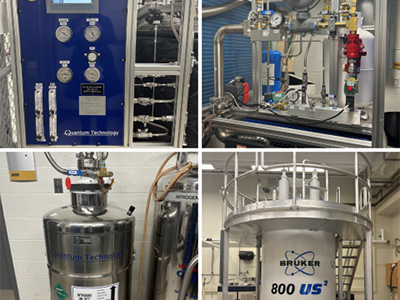
- 2022-23 - U of G’s Mass Spectrometry Facility Offers Unique Learning Experiences
- 2022-23 - New apple variety at U of G may juice up cider industry
- 2021-22 - No Waffling Around for Student Start-up Business
- 2021-22 - New Renovation to Improve Performance-Based Research at U of G
- 2020-21 - Two University of Guelph technologies receive Innovation of the Year Award 2020
- 2020-21 - Federal fund supports U of G research activities affected by COVID-19 pandemic
- 2019-20 - Enhancing research ethics at U of G
- 2019-20 - Turning research knowledge into action



Contact for Further Information
General Inquiries: research.services@uoguelph.ca