LEGO: Suitable for Fish Aged “Larvae” and Up
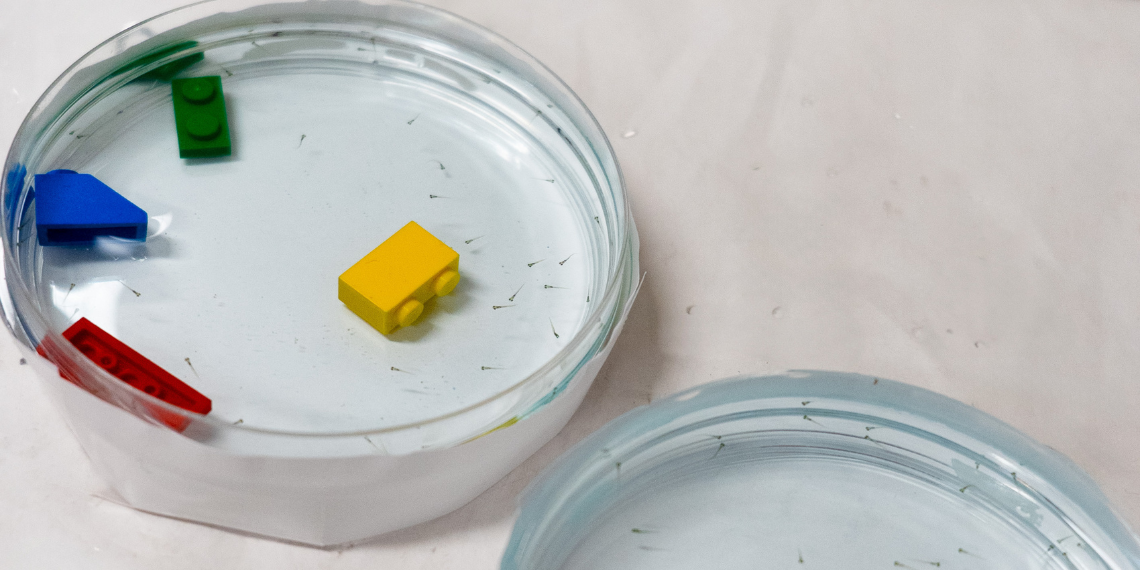
LEGO blocks can help kids of just about any age learn and grow. As it turns out, the same may hold true for fish.
A new study from Dr. Sarah Alderman’s lab in the Department of Integrative Biology has found that the presence of LEGO pieces may enhance cognitive ability in zebrafish larvae, offering an accessible and cost-effective tool to enrich zebrafish husbandry.
A popular research model, zebrafish are used in life science labs around the world. The species is native to southeast Asia, but zebrafish used in research typically come from lab-based colonies that have been reared under highly controlled lab conditions for many generations.
Perhaps unsurprisingly, these lab-reared fish can exhibit important behavioural and physiological differences from their wild counterparts.
“We know that the developing brain is responsive to a stimulating environment when animals are very young, but laboratory zebrafish are typically maintained in simple Petri dishes until they start feeding on their own. This is very practical, but it means the brain is developing with little environmental input, which is very different from nature. We wanted to understand if and how this barren rearing practice influenced the brain and behaviour of the fish,” says Alderman.
Zebrafish larvae become free-swimming juveniles about five days after hatching. Past studies have investigated the cognitive benefits of habitat complexity on juvenile zebrafish, but environmental complexity at an even earlier developmental stage — specifically, the larval stage that occurs just after hatching — had never been studied.
Julia Bourdeau, an undergraduate honour’s student in the Alderman lab, set out to explore this question, rearing zebrafish larvae under one of two conditions in lab: half the larvae were hatched in a Petri dish containing a random assortment of coloured LEGO, while the other half were hatched in a barren Petri dish.
After the larvae transitioned to free-swimming juveniles, the team conducted a series of tests — comparing physical growth, behaviour and response to stress — to assess the benefits of growing up with LEGO.
Behavioural experiments showed that larvae in the LEGO group habituated twice as fast to repeated disturbances (vibrations in the water) compared to the barren environment group. According to the researchers, this is a sign of greater habituation, which is a form of short-term associative learning.
Larvae in the LEGO group also showed a tendency towards reduced anxiety-like behaviour, in that they were less prone to “freezing” in response to a rapid change in their environment (such as a sudden bright light).
And finally, levels of cortisol (a stress hormone in fish) remained stable after experiencing acute stress, whereas cortisol levels in the barren environment group increased two-fold before returning to baseline after 15 minutes.
Interestingly, despite clear improvement in cognitive abilities in the LEGO group, the researchers found no difference in forebrain cell proliferation – a result the team found quite surprising.
Past studies suggest that increased cognition and brain growth are very energy-consuming and may lead to energy trade-offs in other areas. Given that larvae reared with LEGO were also found to be shorter in length than those reared without, Alderman speculates that this could mean that the LEGO group experienced increased development in other areas of the brain not measured in the study, such as the region of the brain that processes visual stimuli.
The design of study was centred largely around the concept of developmental plasticity, in which an animal’s early life environment can mold and shape its ability to respond to changes in its environment.
Says Alderman, “It’s important to think about the whole life history of an organism. Plasticity can start early, and conditions at hatch may have important consequences down the road.”
Going forward, the Alderman lab plans to investigate if the changes they saw at the larval stage persist into juvenile and adult life stages, including incorporating additional measurements of other brain regions to see if Lego blocks do indeed "build brains." They are also interested in designing experiments to determine if early-stage stimuli can make zebrafish more efficient at spatial navigation and catching prey.
“These types of questions are important from both a research model and animal welfare perspective, but they also have relevance to fish conservation,” adds Alderman. “For example, improving the hatchery environment used in a captive-breeding program may lead to better fish survival when they are released to the wild.”
Already the most popular toy in the human world, it appears that LEGO may soon be on its way to also helping researchers build smarter and more stress-resilient fish.
Read the full study in the journal Comparative Biochemistry and Physiology Part A: Molecular & Integrative Physiology.
Read about other CBS Research Highlights.